
We read your photo as:
Using mathematical tables, calculate (364.6)3 and (0.6492)2.
ScanSolve AI Answer
Answers
2 partsStep-by-step solution
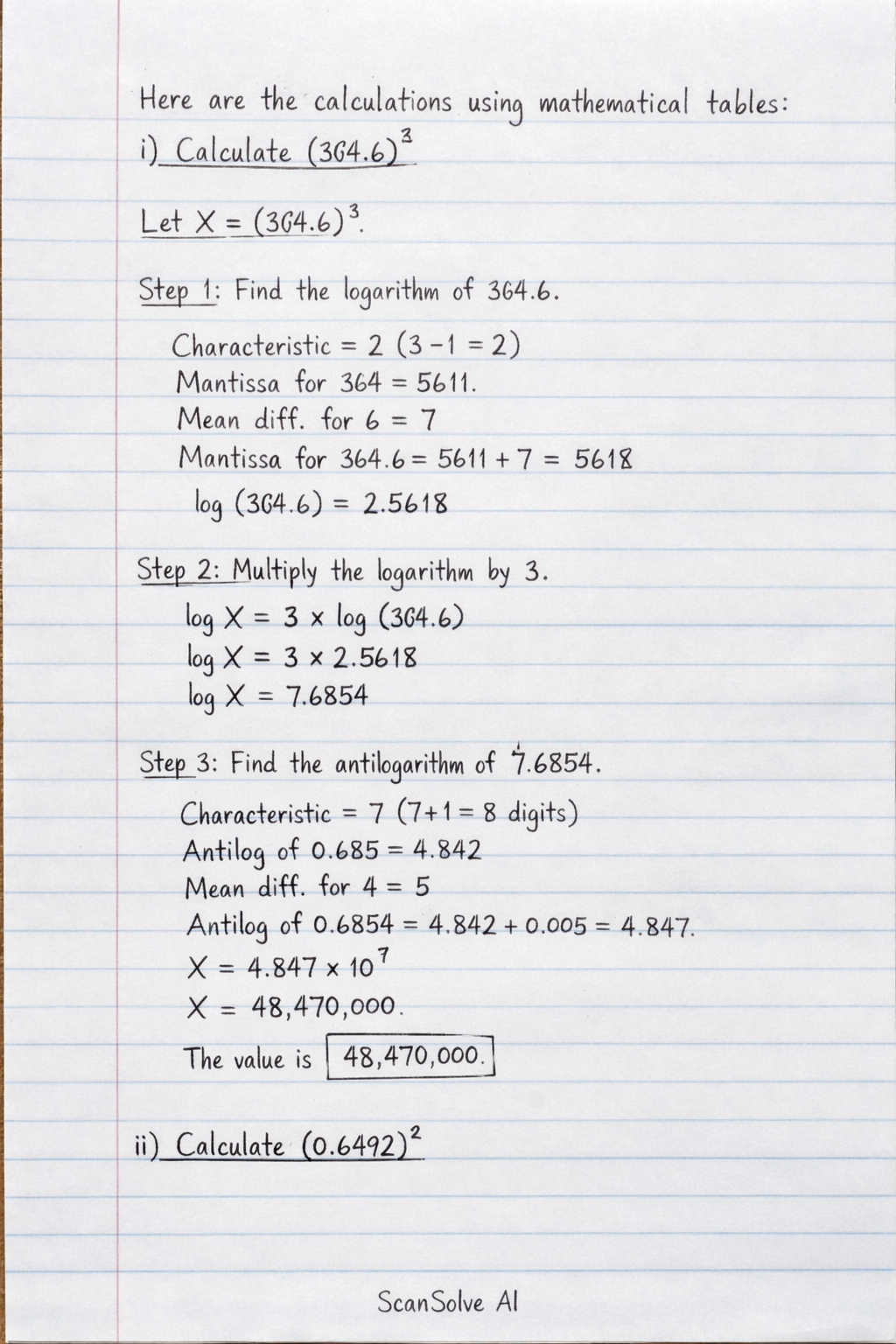
6 stepsHere are the calculations using mathematical tables:
Part i· 3 steps
Calculate
Let .
Find the logarithm of 364.6.
The characteristic of is 2 (since there are 3 digits before the decimal point, ).
From the logarithm table, the mantissa for 364 is 5611.
The mean difference for 6 is 7.
So, the mantissa for 364.6 is .Multiply the logarithm by 3.
Find the antilogarithm of 7.6854.
The characteristic is 7, so the number will have digits before the decimal point.
From the antilogarithm table, the antilog of 0.685 is 4.842.
The mean difference for 4 is 5.
So, the antilog of 0.6854 is .The value is .
Part ii0.4213
Calculate
Let .
Find the logarithm of 0.6492.
The characteristic of is (since there is one zero immediately after the decimal point, ).
From the logarithm table, the mantissa for 649 is 8122.
The mean difference for 2 is 1.
So, the mantissa for 0.6492 is .Multiply the logarithm by 2.
Find the antilogarithm of .
The characteristic is , so the number will have one zero before the first non-zero digit.
From the antilogarithm table, the antilog of 0.624 is 4.207.
The mean difference for 6 is 6.
So, the antilog of 0.6246 is .The value is .
Try one yourself
A new problem that tests the same skill.
Still stuck on this one?
Ask a follow-up, and the answer starts from this question.
More Mathematics Questions
Handwritten Step-by-Step Solution
Get this as a handwritten image on WhatsApp — like a tutor wrote it for you.
Try on WhatsApp