
We read your photo as:
Using pi = 22/7, find the area of the shaded region.
ScanSolve AI Answer
Answer
Step-by-step solution
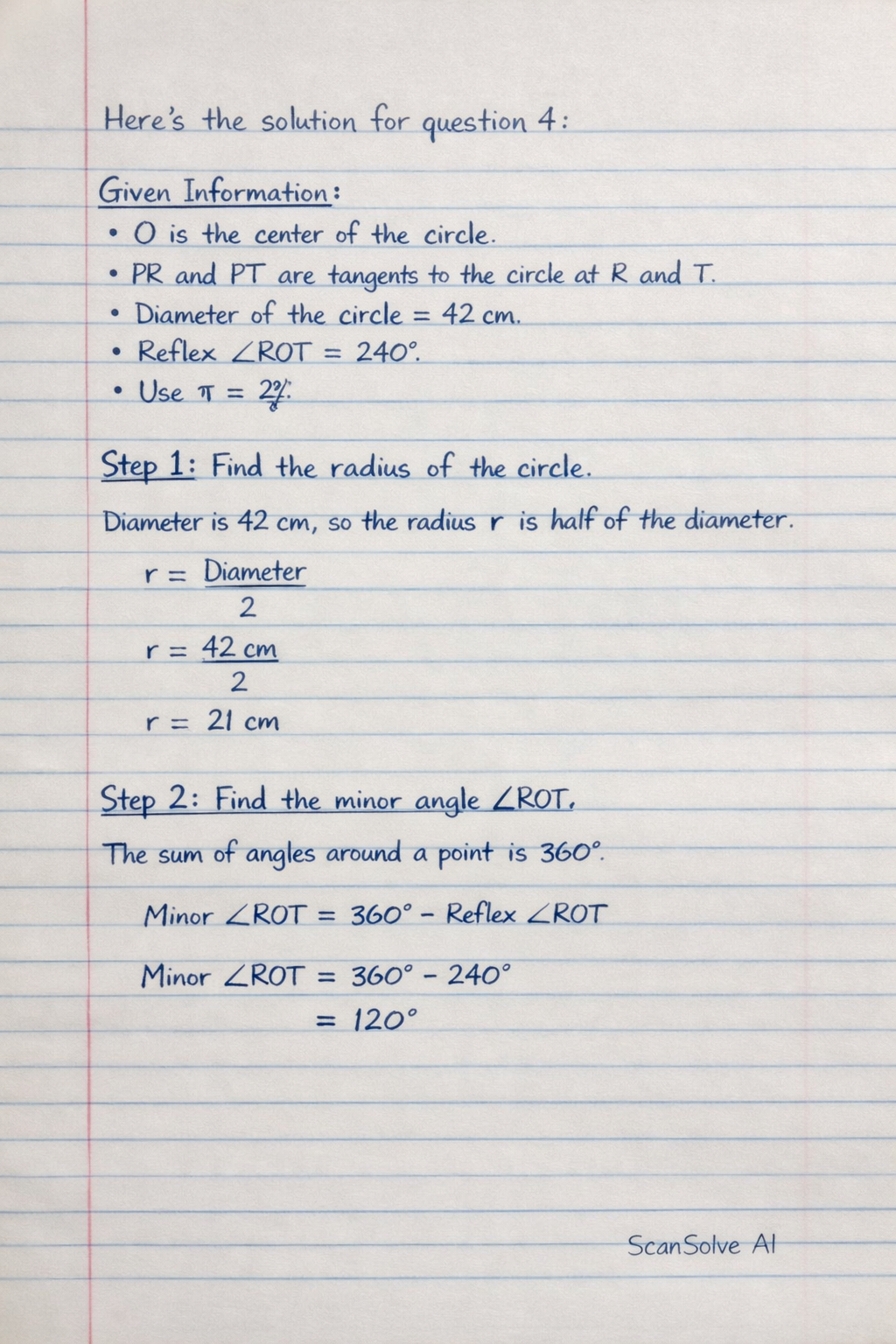
7 stepsHere's the solution for question 4:
Given Information:
- O is the center of the circle.
- PR and PT are tangents to the circle at R and T respectively.
- Diameter of the circle = 42 cm.
- Reflex .
- Use .
Find the radius of the circle.
The diameter is 42 cm, so the radius is half of the diameter.
Find the minor angle .
The sum of angles around a point is .
Minor
Minor .Find the angles in quadrilateral ORPT.
Since PR and PT are tangents to the circle at R and T, the radii OR and OT are perpendicular to the tangents at the points of tangency.
Therefore, and .
The sum of angles in a quadrilateral is .
In quadrilateral ORPT:
.Calculate the length of the tangents PR and PT.
Consider the right-angled triangle .
We know , , and .
Using trigonometry:
.
.
Since tangents from an external point to a circle are equal, .Calculate the area of the quadrilateral ORPT.
The quadrilateral ORPT can be divided into two congruent right-angled triangles, and .
Area of
Area of .
Area of quadrilateral ORPT = .
.Calculate the area of the minor sector ROT.
Area of sector =
Area of minor sector ROT =
Area of minor sector ROT =
Area of minor sector ROT =
Area of minor sector ROT = .Calculate the area of the shaded region.
The shaded region is the area of the quadrilateral ORPT minus the area of the minor sector ROT.
Area of shaded region = Area of quadrilateral ORPT - Area of minor sector ROT
Area of shaded region =
Area of shaded region .Rounding to two decimal places:
Area of shaded region .
Try one yourself
A new problem that tests the same skill.
Still stuck on this one?
Ask a follow-up, and the answer starts from this question.
More Mathematics Questions
Handwritten Step-by-Step Solution
Get this as a handwritten image on WhatsApp — like a tutor wrote it for you.
Try on WhatsApp