
Using the 1st principle of differentiation find the derivative of X²
Mathematics
ScanSolve AI Answer
Answer
Step-by-step solution
5 stepsTo find the derivative of using the first principle, we use the definition:
Identify and .
Given .
Then .Substitute and into the first principle formula.
Simplify the numerator by finding a common denominator.
Factor out from the numerator and cancel it with the in the denominator.
Evaluate the limit by substituting .
The derivative of using the first principle is:
Was this helpful?
Try one yourself
A new problem that tests the same skill.
Still stuck on this one?
Ask a follow-up, and the answer starts from this question.
Got a different question?Ask your own question
More Mathematics Questions
QFind the derivative of y=x²−5x+4 from the First Principle.QWhat is the derivative of x²?QFinding the Derivative of x2QFind the derivative using first principle
Browse by topic:Calculus
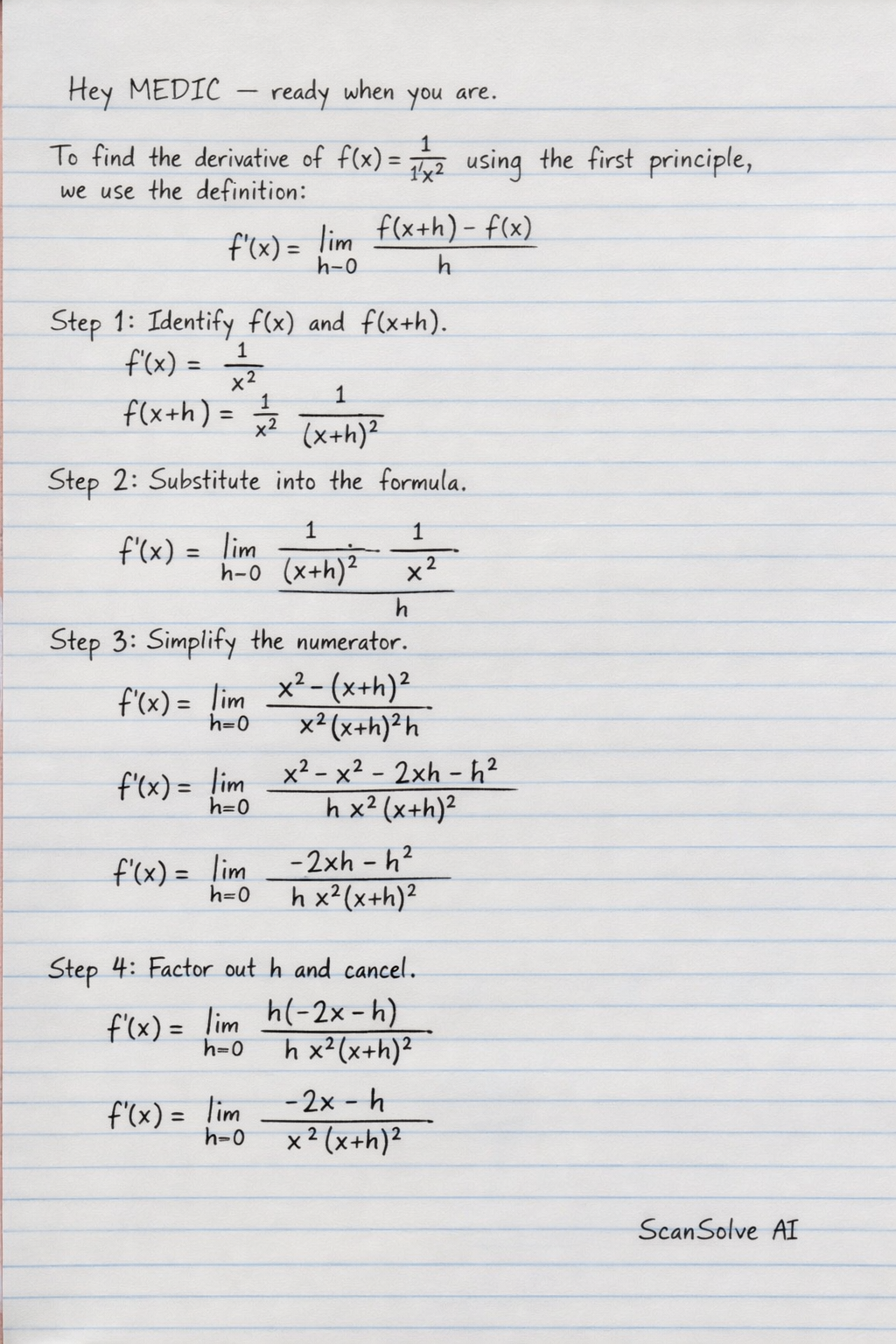
Handwritten Step-by-Step Solution
Get this as a handwritten image on WhatsApp — like a tutor wrote it for you.
Try on WhatsApp