
We read your photo as:
Using the provided graph and equation, answer the following questions about a cyclist's journey. What time did the cyclist leave home? When did they return? What was their distance from home at 10 a.m
ScanSolve AI Answer
Answer
Step-by-step solution
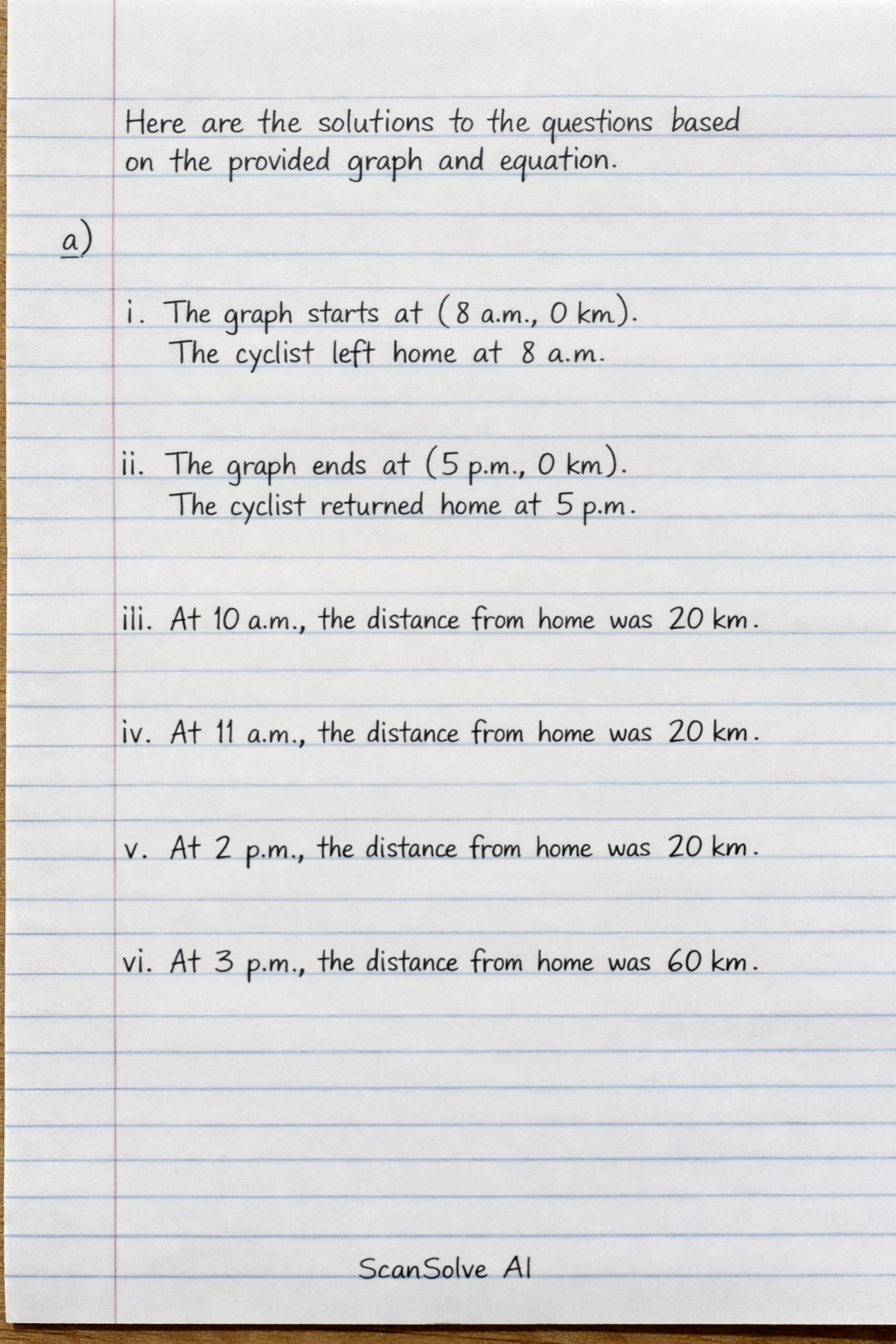
4 stepsHere are the solutions to the questions based on the provided graph and equation.
Part a(i)
Step 1: Identify the starting point of the journey (distance from home is 0 km).
The graph starts at .
The cyclist left home at 8 a.m.
Part a(ii)
Step 1: Identify the point where the cyclist returns home (distance from home is 0 km).
The graph ends at .
The cyclist returned home at 5 p.m.
Part a(iii)
Step 1: Locate 10 a.m. on the time axis and find the corresponding distance.
At 10 a.m., the distance from home was 20 km.
Part a(iv)
Step 1: Locate 11 a.m. on the time axis and find the corresponding distance.
At 11 a.m., the distance from home was 20 km.
Part a(v)
Step 1: Locate 2 p.m. on the time axis and find the corresponding distance.
At 2 p.m., the distance from home was 60 km.
Part a(vi)
Step 1: Locate 3 p.m. on the time axis and find the corresponding distance.
At 3 p.m., the distance from home was 60 km.
Part a(vii)
Step 1: Identify horizontal segments on the graph, which indicate no change in distance over time.
The cyclist took a rest from 10 a.m. to 11 a.m. and from 2 p.m. to 3 p.m.
Part a(viii)
Step 1: Locate noon (12 p.m.) on the time axis and find the corresponding distance.
At noon, the distance from home was 40 km.
Part a(ix)
Step 1: Locate 5 p.m. on the time axis and find the corresponding distance.
At 5 p.m., the distance from home was 0 km.
Part a(x)· 1 step
Step 1: Calculate the speed (gradient) for each moving segment.
Speed is the magnitude of the gradient of the distance-time graph.
Segment 1 (8 a.m. to 10 a.m.):
Segment 2 (11 a.m. to 2 p.m.):
Segment 3 (3 p.m. to 5 p.m.):
Compare the speeds to find the fastest.
The speeds are , , and . The fastest speed is .
The cyclist was travelling most quickly from 3 p.m. to 5 p.m.
Part b3
Rearrange the equation into the slope-intercept form .
Divide by .
Identify the gradient () and y-intercept ().
The gradient is .
The y-intercept is .The gradient is and the y-intercept is .
Try one yourself
A new problem that tests the same skill.
Still stuck on this one?
Ask a follow-up, and the answer starts from this question.
More Mathematics Questions
Handwritten Step-by-Step Solution
Get this as a handwritten image on WhatsApp — like a tutor wrote it for you.
Try on WhatsApp