
We read your photo as:
Using the provided Venn diagram and definitions, identify equivalent sets and calculate the square root of the given numbers using prime factorization.
Mathematics
ScanSolve AI Answer
Step-by-step solution
6 stepsSolve Question 1.
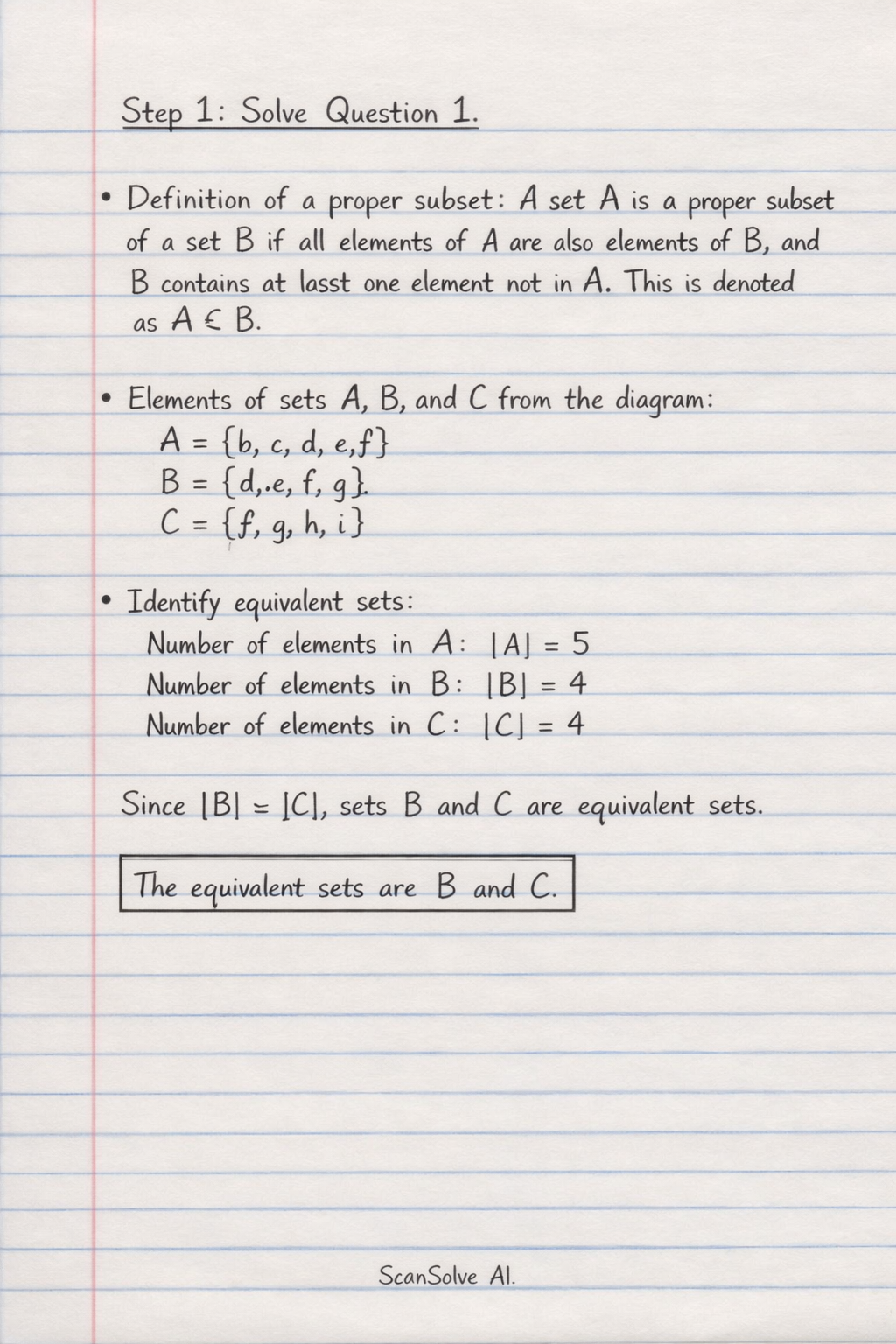
- Definition of a proper subset: A set is a proper subset of a set if all elements of are also elements of , and contains at least one element not in . This is denoted as .
- Elements of sets A, B, and C from the diagram:
- Identify equivalent sets: Two sets are equivalent if they have the same number of elements (cardinality).
- Number of elements in , .
- Number of elements in , .
- Number of elements in , .
- Since , sets and are equivalent sets.
- The equivalent sets are .
Solve Question 2 by finding the square root using prime factorization.
- a) For 50176: To find the square root, we take half of each exponent: The square root of 50176 is .
- b) For 105625: To find the square root, we take half of each exponent: The square root of 105625 is .
Solve Question 3 by finding the cube number of the given numbers.
- a) For 22: The cube number of 22 is . The cube number of 22 is .
- b) For 44: The cube number of 44 is . The cube number of 44 is .
Solve Question 4 by dividing Rs.
100 between Ram and Hari in the ratio 2:3.
- Total amount = Rs. 100
- Ratio of shares for Ram and Hari = 2:3
- Sum of the ratio parts =
- Ram's share:
- Hari's share:
- Ram gets and Hari gets .
Solve Question 5 by simplifying the expressions.
- i) Using the exponent rule : Using the exponent rule : The simplified expression is .
- ii) Using the exponent rule : Using the exponent rule : The simplified expression is .
Solve Question 6 by simplifying the expression.
- $\frac{1}{4} + \left
Was this helpful?
Still stuck on this one?
Ask a follow-up, and the answer starts from this question.
Got a different question?Ask your own question
More Mathematics Questions
QFind the square root of the following numbers using the Prime Factorisation Method: (i) 729 (ii) 400…QFind the square root of numbers by prime factorization of 81, 625 and 1024QCalculate the positive square root of the sum of prime numbers less than 25 using the prime factor…QComplete the Venn diagrams and identify the HCF of each pair of numbers.QFind the square root of 7744 using prime factorization.
Handwritten Step-by-Step Solution
Get this as a handwritten image on WhatsApp — like a tutor wrote it for you.
Try on WhatsApp