Using the trapezium rule, with 8 strips, estimate the area bounded by the curve y = 4 - 1/4x2 and the x-axis for -4 <= x <= 4.
|Mathematics
Using the trapezium rule, with 8 strips, estimate the area bounded by the curve y = 4 - 1/4x2 and the x-axis for -4 <= x <= 4.
ScanSolve AI Answer
Answer
21 square units
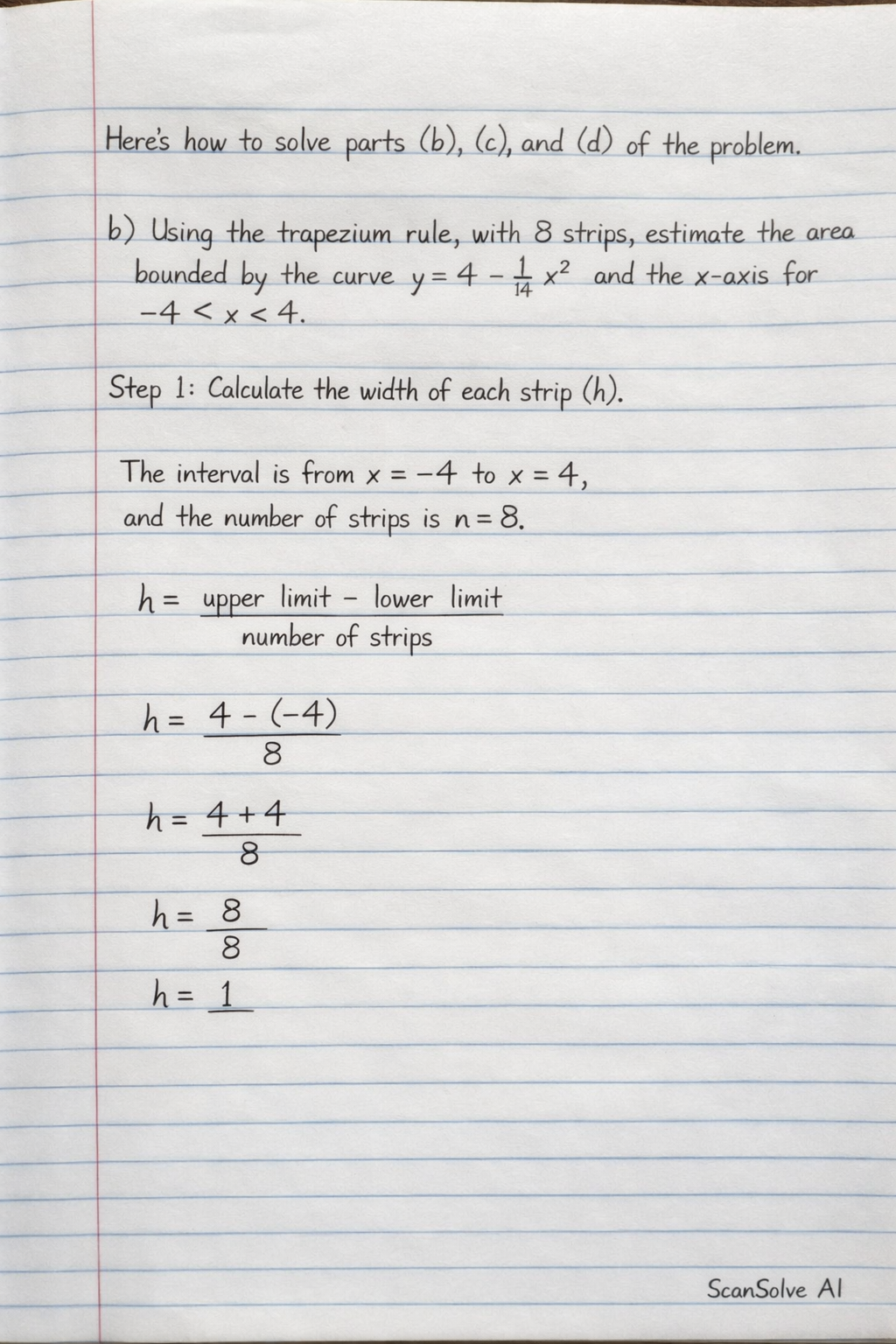
Here's how to solve parts (b), (c), and (d) of the problem.
b) Using the trapezium rule, with 8 strips, estimate the area bounded by the curve y=4−41x2 and the x-axis for −4≤x≤4.
Step 1: Calculate the width of each strip (h).
The interval is from x=−4 to x=4, and the number of strips is n=8.
h=numberofstripsupperlimit−lowerlimit=84−(−4)=88=1
Step 2: Determine the x-values for the ordinates and calculate the corresponding y-values using y=4−41x2.
The x-values are x0=−4,x1=−3,x2=−2,x3=−1,x4=0,x5=1,x6=2,x7=3,x8=4.
The corresponding y-values are:
y0=4−41(−4)2=4−41(16)=4−4=0y1=4−41(−3)2=4−41(9)=4−2.25=1.75y2=4−41(−2)2=4−41(4)=4−1=3y3=4−41(−1)2=4−41(1)=4−0.25=3.75y4=4−41(0)2=4−0=4y5=4−41(1)2=4−41(1)=4−0.25=3.75y6=4−41(2)2=4−41(4)=4−1=3y7=4−41(3)2=4−41(9)=4−2.25=1.75y8=4−41(4)2=4−41(16)=4−4=0
Step 3: Apply the trapezium rule formula.
Area≈2h[y0+yn+2(y1+y2+⋯+yn−1)]Area≈21[y0+y8+2(y1+y2+y3+y4+y5+y6+y7)]Area≈21[0+0+2(1.75+3+3.75+4+3.75+3+1.75)]Area≈21[0+2(21)]Area21[42]Area≈21
The estimated area using the trapezium rule is 21squareunits.
c) Find the area estimated in part (b) above by integration.
Step 1: Set up the definite integral.
The actual area is found by integrating the function y=4−41x2 from x=−4 to x=4.
Actual Area=∫−44(4−41x2)dx
Step 2: Integrate the function.
∫(4−41x2)dx=4x−41⋅3x3+C=4x−12x3+C
Step 3: Evaluate the definite integral using the limits.
Actual Area=[4x−12x3]−44=(4(4)−1243)−(4(−4)−12(−4)3)=(16−1264)−(−16−12−64)=(16−316)−(−16+316)=16−316+16−316=32−332=396−32=364
The actual area by integration is 364squareunits.
d) Calculate the percentage error in estimating the area using the trapezium rule.
Step 1: State the estimated and actual values.
Estimated Area (from part b) = 21
Actual Area (from part c) = 364
Step 2: Calculate the absolute error.
Absolute Error=∣EstimatedArea−ActualArea∣=21−364=363−364=−31=31
Step 3: Calculate the percentage error.
Percentage Error=ActualAreaAbsoluteError×100%=36431×100%=31×643×100%=641×100%=1.5625%
Rounding to two decimal places, the percentage error is 1.56%.
That's 2 down. 3 left today — send the next one.
Was this helpful?
Need help with your own homework?
Get instant step-by-step solutions to any question. Free to start.
Here's how to solve parts (b), (c), and (d) of the problem. b) Using the trapezium rule, with 8 strips, estimate the area bounded by the curve y = 4 - (1)/(4)x^2 and the x-axis for -4 x 4.
Using the trapezium rule, with 8 strips, estimate the area bounded by the curve y = 4 - 1/4x2 and the x-axis for -4 <= x <= 4.
This mathematics problem involves applying core mathematical principles and formulas. Below you will find a complete step-by-step solution with detailed explanations for each step, helping you understand not just the answer but the method behind it.
ScanSolve AI Answer
Here's how to solve parts (b), (c), and (d) of the problem. b) Using the trapezium rule, with 8 strips, estimate the area bounded by the curve y = 4 - (1)/(4)x^2 and the x-axis for -4 x 4. Step 1: Calculate the width of each strip (h). The interval is from x = -4 to x = 4, and the number of strips is n = 8. h = upper limit - lower limitnumber of strips = (4 - (-4))/(8) = (8)/(8) = 1 Step 2: Determine the x-values for the ordinates and calculate the corresponding y-values using y = 4 - (1)/(4)x^2. The x-values are x_0 = -4, x_1 = -3, x_2 = -2, x_3 = -1, x_4 = 0, x_5 = 1, x_6 = 2, x_7 = 3, x_8 = 4. The corresponding y-values are: y_0 = 4 - (1)/(4)(-4)^2 = 4 - (1)/(4)(16) = 4 - 4 = 0 y_1 = 4 - (1)/(4)(-3)^2 = 4 - (1)/(4)(9) = 4 - 2.25 = 1.75 y_2 = 4 - (1)/(4)(-2)^2 = 4 - (1)/(4)(4) = 4 - 1 = 3 y_3 = 4 - (1)/(4)(-1)^2 = 4 - (1)/(4)(1) = 4 - 0.25 = 3.75 y_4 = 4 - (1)/(4)(0)^2 = 4 - 0 = 4 y_5 = 4 - (1)/(4)(1)^2 = 4 - (1)/(4)(1) = 4 - 0.25 = 3.75 y_6 = 4 - (1)/(4)(2)^2 = 4 - (1)/(4)(4) = 4 - 1 = 3 y_7 = 4 - (1)/(4)(3)^2 = 4 - (1)/(4)(9) = 4 - 2.25 = 1.75 y_8 = 4 - (1)/(4)(4)^2 = 4 - (1)/(4)(16) = 4 - 4 = 0 Step 3: Apply the trapezium rule formula. Area ≈ (h)/(2) [y_0 + y_n + 2(y_1 + y_2 + + y_n-1)] Area ≈ (1)/(2) [y_0 + y_8 + 2(y_1 + y_2 + y_3 + y_4 + y_5 + y_6 + y_7)] Area ≈ (1)/(2) [0 + 0 + 2(1.75 + 3 + 3.75 + 4 + 3.75 + 3 + 1.75)] Area ≈ (1)/(2) [0 + 2(21)] Area (1)/(2) [42] Area ≈ 21 The estimated area using the trapezium rule is 21 square units. c) Find the area estimated in part (b) above by integration. Step 1: Set up the definite integral. The actual area is found by integrating the function y = 4 - (1)/(4)x^2 from x = -4 to x = 4. Actual Area = _-4^4 (4 - (1)/(4)x^2)\,dx Step 2: Integrate the function. (4 - (1)/(4)x^2)\,dx = 4x - (1)/(4) · (x^3)/(3) + C = 4x - (x^3)/(12) + C Step 3: Evaluate the definite integral using the limits. Actual Area = [4x - (x^3)/(12)]_-4^4 = (4(4) - (4^3)/(12)) - (4(-4) - ((-4)^3)/(12)) = (16 - (64)/(12)) - (-16 - (-64)/(12)) = (16 - (16)/(3)) - (-16 + (16)/(3)) = 16 - (16)/(3) + 16 - (16)/(3) = 32 - (32)/(3) = (96 - 32)/(3) = (64)/(3) The actual area by integration is (64)/(3) square units. d) Calculate the percentage error in estimating the area using the trapezium rule. Step 1: State the estimated and actual values. Estimated Area (from part b) = 21 Actual Area (from part c) = (64)/(3) Step 2: Calculate the absolute error. Absolute Error = |Estimated Area - Actual Area| = |21 - (64)/(3)| = |(63)/(3) - (64)/(3)| = |-(1)/(3)| = (1)/(3) Step 3: Calculate the percentage error. Percentage Error = Absolute ErrorActual Area × 100\% = (1)/(3)(64)/(3) × 100\% = (1)/(3) × (3)/(64) × 100\% = (1)/(64) × 100\% = 1.5625\% Rounding to two decimal places, the percentage error is 1.56\%. That's 2 down. 3 left today — send the next one.