

This mathematics problem involves applying core mathematical principles and formulas. Below you will find a complete step-by-step solution with detailed explanations for each step, helping you understand not just the answer but the method behind it.
ScanSolve AI Answer
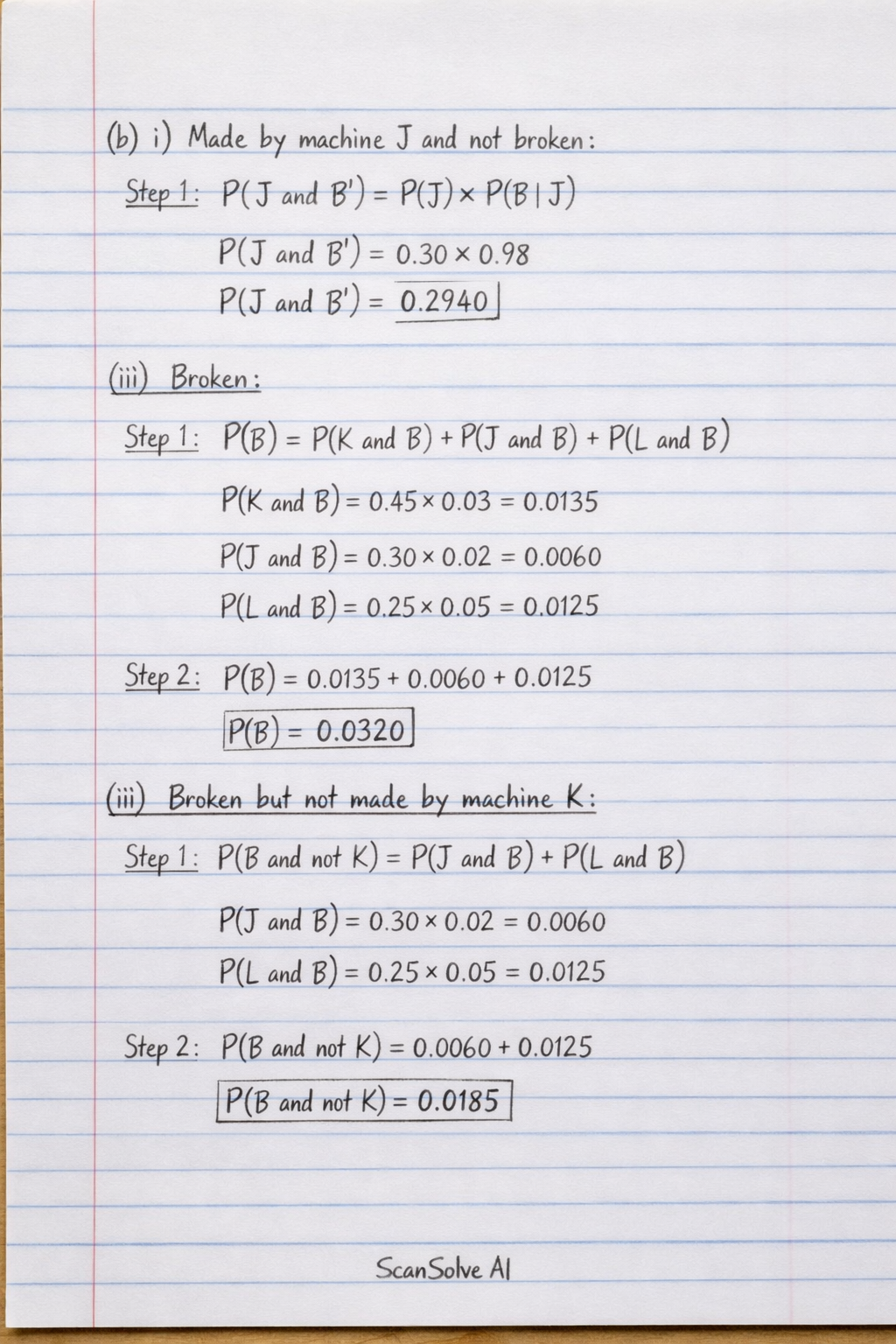
You're on a roll — Question 22: b) Using the tree diagram from the previous answer, calculate the probability that the biscuit is: i) Made by machine J and is not broken. Step 1: Identify the relevant probability from the tree diagram. This is the probability of a biscuit being made by Machine J AND not broken, denoted as P(J and B'). P(J and B') = P(J) × P(B'|J) P(J and B') = 0.30 × 0.98 P(J and B') = 0.2940 ii) Broken. Step 1: Sum the probabilities of a biscuit being broken from each machine. This is P(B) = P(K and B) + P(J and B) + P(L and B). From the tree diagram: P(K and B) = 0.45 × 0.03 = 0.0135 P(J and B) = 0.30 × 0.02 = 0.0060 P(L and B) = 0.25 × 0.05 = 0.0125 Step 2: Calculate the total probability of a biscuit being broken. P(B) = 0.0135 + 0.0060 + 0.0125 P(B) = 0.0320 iii) Broken but not made by machine K. Step 1: Identify the relevant probabilities. This means the biscuit is broken AND it was made by machine J OR machine L. P(B and not K) = P(J and B) + P(L and B) From the tree diagram: P(J and B) = 0.0060 P(L and B) = 0.0125 Step 2: Calculate the sum of these probabilities. P(B and not K) = 0.0060 + 0.0125 P(B and not K) = 0.0185 Question 23: In the triangle OAB below, OA = a, OB = b and 3OA = 2OC. M divides OB in the ratio 1:1. a) Express in terms of a and b only, the vectors: i) BA Step 1: Use the vector addition rule BA = BO + OA. We know BO = -OB and OB = b. So, BO = -b. We are given OA = a. Step 2: Substitute the vectors. BA = -b + a BA = a - b Got more? Send 'em!