

This mathematics problem involves applying core mathematical principles and formulas. Below you will find a complete step-by-step solution with detailed explanations for each step, helping you understand not just the answer but the method behind it.
ScanSolve AI Answer
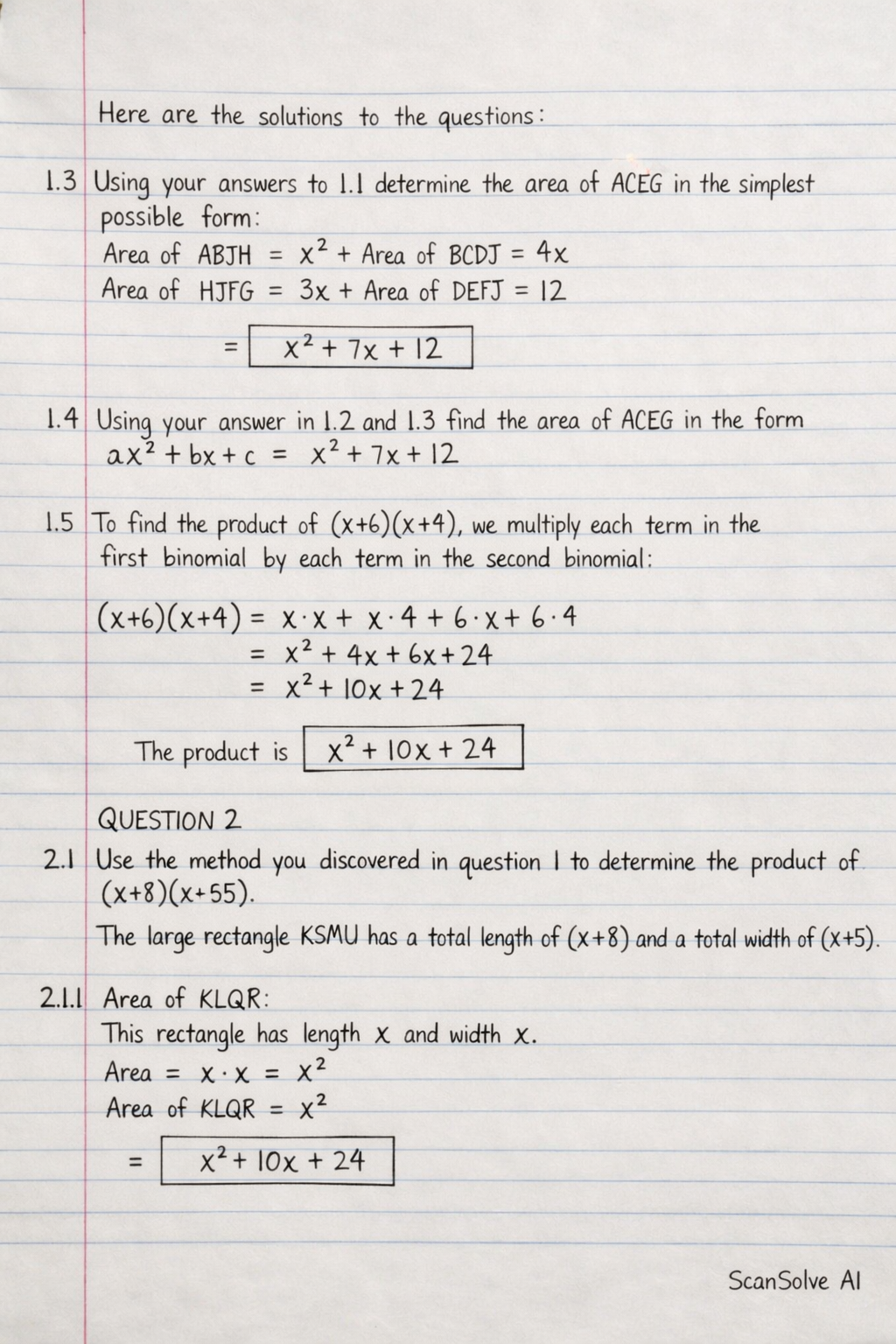
Here are the solutions to the questions: 1.3 Using your answers to 1.1 determine the area of ACEG in the simplest possible form: Area of ABJH x^2 + Area of BCDJ 4x Area of HJFG 3x + Area of DEFJ 12 = x^2 + 7x + 12 1.4 Using your answer in 1.2 and 1.3 find the area of ACEG in the form ax^2 + bx + c = x^2 + 7x + 12 1.5 To find the product of (x+6)(x+4), we multiply each term in the first binomial by each term in the second binomial. (x+6)(x+4) = x · x + x · 4 + 6 · x + 6 · 4 = x^2 + 4x + 6x + 24 = x^2 + 10x + 24 The product is x^2 + 10x + 24. QUESTION 2 2.1 Use the method you discovered in question 1 to determine the product of (x+8)(x+5). The large rectangle KSMU has a total length of (x+8) and a total width of (x+5). 2.1.1 Area of KLQR: This rectangle has length x and width x. Area = x × x = x^2 Area of KLQR = x^2 2.1.2 Area of LMPQ: This rectangle has length 8 and width x. Area = 8 × x = 8x Area of LMPQ = 8x 2.1.3 Area of RQTS: This rectangle has length x and width 5. Area = x × 5 = 5x Area of RQTS = 5x 2.1.4 Area of QPTU: This rectangle has length 8 and width 5. Area = 8 × 5 = 40 Area of QPTU = 40 2.1.5 (x+8)(x+5): The product is the sum of the areas of the four smaller rectangles. (x+8)(x+5) = Area of KLQR + Area of LMPQ + Area of RQTS + Area of QPTU = x^2 + 8x + 5x + 40 = x^2 + 13x + 40 The product is x^2 + 13x + 40. That's 2 down. 3 left today — send the next one.