We read your photo as:

Find the value of the unknown in the system of equations: a) 3a + 4b = 32, 2a + 5b = 34 b) 6x + 3y = 48, 4x + 2y = 32

Mathematics

ScanSolve AI Answer

Answers

5 parts
a

a=247,b=387a = \frac{24}{7}, b = \frac{38}{7}

b

Infinitely many solutions, y=16−2x\text{Infinitely many solutions, } y = 16 - 2x

c

k=2,t=2k = 2, t = 2

d

m=5,n=52m = 5, n = \frac{5}{2}

e

h=172,j=9h = \frac{17}{2}, j = 9

Step-by-step solution

17 steps

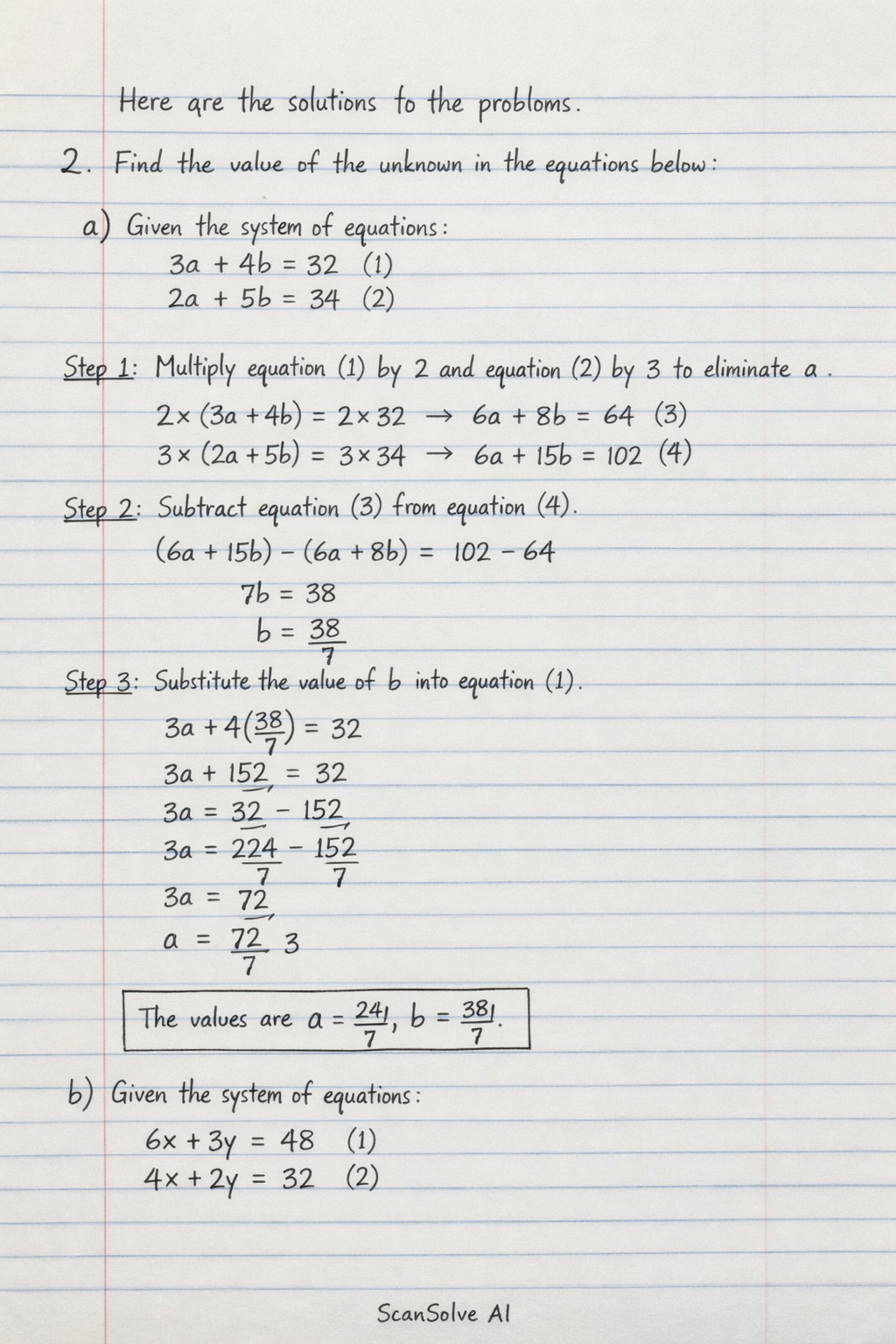
Here are the solutions to the problems.

2. Find the value of the unknown in the equations below:

Part a· 3 steps

Given the system of equations:

3a+4b=32(1)3a + 4b = 32 \quad (1) 2a+5b=34(2)2a + 5b = 34 \quad (2)
  1. Multiply equation (1) by 2 and equation (2) by 3 to eliminate aa.

    2×(3a+4b)=2×32  ⟹  6a+8b=64(3)2 \times (3a + 4b) = 2 \times 32 \implies 6a + 8b = 64 \quad (3) 3×(2a+5b)=3×34  ⟹  6a+15b=102(4)3 \times (2a + 5b) = 3 \times 34 \implies 6a + 15b = 102 \quad (4)
  2. Subtract equation (3) from equation (4).

    (6a+15b)−(6a+8b)=102−64(6a + 15b) - (6a + 8b) = 102 - 64 7b=387b = 38 b=387b = \frac{38}{7}
  3. Substitute the value of bb into equation (1).

    3a+4(387)=323a + 4\left(\frac{38}{7}\right) = 32 3a+1527=323a + \frac{152}{7} = 32 3a=32−15273a = 32 - \frac{152}{7} 3a=224−15273a = \frac{224 - 152}{7} 3a=7273a = \frac{72}{7} a=727×3a = \frac{72}{7 \times 3} a=247a = \frac{24}{7}

    The values are a=247,b=387\boxed{a = \frac{24}{7}, b = \frac{38}{7}}.

Part b

Infinitely many solutions, y=16−2x\text{Infinitely many solutions, } y = 16 - 2x

Given the system of equations:

6x+3y=48(1)6x + 3y = 48 \quad (1) 4x+2y=32(2)4x + 2y = 32 \quad (2)
  1. Simplify both equations by dividing by their common factors.

    Divide equation (1) by 3:

    6x3+3y3=483  ⟹  2x+y=16(3)\frac{6x}{3} + \frac{3y}{3} = \frac{48}{3} \implies 2x + y = 16 \quad (3)

    Divide equation (2) by 2:

    4x2+2y2=322  ⟹  2x+y=16(4)\frac{4x}{2} + \frac{2y}{2} = \frac{32}{2} \implies 2x + y = 16 \quad (4)
  2. Observe that equation (3) and equation (4) are identical.

    This means the two original equations represent the same line.
    Therefore, there are infinitely many solutions. We can express one variable in terms of the other.
    From 2x+y=162x + y = 16, we get y=16−2xy = 16 - 2x.
    The solution is Infinitely many solutions, y=16−2x\boxed{\text{Infinitely many solutions, } y = 16 - 2x}.

Part c

k=2,t=2k = 2, t = 2

Given the system of equations:

k+4t=10(1)k + 4t = 10 \quad (1) k+2t=6(2)k + 2t = 6 \quad (2)
  1. Subtract equation (2) from equation (1).

    (k+4t)−(k+2t)=10−6(k + 4t) - (k + 2t) = 10 - 6 2t=42t = 4 t=2t = 2
  2. Substitute the value of tt into equation (2).

    k+2(2)=6k + 2(2) = 6 k+4=6k + 4 = 6 k=6−4k = 6 - 4 k=2k = 2

    The values are k=2,t=2\boxed{k = 2, t = 2}.

Part d

m=5,n=52m = 5, n = \frac{5}{2}

Given the system of equations:

5m+6n=40(1)5m + 6n = 40 \quad (1) 3m+2n=20(2)3m + 2n = 20 \quad (2)
  1. Multiply equation (2) by 3 to eliminate nn.

    3×(3m+2n)=3×20  ⟹  9m+6n=60(3)3 \times (3m + 2n) = 3 \times 20 \implies 9m + 6n = 60 \quad (3)
  2. Subtract equation (1) from equation (3).

    (9m+6n)−(5m+6n)=60−40(9m + 6n) - (5m + 6n) = 60 - 40 4m=204m = 20 m=5m = 5
  3. Substitute the value of mm into equation (2).

    3(5)+2n=203(5) + 2n = 20 15+2n=2015 + 2n = 20 2n=20−152n = 20 - 15 2n=52n = 5 n=52n = \frac{5}{2}

    The values are m=5,n=52\boxed{m = 5, n = \frac{5}{2}}.

Part e

h=172,j=9h = \frac{17}{2}, j = 9

Given the system of equations:

4h+2j=52(1)4h + 2j = 52 \quad (1) 2h+3j=44(2)2h + 3j = 44 \quad (2)
  1. Divide equation (1) by 2 to simplify.

    4h2+2j2=522  ⟹  2h+j=26(3)\frac{4h}{2} + \frac{2j}{2} = \frac{52}{2} \implies 2h + j = 26 \quad (3)
  2. From equation (3), express jj in terms of hh.

    j=26−2hj = 26 - 2h
  3. Substitute this expression for jj into equation (2).

    2h+3(26−2h)=442h + 3(26 - 2h) = 44 2h+78−6h=442h + 78 - 6h = 44 −4h=44−78-4h = 44 - 78 −4h=−34-4h = -34 h=−34−4h = \frac{-34}{-4} h=172h = \frac{17}{2}
  4. Substitute the value of hh back into the expression for jj.

    j=26−2(172)j = 26 - 2\left(\frac{17}{2}\right) j=26−17j = 26 - 17 j=9j = 9

    The values are h=172,j=9\boxed{h = \frac{17}{2}, j = 9}.

    1. A shopkeeper sold 3 kg of flour and 2 kg of sugar for sh. 180, and another sold 4 kg of flour and 3 kg of sugar for sh. 260. Find the price of 1 kg of flour and 1 kg of sugar.

  5. Define variables.

    Let ff be the price of 1 kg of flour (in shillings).
    Let ss be the price of 1 kg of sugar (in shillings).

  6. Formulate the equations based on the given information.

    From the first sale:

    3f+2s=180(1)3f + 2s = 180 \quad (1)

    From the second sale:

    4f+3s=260(2)4f + 3s = 260 \quad (2)
  7. Multiply equation (1) by 3 and equation (2) by 2 to eliminate ss.

    3×(3f+2s)=3×180  ⟹  9f+6s=540(3)3 \times (3f + 2s) = 3 \times 180 \implies 9f + 6s = 540 \quad (3)
Was this helpful?

Try one yourself

A new problem that tests the same skill.

Still stuck on this one?

Ask a follow-up, and the answer starts from this question.

Got a different question?Ask your own question
Handwritten step-by-step solution preview

Handwritten Step-by-Step Solution

Get this as a handwritten image on WhatsApp — like a tutor wrote it for you.

Try on WhatsApp