
We read your photo as:
Find the value of x in the diagram. Find the median.
ScanSolve AI Answer
Step-by-step solution
11 stepsFind the value of x in the diagram.
Identify the parallel lines and transversals.
The arrows indicate two parallel lines.
Draw an auxiliary line through the vertex of angle that is parallel to the two given parallel lines.
This divides angle into two parts, let's call them and .
Use the property of alternate interior angles.
The angle is an alternate interior angle to the upper part of . So, .
The angle is an exterior angle. The interior angle adjacent to it is . This angle is an alternate interior angle to the lower part of . So, .Add the two parts to find .
The final answer is .
48. Find the median.
Calculate the total number of students ().
Determine the position of the median.
Since the total number of students is even (), the median is the average of the -th and -th values.
So, we need the 15th and 16th values.
Create a cumulative frequency table to find the values.
- For 1 subject: 2 students (CF = 2)
- For 2 subjects: 1 student (CF = 2 + 1 = 3)
- For 3 subjects: 4 students (CF = 3 + 4 = 7)
- For 4 subjects: 3 students (CF = 7 + 3 = 10)
- For 5 subjects: 8 students (CF = 10 + 8 = 18) The 15th and 16th values both fall within the "5 subjects" category, as the cumulative frequency reaches 18 at this point.
Calculate the median.
The final answer is .
49. Calculate the mean of the distribution.
Calculate the sum of the product of the number of subjects () and the number of students (), i.e., .
Use the formula for the mean of a frequency distribution
.
We already found in question 48.Calculate the mean.
The final answer is .
Still stuck on this one?
Ask a follow-up, and the answer starts from this question.
More Mathematics Questions
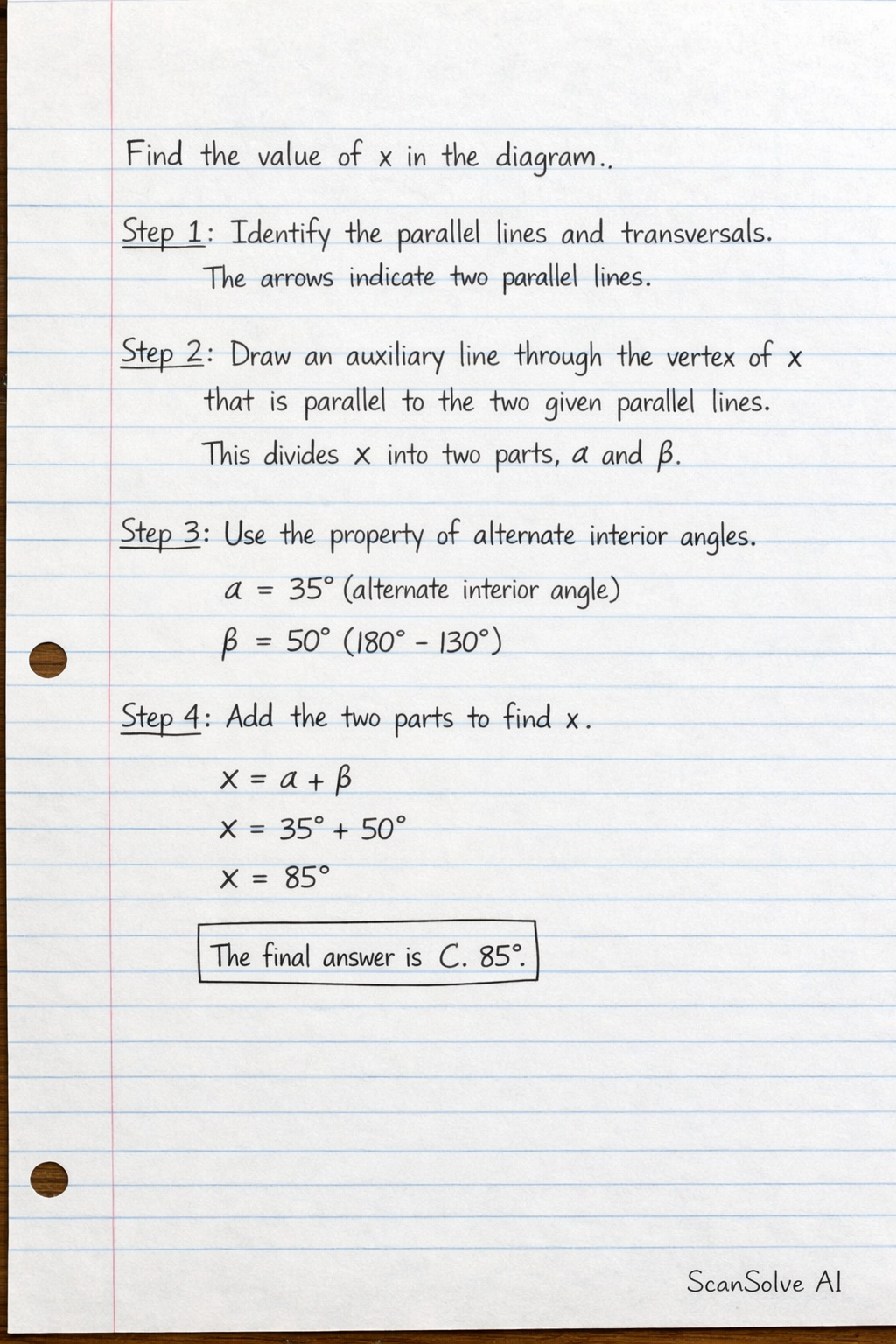
Handwritten Step-by-Step Solution
Get this as a handwritten image on WhatsApp — like a tutor wrote it for you.
Try on WhatsApp