
We read your photo as:
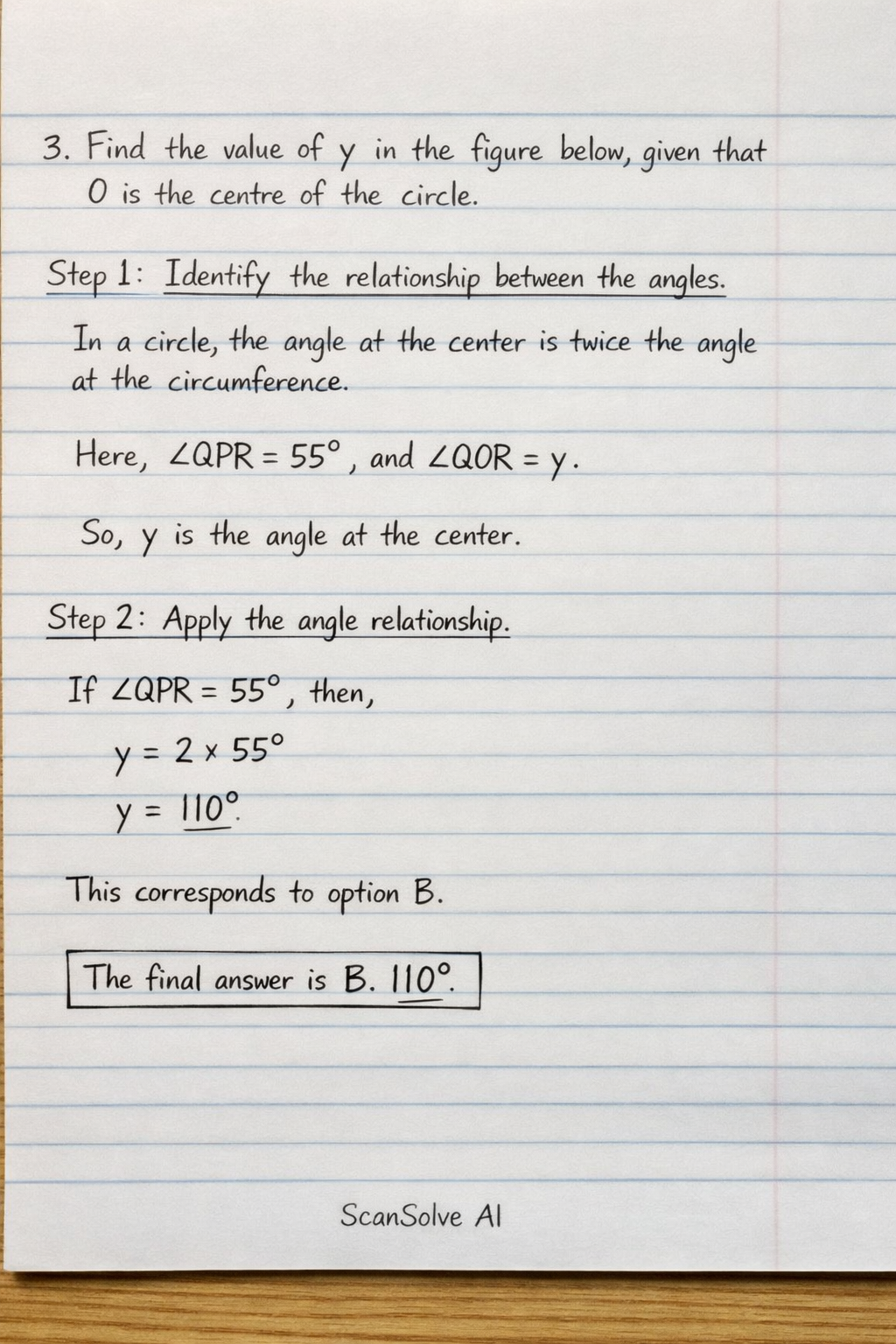
Find the value of y in the figure below, given that O is the centre of the circle.
ScanSolve AI Answer
Step-by-step solution
18 stepsHere are the solutions to the problems.
3. Find the value of in the figure below, given that O is the centre of the circle.
Identify the relationship between the angles.
In a circle, the angle subtended by an arc at the center is twice the angle subtended by the same arc at any point on the remaining part of the circle (circumference).
From the diagram, the angle at the center is (labeled at O), and the angle at the circumference is (labeled at P). However, based on the options provided, it is highly probable that the is the angle at the circumference () and is the angle at the center (). We will proceed with this common interpretation for such problems when options are integers.Apply the angle relationship.
If the angle at the circumference , then the angle at the center is twice this value.
This corresponds to option B.
The final answer is .
4. In the figure below, AD is a tangent to the circle ABC, and . Find .
Use the property of an isosceles triangle.
Given that , triangle ABC is an isosceles triangle. Therefore, the base angles are equal: .
Find the measure of .
The sum of angles in a triangle is .
Substitute and :
Apply the Alternate Segment Theorem.
The Alternate Segment Theorem states that the angle between a tangent and a chord through the point of contact is equal to the angle in the alternate segment.
Here, AD is the tangent and AC is the chord. The angle in the alternate segment is .
Therefore, .This corresponds to option B.
The final answer is .
5. A fair die is rolled once. What is the probability of obtaining a 3 or 4?
Determine the total number of possible outcomes.
A fair die has 6 faces, so the possible outcomes are .
Total number of outcomes = 6.Determine the number of favorable outcomes.
We want to obtain a 3 or a 4. The favorable outcomes are .
Number of favorable outcomes = 2.Calculate the probability.
The probability of an event is given by the formula:
Simplify the probability.
This corresponds to option D.
The final answer is .
6. Find the midpoint of a line joining the points A(2, 2) and B(6, 4).
Recall the midpoint formula.
For two points and , the midpoint is given by:
Substitute the coordinates of points A and B.
Given and , we have .
Calculate the coordinates of the midpoint.
The midpoint is .
This corresponds to option A.The final answer is .
7. Find the distance between the points A(3, -3) and B(4, -3).
Recall the distance formula.
For two points and , the distance is given by:
Substitute the coordinates of points A and B.
Given and , we have .
Simplify the expression.
This corresponds to option D.
The final answer is .
8. If the equation has equal roots, find the value of .
Recall the condition for equal roots in a quadratic equation.
A quadratic equation in the form has equal roots if its discriminant () is equal to zero.
Identify the coefficients of the given equation.
The equation is .
Comparing this to , we have:
Substitute the coefficients into the discriminant formula and solve for .
This corresponds to option C.
The final answer is .
Still stuck on this one?
Ask a follow-up, and the answer starts from this question.
More Mathematics Questions
Handwritten Step-by-Step Solution
Get this as a handwritten image on WhatsApp — like a tutor wrote it for you.
Try on WhatsApp