We read your photo as:

Vector and Plane Geometry Problems: Find q if A and B are perpendicular, find the normal vector to a plane, and simplify an expression involving arctan.

Mathematics

ScanSolve AI Answer

Answer

B

Step-by-step solution

9 steps

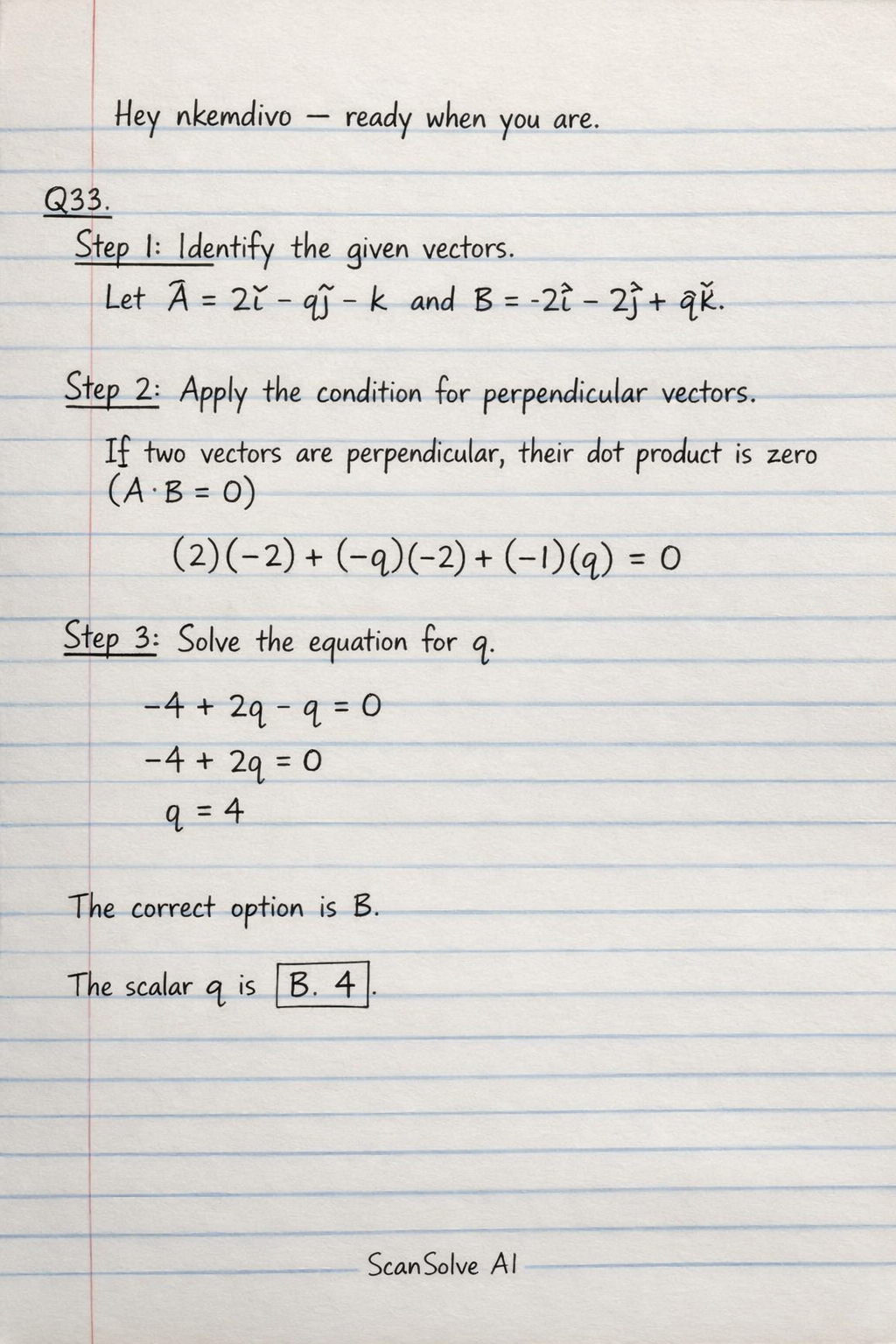
Q33.

  1. Identify the given vectors.

    Let A=2i−qj−k\mathbf{A} = 2\mathbf{i} - q\mathbf{j} - \mathbf{k} and B=−2i−2j+qk\mathbf{B} = -2\mathbf{i} - 2\mathbf{j} + q\mathbf{k}.

  2. Apply the condition for perpendicular vectors.

    If two vectors are perpendicular, their dot product is zero (A⋅B=0\mathbf{A} \cdot \mathbf{B} = 0).

    (2)(−2)+(−q)(−2)+(−1)(q)=0(2)(-2) + (-q)(-2) + (-1)(q) = 0
  3. Solve the equation for qq.

    −4+2q−q=0-4 + 2q - q = 0 −4+q=0-4 + q = 0 q=4q = 4

    The correct option is B.
    The scalar qq is B. 4\boxed{\text{B. } 4}.

    Q34.

  4. Recall the normal vector to a plane.

    For a plane given by the equation Ax+By+Cz+D=0Ax + By + Cz + D = 0, the vector perpendicular to the plane (normal vector) is N=Ai+Bj+Ck\mathbf{N} = A\mathbf{i} + B\mathbf{j} + C\mathbf{k}.

  5. Identify the coefficients from the given plane equation.

    The equation of the plane is 3x−5y+z+7=03x - 5y + z + 7 = 0.
    Here, A=3A=3, B=−5B=-5, and C=1C=1.

  6. Form the perpendicular vector.

    The vector perpendicular to the plane is 3i−5j+1k3\mathbf{i} - 5\mathbf{j} + 1\mathbf{k}.
    The correct option is B.
    The vector perpendicular to the plane is B. 3i−5j+k\boxed{\text{B. } 3\mathbf{i} - 5\mathbf{j} + \mathbf{k}}.

    Q35.

  7. Identify the given expression for AA.

    A=tan⁡−15+tan⁡−1(−3)A = \tan^{-1} 5 + \tan^{-1} (-3)
  8. Apply the tangent addition formula.

    The formula for tan⁡(x+y)\tan(x+y) is tan⁡(x+y)=tan⁡x+tan⁡y1−tan⁡xtan⁡y\tan(x+y) = \frac{\tan x + \tan y}{1 - \tan x \tan y}.
    Let x=tan⁡−15x = \tan^{-1} 5 and y=tan⁡−1(−3)y = \tan^{-1} (-3). Then tan⁡x=5\tan x = 5 and tan⁡y=−3\tan y = -3.

  9. Substitute the values into the formula.

    tan⁡A=5+(−3)1−(5)(−3)\tan A = \frac{5 + (-3)}{1 - (5)(-3)} tan⁡A=5−31−(−15)\tan A = \frac{5 - 3}{1 - (-15)} tan⁡A=21+15\tan A = \frac{2}{1 + 15} tan⁡A=216\tan A = \frac{2}{16} tan⁡A=18\tan A = \frac{1}{8}

    The correct option is C.
    Then tan⁡A=C. 18\tan A = \boxed{\text{C. } \frac{1}{8}}.

    **

Was this helpful?

Try one yourself

A new problem that tests the same skill.

Still stuck on this one?

Ask a follow-up, and the answer starts from this question.

Got a different question?Ask your own question
Handwritten step-by-step solution preview

Handwritten Step-by-Step Solution

Get this as a handwritten image on WhatsApp — like a tutor wrote it for you.

Try on WhatsApp