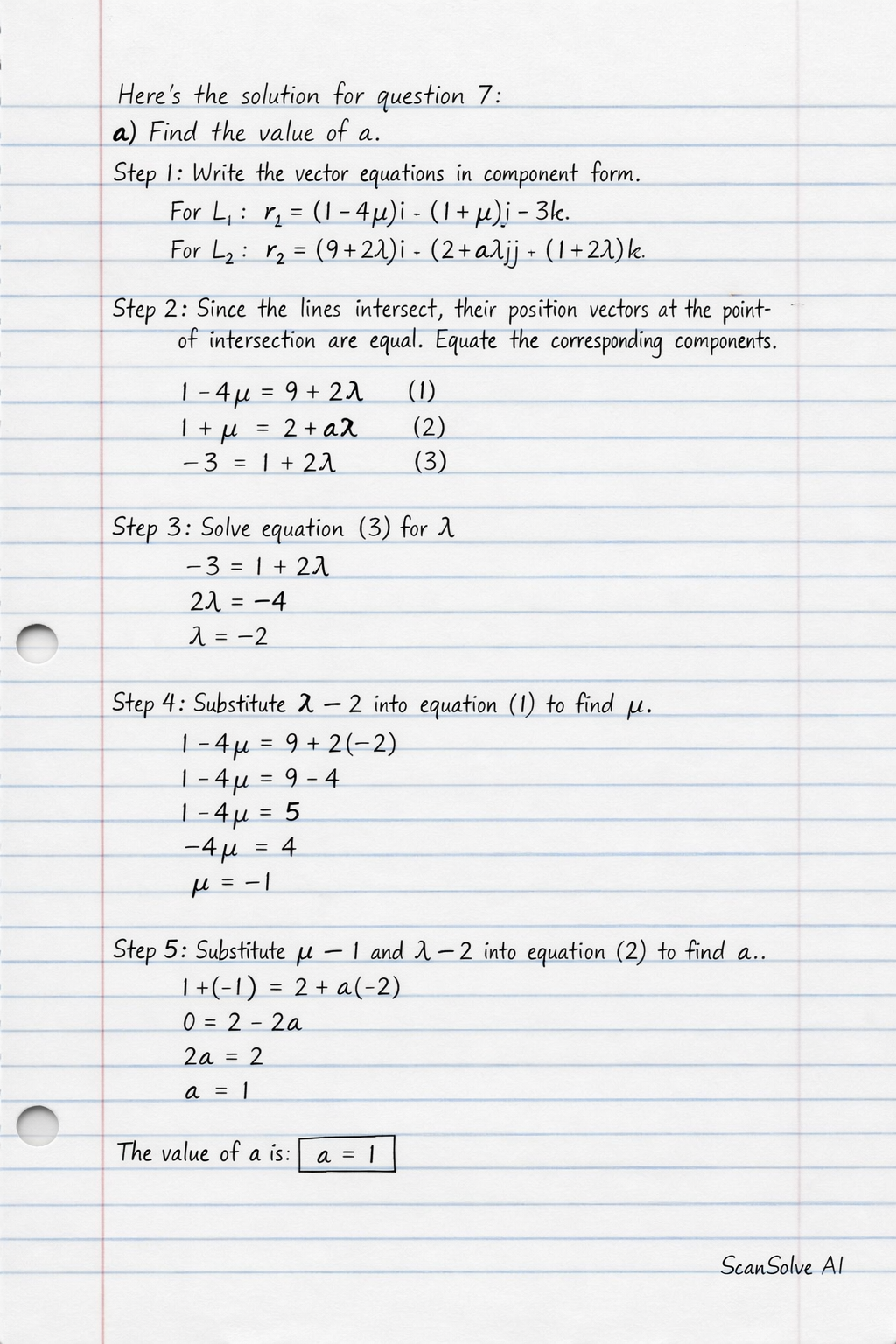
Here's the solution for question 7:
a) Find the value of $a$.
Step 1: Write the vector equations in component form.
For $L_1$: $\mathbf{r}_1 = (1 - 4\mu)\mathbf{i} + (1 + \mu)\mathbf{j} - 3\mathbf{k}$
For $L_2$: $\mathbf{r}_2 = (9 + 2\lambda)\mathbf{…
This mathematics problem involves applying core mathematical principles and formulas. Below you will find a complete step-by-step solution with detailed explanations for each step, helping you understand not just the answer but the method behind it.
ScanSolve AI Answer
Here's the solution for question 7:
a) Find the value of $a$.
Step 1: Write the vector equations in component form.
For $L_1$: $\mathbf{r}_1 = (1 - 4\mu)\mathbf{i} + (1 + \mu)\mathbf{j} - 3\mathbf{k}$
For $L_2$: $\mathbf{r}_2 = (9 + 2\lambda)\mathbf{i} + (2 + a\lambda)\mathbf{j} + (1 + 2\lambda)\mathbf{k}$
Step 2: Since the lines intersect, their position vectors at the point of intersection are equal. Equate the corresponding components.
$$ 1 - 4\mu = 9 + 2\lambda \quad (1) $$
$$ 1 + \mu = 2 + a\lambda \quad (2) $$
$$ -3 = 1 + 2\lambda \quad (3) $$
Step 3: Solve equation (3) for $\lambda$.
$$ -3 = 1 + 2\lambda $$
$$ 2\lambda = -4 $$
$$ \lambda = -2 $$
Step 4: Substitute $\lambda = -2$ into equation (1) to find $\mu$.
$$ 1 - 4\mu = 9 + 2(-2) $$
$$ 1 - 4\mu = 9 - 4 $$
$$ 1 - 4\mu = 5 $$
$$ -4\mu = 4 $$
$$ \mu = -1 $$
Step 5: Substitute $\mu = -1$ and $\lambda = -2$ into equation (2) to find $a$.
$$ 1 + (-1) = 2 + a(-2) $$
$$ 0 = 2 - 2a $$
$$ 2a = 2 $$
$$ a = 1 $$
The value of $a$ is:
$$\boxed{\text{1}}$$
b) Find the position vector of the point of intersection of $L_1$ and $L_2$.
Step 1: Substitute $\mu = -1$ into the equation for $L_1$.
$$ \mathbf{r} = \mathbf{i} + \mathbf{j} - 3\mathbf{k} + (-1)(-4\mathbf{i} + \mathbf{j}) $$
$$ \mathbf{r} = \mathbf{i} + \mathbf{j} - 3\mathbf{k} + 4\mathbf{i} - \mathbf{j} $$
$$ \mathbf{r} = (1+4)\mathbf{i} + (1-1)\mathbf{j} - 3\mathbf{k} $$
$$ \mathbf{r} = 5\mathbf{i} + 0\mathbf{j} - 3\mathbf{k} $$
The position vector of the point of intersection is:
$$\boxed{\text{5\mathbf{i} - 3\mathbf{k}}}$$
c) Find the cosine of the angle between $L_1$ and $L_2$.
Step 1: Identify the direction vectors of the lines.
For $L_1$, the direction vector is $\mathbf{d}_1 = -4\mathbf{i} + \mathbf{j}$.
For $L_2$, the direction vector is $\mathbf{d}_2 = 2\mathbf{i} + a\mathbf{j} + 2\mathbf{k}$. Since $a=1$, $\mathbf{d}_2 = 2\mathbf{i} + \mathbf{j} + 2\mathbf{k}$.
Step 2: Calculate the dot product of the direction vectors.
$$ \mathbf{d}_1 \cdot \mathbf{d}_2 = (-4)(2) + (1)(1) + (0)(2) $$
$$ \mathbf{d}_1 \cdot \mathbf{d}_2 = -8 + 1 + 0 = -7 $$
Step 3: Calculate the magnitudes of the direction vectors.
$$ |\mathbf{d}_1| = \sqrt{(-4)^2 + (1)^2 + (0)^2} = \sqrt{16 + 1 + 0} = \sqrt{17} $$
$$ |\mathbf{d}_2| = \sqrt{(2)^2 + (1)^2 + (2)^2} = \sqrt{4 + 1 + 4} = \sqrt{9} = 3 $$
Step 4: Use the formula for the cosine of the angle between two vectors, $\cos\theta = \frac{\mathbf{d}_1 \cdot \mathbf{d}_2}{|\mathbf{d}_1| |\mathbf{d}_2|}$.
$$ \cos\theta = \frac{-7}{\sqrt{17} \cdot 3} $$
$$ \cos\theta = \frac{-7}{3\sqrt{17}} $$
The cosine of the angle between $L_1$ and $L_2$ is:
$$\boxed{\text{}\frac{-7}{3\sqrt{17}}\text{}}$$
3 done, 2 left today. You're making progress.
Write the vector equations in component form.
|Mathematics
Write the vector equations in component form.
ScanSolve AI Answer
Verified
Here's the solution for question 7:
a) Find the value of a.
Step 1: Write the vector equations in component form.
For L1: r1=(1−4μ)i+(1+μ)j−3k
For L2: r2=(9+2λ)i+(2+aλ)j+(1+2λ)k
Step 2: Since the lines intersect, their position vectors at the point of intersection are equal. Equate the corresponding components.
1−4μ=9+2λ(1)1+μ=2+aλ(2)−3=1+2λ(3)
Step 3: Solve equation (3) for λ.
−3=1+2λ2λ=−4λ=−2
Step 4: Substitute λ=−2 into equation (1) to find μ.
1−4μ=9+2(−2)1−4μ=9−41−4μ=5−4μ=4μ=−1
Step 5: Substitute μ=−1 and λ=−2 into equation (2) to find a.
1+(−1)=2+a(−2)0=2−2a2a=2a=1
The value of a is:
∗1∗
b) Find the position vector of the point of intersection of L1 and L2.
Step 1: Substitute μ=−1 into the equation for L1.
r=i+j−3k+(−1)(−4i+j)r=i+j−3k+4i−jr=(1+4)i+(1−1)j−3kr=5i+0j−3k
The position vector of the point of intersection is:
∗5i−3k∗
c) Find the cosine of the angle between L1 and L2.
Step 1: Identify the direction vectors of the lines.
For L1, the direction vector is d1=−4i+j.
For L2, the direction vector is d2=2i+aj+2k. Since a=1, d2=2i+j+2k.
Step 2: Calculate the dot product of the direction vectors.
d1⋅d2=(−4)(2)+(1)(1)+(0)(2)d1⋅d2=−8+1+0=−7
Step 3: Calculate the magnitudes of the direction vectors.
∣d1∣=(−4)2+(1)2+(0)2=16+1+0=17∣d2∣=(2)2+(1)2+(2)2=4+1+4=9=3
Step 4: Use the formula for the cosine of the angle between two vectors, cosθ=∣d1∣∣d2∣d1⋅d2.
cosθ=17⋅3−7cosθ=317−7
The cosine of the angle between L1 and L2 is:
∗317−7∗
3 done, 2 left today. You're making progress.
Need help with your own homework?
Get instant step-by-step solutions to any question. Free to start.