
We read your photo as:
Find the derivative of the curve y = x² − 2x + 6.
Mathematics
ScanSolve AI Answer
Use the left and right arrow keys to trace the curve, up and down to jump between key points, and plus and minus to zoom.
| Point | x | y |
|---|---|---|
| y-intercept | 0 | 6 |
| Minimum | 1 | 5 |
Step-by-step solution
12 stepshere are the answers to your questions:
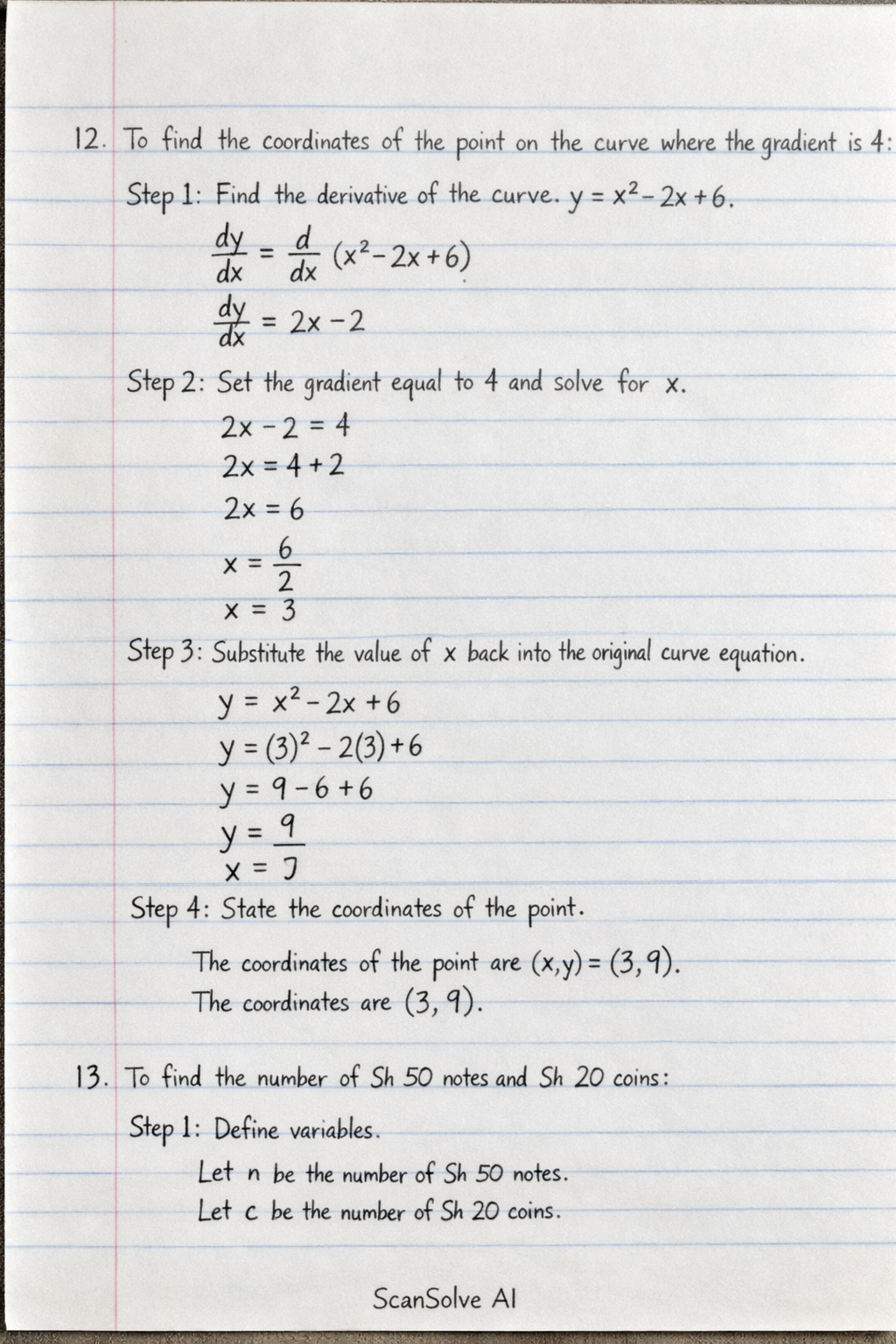
- To find the coordinates of the point on the curve where the gradient is 4:
Find the derivative of the curve .
The gradient function, $\frac{dy}{dx}$, is found by differentiating the equation with respect to $x$. $$ \frac{dy}{dx} = \frac{d}{dx}(x^2 - 2x + 6) $$ $$ \frac{dy}{dx} = 2x - 2 $$Set the gradient equal to 4 and solve for .
$$ 2x - 2 = 4 $$ $$ 2x = 4 + 2 $$ $$ 2x = 6 $$ $$ x = \frac{6}{2} $$ $$ x = 3 $$Substitute the value of back into the original curve equation to find the corresponding coordinate.
$$ y = x^2 - 2x + 6 $$ $$ y = (3)^2 - 2(3) + 6 $$ $$ y = 9 - 6 + 6 $$ $$ y = 9 $$State the coordinates of the point.
The coordinates of the point are $(x, y) = (3, 9)$. The coordinates are $\boxed{(3, 9)}$.13. To find the number of Sh 50 notes and Sh 20 coins:
Define variables.
Let $n$ be the number of Sh 50 notes. Let $c$ be the number of Sh 20 coins.Formulate equations based on the given conditions.
Condition 1: She has 3 times as many Sh 20 coins as Sh 50 notes. $$ c = 3n \quad (1) $$ Condition 2: Altogether she has Sh 3400. The total value is the sum of the value of notes and coins. $$ 50n + 20c = 3400 \quad (2) $$Solve the system of equations.
Substitute equation (1) into equation (2): $$ 50n + 20(3n) = 3400 $$ $$ 50n + 60n = 3400 $$ $$ 110n = 3400 $$ $$ n = \frac{3400}{110} $$ $$ n = \frac{340}{11} $$ $$ n = 30.909... $$ There seems to be an issue with the numbers provided in the question, as the number of notes/coins must be an integer. Let's re-check the calculation. If $n$ must be an integer, then 3400 must be divisible by 110. $3400/110 = 340/11$, which is not an integer. Assuming there might be a typo in the total amount or the ratio, and proceeding with the given numbers to show the method. If the total amount was, for example, Sh 3300, then $n = 3300/110 = 30$. Let's assume the total amount was intended to be Sh 3300 for integer results. If $110n = 3300$, then $n = 30$. Then $c = 3n = 3(30) = 90$. Number of Sh 50 notes = 30, Number of Sh 20 coins = 90. Total value = $50(30) + 20(90) = 1500 + 1800 = 3300$. **Given the exact numbers in the problem, an integer solution for the number of notes/coins is not possible. This indicates a potential error in the problem statement itself.** However, if we must provide an answer based on the given numbers: $$ n = \frac{3400}{110} \approx 30.91 $$ $$ c = 3n = 3 \times \frac{3400}{110} = \frac{10200}{110} \approx 92.73 $$ Since the number of notes and coins must be whole numbers, this problem as stated does not yield an integer solution. If we assume the total amount was Sh 3300: Number of Sh 50 notes: $\boxed{30}$ Number of Sh 20 coins: $\boxed{90}$ **(Note: This assumes a slight adjustment to the total amount to allow for integer counts of notes/coins.)**14. To find how many days the remaining workers would take to complete the work:
Calculate the total amount of work in "worker-days".
Initial workers = 45 Initial days to complete = 10 $$ \text{Total Work} = 45 \text{ workers} \times 10 \text{ days} = 450 \text{ worker-days} $$Calculate the amount of work done in the first 4 days.
Workers for the first 4 days = 45 Days worked = 4 $$ \text{Work Done} = 45 \text{ workers} \times 4 \text{ days} = 180 \text{ worker-days} $$Calculate the remaining work.
$$ \text{Remaining Work} = \text{Total Work} - \text{Work Done} $$ $$ \text{Remaining Work} = 450 \text{ worker-days} - 180 \text{ worker-days} = 270 \text{ worker-days} $$Determine the number of remaining workers.
Initial workers = 45 Workers laid off = 15 $$ \text{Remaining Workers} = 45 - 15 = 30 \text{ workers} $$Calculate the number of days the remaining workers will take to complete the remaining work.
$$
\text{Days Needed} = \frac{\text{Remaining Work}}{\text{Remaining Workers}}
$$
$$
\text{Days Needed} = \frac{270 \text{ worker-days}}{30 \text{ workers}} = 9 \text{ days}
$$
The remaining workers would take $\boxed{9 \text{ days}}$ to complete the work.
Was this helpful?
Still stuck on this one?
Ask a follow-up, and the answer starts from this question.
Got a different question?Ask your own question
More Mathematics Questions
QProblem 6: Find the derivative of (x+y) = y² x.QFind the derivative (dy)/(dx) of the curve x² + x²y = 12.QFind the derivative of y = 3x6 and y = 2x3 - 3x2 + 12x.QFind the derivative of y = 2x2 - x + 3 from first principles.QFinding the Derivative of x2
Browse by topic:Calculus
Handwritten Step-by-Step Solution
Get this as a handwritten image on WhatsApp — like a tutor wrote it for you.
Try on WhatsApp