This mathematics problem involves applying core mathematical principles and formulas. Below you will find a complete step-by-step solution with detailed explanations for each step, helping you understand not just the answer but the method behind it.
ScanSolve AI Answer
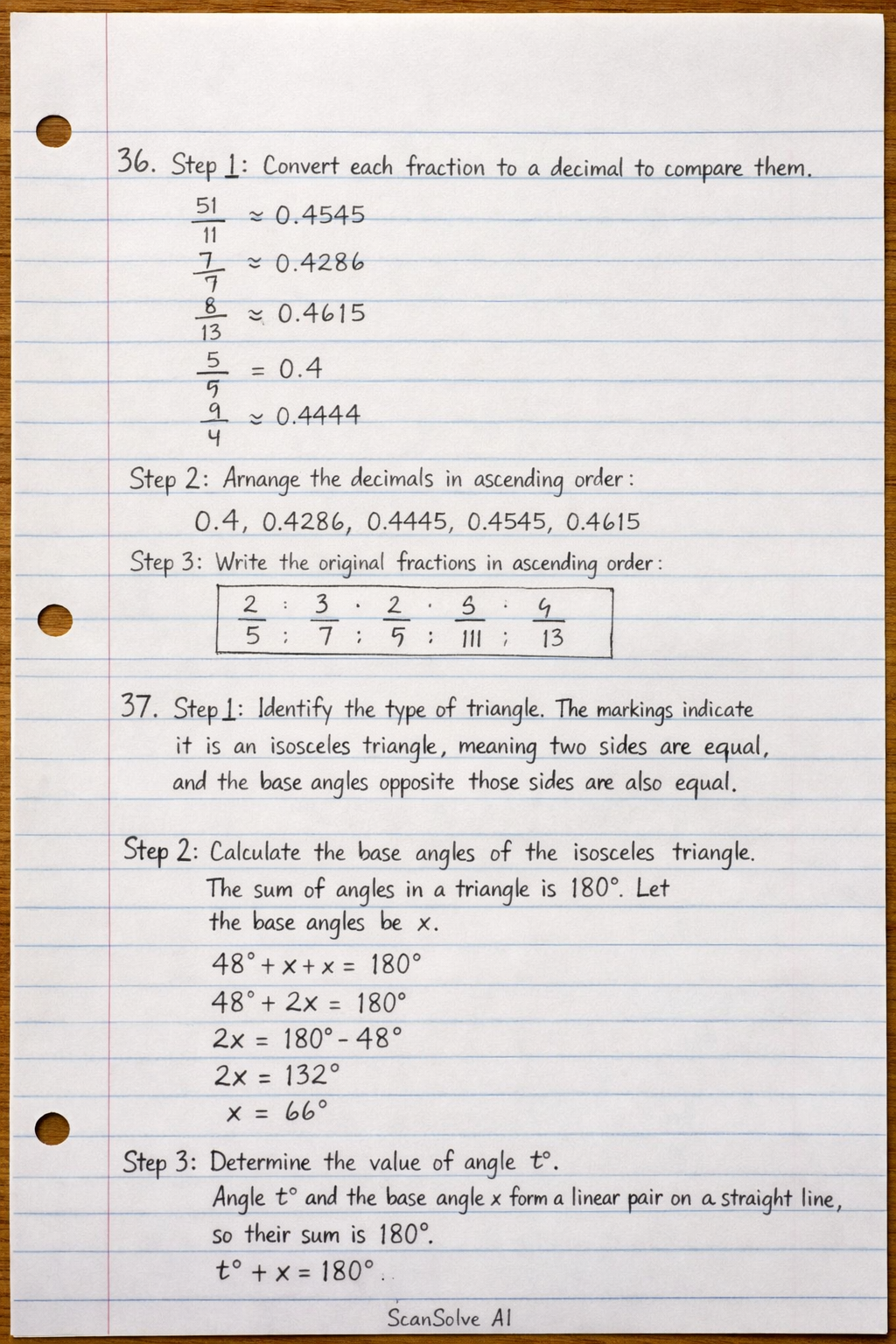
36. Step 1: Convert each fraction to a decimal to compare them.
$$\frac{5}{11} \approx 0.4545$$
$$\frac{3}{7} \approx 0.4286$$
$$\frac{6}{13} \approx 0.4615$$
$$\frac{2}{5} = 0.4$$
$$\frac{4}{9} \approx 0.4444$$
Step 2: Arrange the decimals in ascending order.
$$0.4, 0.4286, 0.4444, 0.4545, 0.4615$$
Step 3: Write the original fractions in ascending order.
$$\boxed{\frac{2}{5}, \frac{3}{7}, \frac{4}{9}, \frac{5}{11}, \frac{6}{13}}$$
37. Step 1: Identify the type of triangle. The markings indicate it is an isosceles triangle, meaning two sides are equal, and the base angles opposite those sides are also equal.
Step 2: Calculate the base angles of the isosceles triangle. The sum of angles in a triangle is $180^\circ$. Let the base angles be $x$.
$$48^\circ + x + x = 180^\circ$$
$$48^\circ + 2x = 180^\circ$$
$$2x = 180^\circ - 48^\circ$$
$$2x = 132^\circ$$
$$x = \frac{132^\circ}{2}$$
$$x = 66^\circ$$
Step 3: Determine the value of angle $t^\circ$. Angle $t^\circ$ and the base angle $x$ form a linear pair on a straight line, so their sum is $180^\circ$.
$$t^\circ + x = 180^\circ$$
$$t^\circ + 66^\circ = 180^\circ$$
$$t^\circ = 180^\circ - 66^\circ$$
$$t^\circ = 114^\circ$$
The value of the angle marked $t^\circ$ is $\boxed{114^\circ}$.
38. Step 1: Use the area of a right-angled triangle formula to find the height.
Area $A = \frac{1}{2} \times \text{base} \times \text{height}$
Given $A = 96 \text{ m}^2$ and base $b = 12 \text{ m}$.
$$96 \text{ m}^2 = \frac{1}{2} \times 12 \text{ m} \times h$$
$$96 \text{ m}^2 = 6 \text{ m} \times h$$
$$h = \frac{96 \text{ m}^2}{6 \text{ m}}$$
$$h = 16 \text{ m}$$
Step 2: Use the Pythagorean theorem to find the hypotenuse.
Let the hypotenuse be $c$.
$$c^2 = b^2 + h^2$$
$$c^2 = (12 \text{ m})^2 + (16 \text{ m})^2$$
$$c^2 = 144 \text{ m}^2 + 256 \text{ m}^2$$
$$c^2 = 400 \text{ m}^2$$
$$c = \sqrt{400 \text{ m}^2}$$
$$c = 20 \text{ m}$$
Step 3: Calculate the perimeter of the triangle.
Perimeter $P = \text{base} + \text{height} + \text{hypotenuse}$
$$P = 12 \text{ m} + 16 \text{ m} + 20 \text{ m}$$
$$P = 48 \text{ m}$$
The perimeter of the triangle is $\boxed{48 \text{ m}}$.
39. Step 1: Identify the shape. The figure shows a semicircle with a right-angled triangle inscribed within it. The shaded region is the area of the semicircle minus the area of the triangle. The sides $42 \text{ cm}$ and $56 \text{ cm}$ are the legs of the right-angled triangle, and its hypotenuse is the diameter of the semicircle.
Step 2: Calculate the diameter of the semicircle using the Pythagorean theorem.
$$d^2 = (42 \text{ cm})^2 + (56 \text{ cm})^2$$
$$d^2 = 1764 \text{ cm}^2 + 3136 \text{ cm}^2$$
$$d^2 = 4900 \text{ cm}^2$$
$$d = \sqrt{4900 \text{ cm}^2}$$
$$d = 70 \text{ cm}$$
Step 3: Calculate the radius of the semicircle.
$$r = \frac{d}{2} = \frac{70 \text{ cm}}{2} = 35 \text{ cm}$$
Step 4: Calculate the area of the semicircle. Use $\pi = \frac{22}{7}$.
$$A_{semicircle} = \frac{1}{2} \pi r^2$$
$$A_{semicircle} = \frac{1}{2} \times \frac{22}{7} \times (35 \text{ cm})^2$$
$$A_{semicircle} = \frac{1}{2} \times \frac{22}{7} \times 1225 \text{ cm}^2$$
$$A_{semicircle} = 11 \times \frac{1225}{7} \text{ cm}^2$$
$$A_{semicircle} = 11 \times 175 \text{ cm}^2$$
$$A_{semicircle} = 1925 \text{ cm}^2$$
Step 5: Calculate the area of the triangle.
$$A_{triangle} = \frac{1}{2} \times \text{base} \times \text{height}$$
$$A_{triangle} = \frac{1}{2} \times 42 \text{ cm} \times 56 \text{ cm}$$
$$A_{triangle} = 21 \text{ cm} \times 56 \text{ cm}$$
$$A_{triangle} = 1176 \text{ cm}^2$$
Step 6: Calculate the area of the shaded region.
$$A_{shaded} = A_{semicircle} - A_{triangle}$$
$$A_{shaded} = 1925 \text{ cm}^2 - 1176 \text{ cm}^2$$
$$A_{shaded} = 749 \text{ cm}^2$$
The area of the shaded region is $\boxed{749 \text{ cm}^2}$.
40. Step 1: List the number of slips of each color.
Number of blue slips = 3
Number of red slips = 4
Number of green slips = 2
Number of yellow slips = 6
Step 2: Calculate the total number of slips.
Total slips = $3 + 4 + 2 + 6 = 15$
Step 3: Determine the number of red slips.
Number of red slips = 4
Step 4: Calculate the probability of drawing a red slip.
$$P(\text{red}) = \frac{\text{Number of red slips}}{\text{Total number of slips}}$$
$$P(\text{red}) = \frac{4}{15}$$
The probability of it being a red slip is $\boxed{\frac{4}{15}}$.
That's 2 down. 3 left today — send the next one.
36. Step 1: Convert each fraction to a decimal to compare them.
|Mathematics
36. Step 1: Convert each fraction to a decimal to compare them.
ScanSolve AI Answer
Verified
Step 1: Convert each fraction to a decimal to compare them.
115≈0.454573≈0.4286136≈0.461552=0.494≈0.4444
Step 2: Arrange the decimals in ascending order.
0.4,0.4286,0.4444,0.4545,0.4615
Step 3: Write the original fractions in ascending order.
52,73,94,115,136
Step 1: Identify the type of triangle. The markings indicate it is an isosceles triangle, meaning two sides are equal, and the base angles opposite those sides are also equal.
Step 2: Calculate the base angles of the isosceles triangle. The sum of angles in a triangle is 180∘. Let the base angles be x.
48∘+x+x=180∘48∘+2x=180∘2x=180∘−48∘2x=132∘x=2132∘x=66∘
Step 3: Determine the value of angle t∘. Angle t∘ and the base angle x form a linear pair on a straight line, so their sum is 180∘.
t∘+x=180∘t∘+66∘=180∘t∘=180∘−66∘t∘=114∘
The value of the angle marked t∘ is 114∘.
Step 1: Use the area of a right-angled triangle formula to find the height.
Area A=21×base×height
Given A=96m2 and base b=12 m.
96m2=21×12m×h96m2=6m×hh=6m96m2h=16 m
Step 2: Use the Pythagorean theorem to find the hypotenuse.
Let the hypotenuse be c.
c2=b2+h2c2=(12m)2+(16m)2c2=144m2+256m2c2=400m2c=400m2c=20 m
Step 3: Calculate the perimeter of the triangle.
Perimeter P=base+height+hypotenuseP=12m+16m+20 mP=48 m
The perimeter of the triangle is 48m.
Step 1: Identify the shape. The figure shows a semicircle with a right-angled triangle inscribed within it. The shaded region is the area of the semicircle minus the area of the triangle. The sides 42 cm and 56 cm are the legs of the right-angled triangle, and its hypotenuse is the diameter of the semicircle.
Step 2: Calculate the diameter of the semicircle using the Pythagorean theorem.
d2=(42cm)2+(56cm)2d2=1764cm2+3136cm2d2=4900cm2d=4900cm2d=70 cm
Step 3: Calculate the radius of the semicircle.
r=2d=270cm=35 cm
Step 4: Calculate the area of the semicircle. Use π=722.
Asemicircle=21πr2Asemicircle=21×722×(35cm)2Asemicircle=21×722×1225cm2Asemicircle=11×71225cm2Asemicircle=11×175cm2Asemicircle=1925cm2
Step 5: Calculate the area of the triangle.
Atriangle=21×base×heightAtriangle=21×42cm×56 cmAtriangle=21cm×56 cmAtriangle=1176cm2
Step 6: Calculate the area of the shaded region.
Ashaded=Asemicircle−AtriangleAshaded=1925cm2−1176cm2Ashaded=749cm2
The area of the shaded region is 749cm2.
Step 1: List the number of slips of each color.
Number of blue slips = 3
Number of red slips = 4
Number of green slips = 2
Number of yellow slips = 6
Step 2: Calculate the total number of slips.
Total slips = 3+4+2+6=15
Step 3: Determine the number of red slips.
Number of red slips = 4
Step 4: Calculate the probability of drawing a red slip.
P(red)=TotalnumberofslipsNumberofredslipsP(red)=154
The probability of it being a red slip is 154.
That's 2 down. 3 left today — send the next one.
Need help with your own homework?
Get instant step-by-step solutions to any question. Free to start.