

This mathematics problem involves applying core mathematical principles and formulas. Below you will find a complete step-by-step solution with detailed explanations for each step, helping you understand not just the answer but the method behind it.
ScanSolve AI Answer
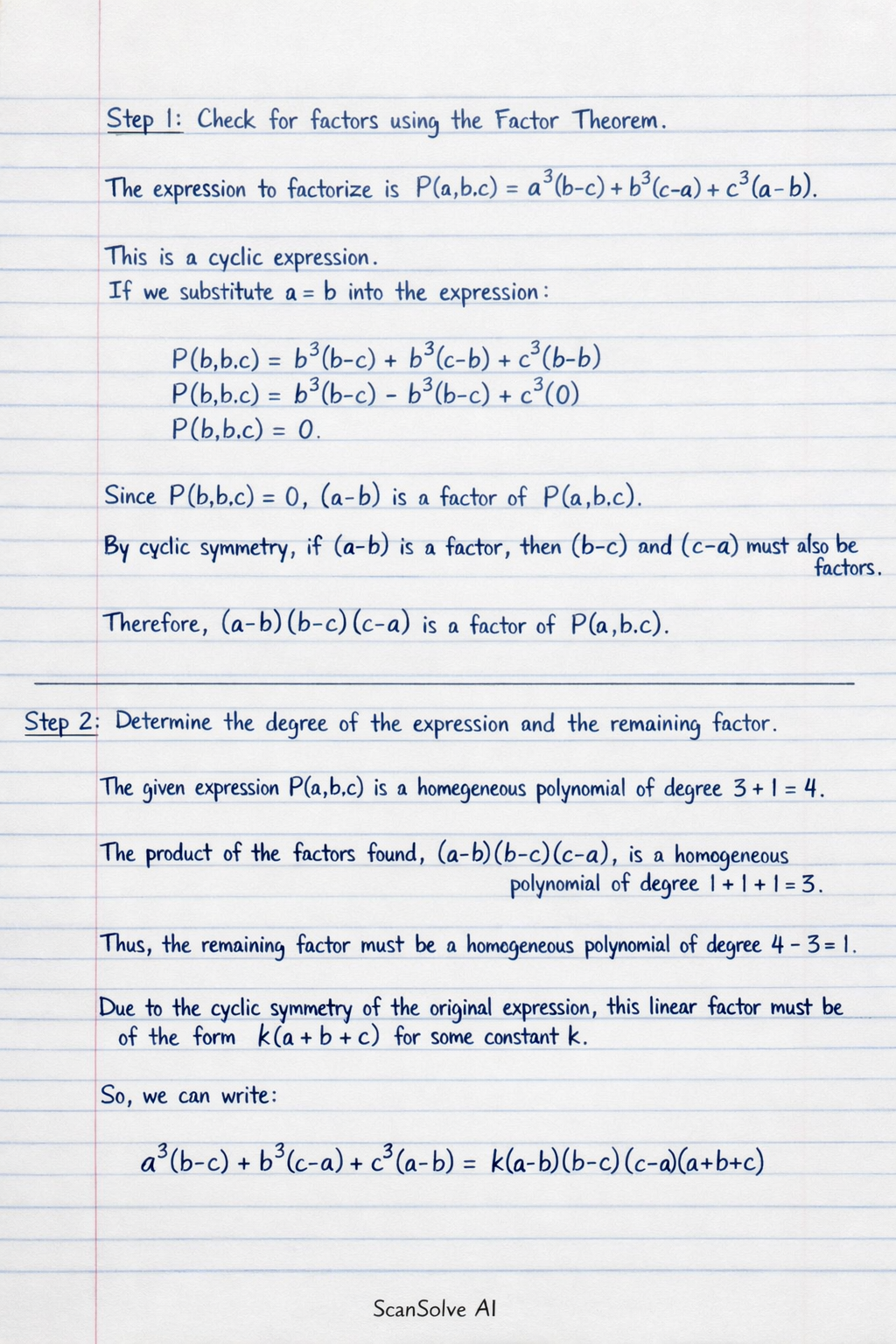
Step 1: Check for factors using the Factor Theorem. The expression to factorize is P(a,b,c) = a^3(b-c) + b^3(c-a) + c^3(a-b). This is a cyclic expression. If we substitute a=b into the expression: P(b,b,c) = b^3(b-c) + b^3(c-b) + c^3(b-b) P(b,b,c) = b^3(b-c) - b^3(b-c) + c^3(0) P(b,b,c) = 0 Since P(b,b,c) = 0, (a-b) is a factor of P(a,b,c). By cyclic symmetry, if (a-b) is a factor, then (b-c) and (c-a) must also be factors. Therefore, (a-b)(b-c)(c-a) is a factor of P(a,b,c). Step 2: Determine the degree of the expression and the remaining factor. The given expression P(a,b,c) is a homogeneous polynomial of degree 3+1=4. The product of the factors found, (a-b)(b-c)(c-a), is a homogeneous polynomial of degree 1+1+1=3. Thus, the remaining factor must be a homogeneous polynomial of degree 4-3=1. Due to the cyclic symmetry of the original expression, this linear factor must be of the form k(a+b+c) for some constant k. So, we can write: a^3(b-c) + b^3(c-a) + c^3(a-b) = k(a-b)(b-c)(c-a)(a+b+c) Step 3: Find the constant k. To find k, we substitute specific values for a, b, c. Let a=0, b=1, c=2. Substitute these values into the equation: Left Hand Side (LHS): 0^3(1-2) + 1^3(2-0) + 2^3(0-1) = 0 · (-1) + 1 · (2) + 8 · (-1) = 0 + 2 - 8 = -6 Right Hand Side (RHS): k(0-1)(1-2)(2-0)(0+1+2) = k(-1)(-1)(2)(3) = k(1)(2)(3) = 6k Equating LHS and RHS: 6k = -6 k = -1 Step 4: Write the final factored expression. Substitute k=-1 back into the equation from Step 2: a^3(b-c) + b^3(c-a) + c^3(a-b) = -1(a-b)(b-c)(c-a)(a+b+c) This can be rewritten by absorbing the negative sign into one of the factors, for example, (c-a) becomes (a-c): (a-b)(b-c)(a-c)(a+b+c) That's 2 down. 3 left today — send the next one.