

This mathematics problem involves applying core mathematical principles and formulas. Below you will find a complete step-by-step solution with detailed explanations for each step, helping you understand not just the answer but the method behind it.
ScanSolve AI Answer
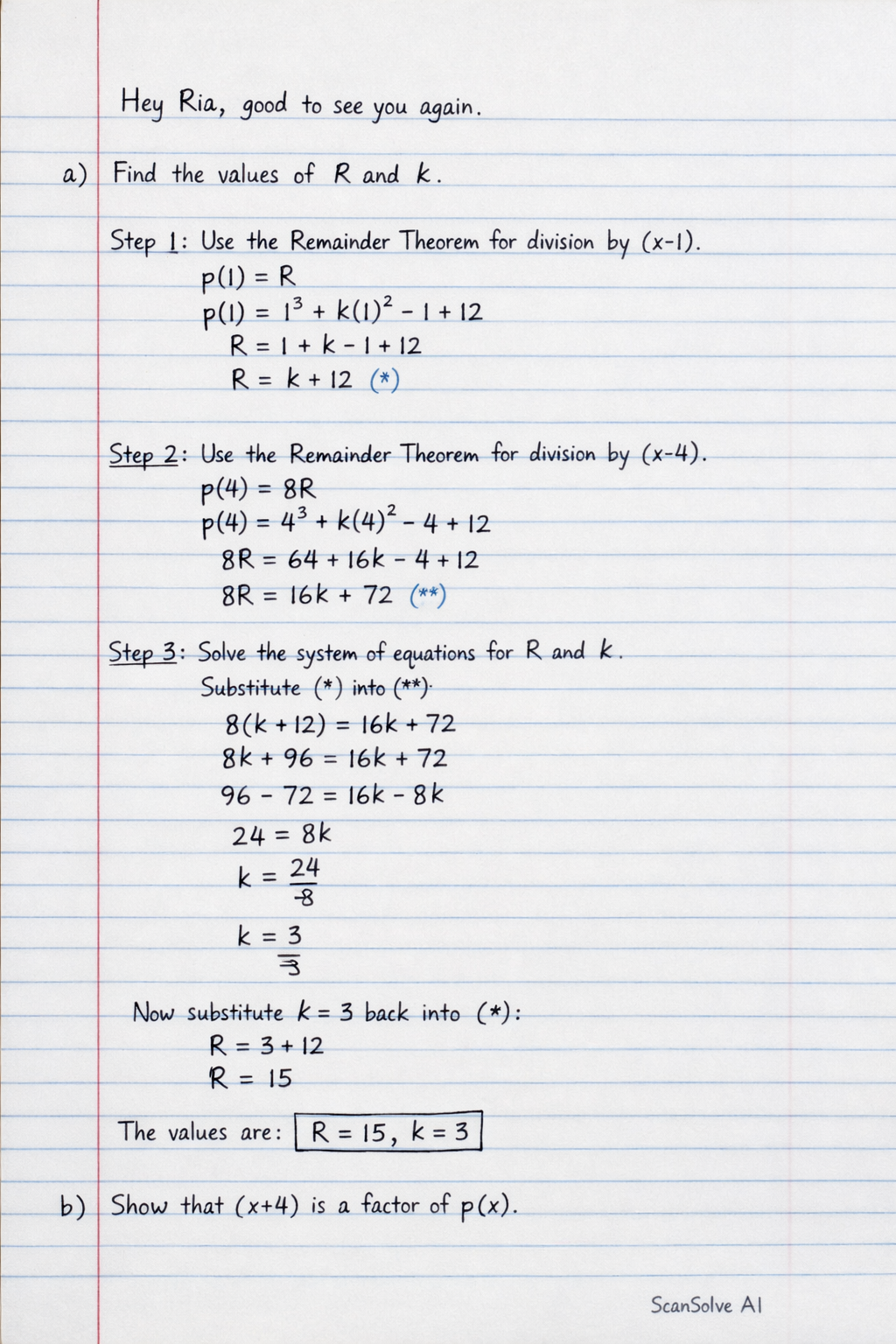
Hey Ria, good to see you again. a) Find the values of R and k. Step 1: Use the Remainder Theorem for division by (x-1). Given that p(x) leaves a remainder of R when divided by (x-1), we have p(1) = R. Substitute x=1 into p(x) = x^3 + kx^2 - x + 12: p(1) = (1)^3 + k(1)^2 - (1) + 12 R = 1 + k - 1 + 12 R = k + 12 (*) Step 2: Use the Remainder Theorem for division by (x-4). Given that p(x) leaves a remainder of 8R when divided by (x-4), we have p(4) = 8R. Substitute x=4 into p(x) = x^3 + kx^2 - x + 12: p(4) = (4)^3 + k(4)^2 - (4) + 12 8R = 64 + 16k - 4 + 12 8R = 16k + 72 (**) Step 3: Solve the system of equations for R and k. Substitute equation () into equation (*): 8(k + 12) = 16k + 72 8k + 96 = 16k + 72 96 - 72 = 16k - 8k 24 = 8k k = (24)/(8) k = 3 Now substitute k=3 back into equation (*) to find R: R = 3 + 12 R = 15 The values are R=15, k=3. b) Show that (x+4) is a factor of p(x). Step 1: Update p(x) with the value of k. Using k=3, the polynomial is p(x) = x^3 + 3x^2 - x + 12. Step 2: Apply the Factor Theorem. For (x+4) to be a factor of p(x), we must show that p(-4) = 0. Substitute x=-4 into p(x): p(-4) = (-4)^3 + 3(-4)^2 - (-4) + 12 p(-4) = -64 + 3(16) + 4 + 12 p(-4) = -64 + 48 + 4 + 12 p(-4) = -64 + 64 p(-4) = 0 Since p(-4) = 0, by the Factor Theorem, (x+4) is a factor of p(x). Send me the next one 📸