We read your photo as:

Calculate the volume of a frustum of a cone if the diameters of the top and bottom ends are 6 cm and 10 cm, respectively and the vertical distance between them is 4 cm.

Mathematics

ScanSolve AI Answer

Answer

b

32979.6 cm3\text{32979.6 cm}^3

4370.2 cm2\text{4370.2 cm}^2

Step-by-step solution

5 steps

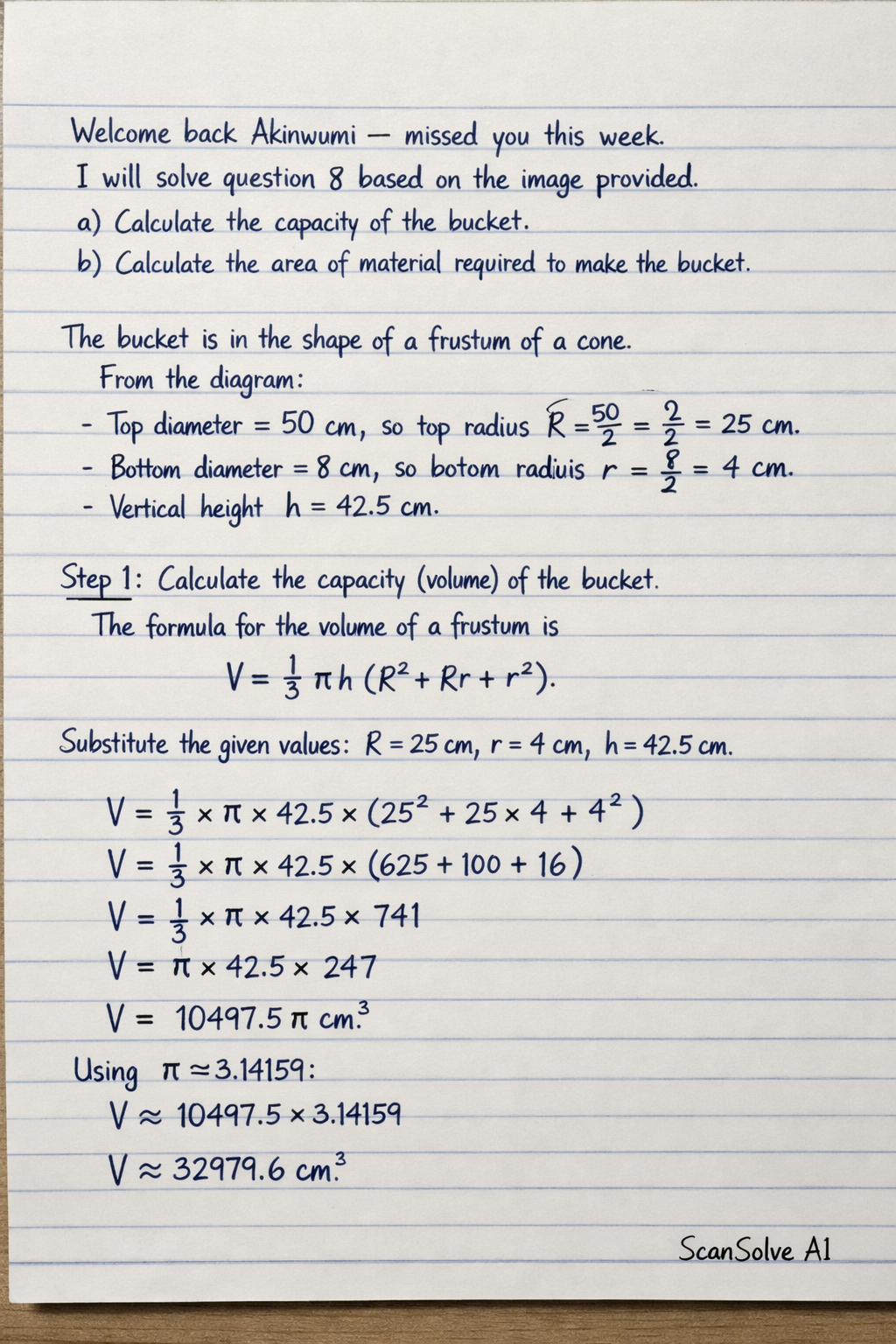
I will solve question 8 based on the image provided.

Part a

Calculate the capacity of the bucket.

Part b

32979.6 cm3\text{32979.6 cm}^3

Calculate the area of material required to make the bucket.

The bucket is in the shape of a frustum of a cone.
From the diagram:
Top diameter =50 cm= 50 \text{ cm}, so top radius R=502=25 cmR = \frac{50}{2} = 25 \text{ cm}.
Bottom diameter =8 cm= 8 \text{ cm}, so bottom radius r=82=4 cmr = \frac{8}{2} = 4 \text{ cm}.
Vertical height h=42.5 cmh = 42.5 \text{ cm}.

  1. Calculate the capacity (volume) of the bucket.

    The formula for the volume of a frustum is V=13πh(R2+Rr+r2)V = \frac{1}{3}\pi h (R^2 + Rr + r^2).
    Substitute the given values: R=25 cmR = 25 \text{ cm}, r=4 cmr = 4 \text{ cm}, h=42.5 cmh = 42.5 \text{ cm}.

    V=13×π×42.5×(252+25×4+42)V = \frac{1}{3} \times \pi \times 42.5 \times (25^2 + 25 \times 4 + 4^2) V=13×π×42.5×(625+100+16)V = \frac{1}{3} \times \pi \times 42.5 \times (625 + 100 + 16) V=13×π×42.5×741V = \frac{1}{3} \times \pi \times 42.5 \times 741 V=π×42.5×247V = \pi \times 42.5 \times 247 V=10497.5π cm3V = 10497.5 \pi \text{ cm}^3

    Using π≈3.14159\pi \approx 3.14159:

    V≈10497.5×3.14159V \approx 10497.5 \times 3.14159 V≈32979.6 cm3V \approx 32979.6 \text{ cm}^3

    The capacity of the bucket is approximately 32979.6 cm3\boxed{\text{32979.6 cm}^3}.

  2. Calculate the area of material required to make the bucket.

    This refers to the curved surface area of the frustum plus the area of the bottom circular base. The top is open.
    First, we need to find the slant height ll of the frustum.
    The formula for the slant height of a frustum is l=h2+(R−r)2l = \sqrt{h^2 + (R-r)^2}.

    l=42.52+(25−4)2l = \sqrt{42.5^2 + (25-4)^2} l=42.52+212l = \sqrt{42.5^2 + 21^2} l=1806.25+441l = \sqrt{1806.25 + 441} l=2247.25l = \sqrt{2247.25} l≈47.405 cml \approx 47.405 \text{ cm}
  3. Calculate the curved surface area of the frustum.

    The formula for the curved surface area of a frustum is Acurved=π(R+r)lA_{curved} = \pi (R+r)l.

    Acurved=π(25+4)×47.405A_{curved} = \pi (25+4) \times 47.405 Acurved=π×29×47.405A_{curved} = \pi \times 29 \times 47.405 Acurved=1374.745π cm2A_{curved} = 1374.745 \pi \text{ cm}^2

    Using π≈3.14159\pi \approx 3.14159:

    Acurved≈1374.745×3.14159A_{curved} \approx 1374.745 \times 3.14159 Acurved≈4319.9 cm2A_{curved} \approx 4319.9 \text{ cm}^2
  4. Calculate the area of the bottom circular base.

    The formula for the area of a circle is Abase=πr2A_{base} = \pi r^2.

    Abase=π×42A_{base} = \pi \times 4^2 Abase=16π cm2A_{base} = 16 \pi \text{ cm}^2

    Using π≈3.14159\pi \approx 3.14159:

    Abase≈16×3.14159A_{base} \approx 16 \times 3.14159 Abase≈50.265 cm2A_{base} \approx 50.265 \text{ cm}^2
  5. Calculate the total area of material required.

    Total area Atotal=Acurved+AbaseA_{total} = A_{curved} + A_{base}.

    Atotal=4319.9+50.265A_{total} = 4319.9 + 50.265 Atotal=4370.165 cm2A_{total} = 4370.165 \text{ cm}^2

    The area of material required to make the bucket is approximately 4370.2 cm2\boxed{\text{4370.2 cm}^2}.

Was this helpful?

Try one yourself

A new problem that tests the same skill.

Still stuck on this one?

Ask a follow-up, and the answer starts from this question.

Got a different question?Ask your own question
Handwritten step-by-step solution preview

Handwritten Step-by-Step Solution

Get this as a handwritten image on WhatsApp — like a tutor wrote it for you.

Try on WhatsApp