This mathematics problem involves applying core mathematical principles and formulas. Below you will find a complete step-by-step solution with detailed explanations for each step, helping you understand not just the answer but the method behind it.
ScanSolve AI Answer
Here's a step-by-step solution to the problem:
We define our coordinate system such that the positive X-axis points East and the positive Y-axis points North.
Part (i): The components of each displacement
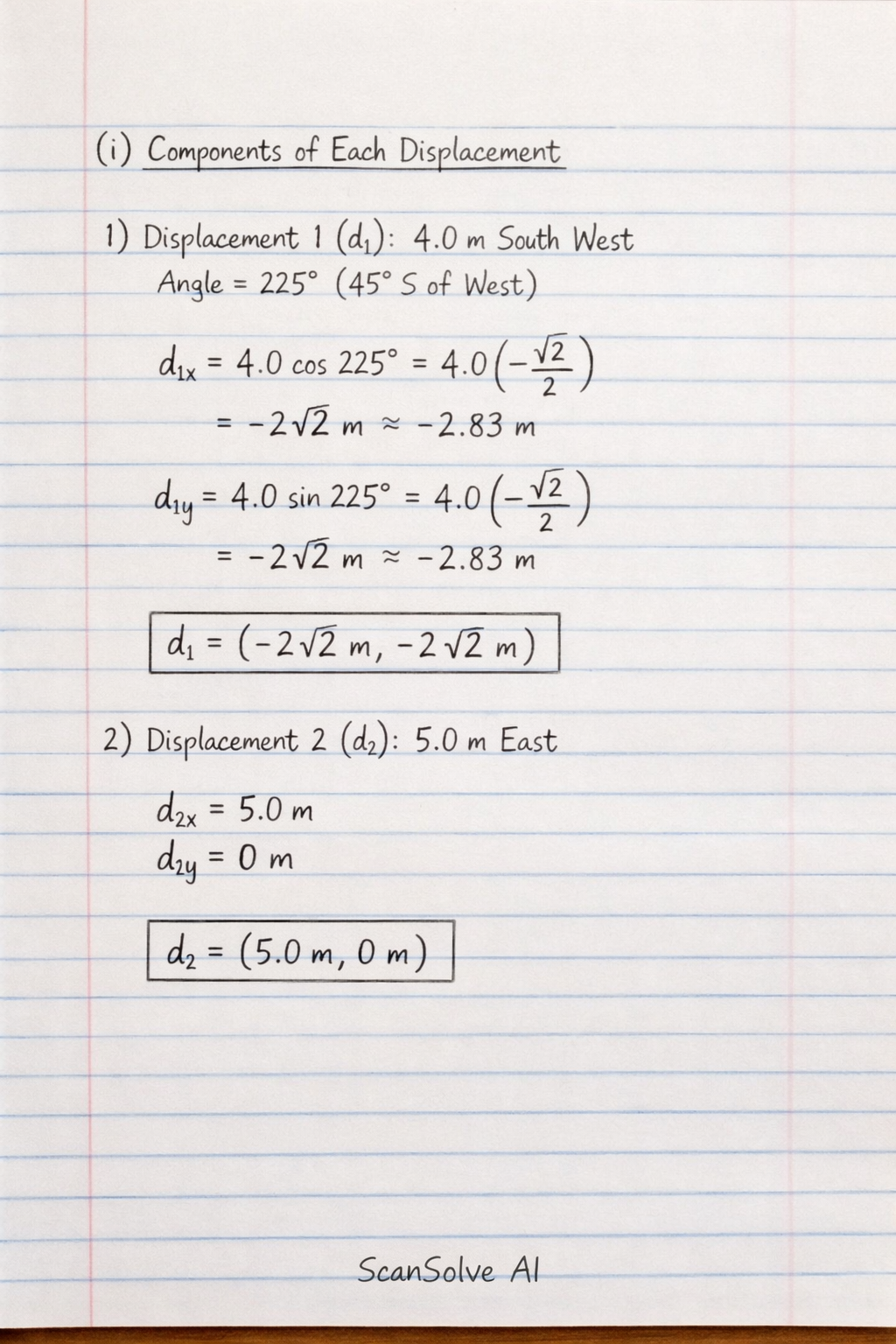
Displacement 1 ($\vec{d_1}$): 4.0 m South West
South West means the angle is $225^\circ$ from the positive X-axis, or $45^\circ$ South of West.
$$d_{1x} = 4.0 \cos(225^\circ) = 4.0 \left(-\frac{\sqrt{2}}{2}\right) = -2\sqrt{2} \text{ m} \approx -2.83 \text{ m}$$
$$d_{1y} = 4.0 \sin(225^\circ) = 4.0 \left(-\frac{\sqrt{2}}{2}\right) = -2\sqrt{2} \text{ m} \approx -2.83 \text{ m}$$
So, $\vec{d_1} = \boxed{(-2\sqrt{2} \text{ m}, -2\sqrt{2} \text{ m})}$
Displacement 2 ($\vec{d_2}$): 5.0 m East
This displacement is entirely along the positive X-axis.
$$d_{2x} = 5.0 \text{ m}$$
$$d_{2y} = 0 \text{ m}$$
So, $\vec{d_2} = \boxed{(5.0 \text{ m}, 0 \text{ m})}$
Displacement 3 ($\vec{d_3}$): 6.0 m in a direction 30° E of N
"30° E of N" means $30^\circ$ from the North axis towards the East. This corresponds to an angle of $90^\circ - 30^\circ = 60^\circ$ from the positive X-axis.
$$d_{3x} = 6.0 \cos(60^\circ) = 6.0 \left(\frac{1}{2}\right) = 3.0 \text{ m}$$
$$d_{3y} = 6.0 \sin(60^\circ) = 6.0 \left(\frac{\sqrt{3}}{2}\right) = 3\sqrt{3} \text{ m} \approx 5.20 \text{ m}$$
So, $\vec{d_3} = \boxed{(3.0 \text{ m}, 3\sqrt{3} \text{ m})}$
Part (ii): The components of the resultant displacement
Let the resultant displacement be $\vec{R}$. We sum the respective components:
$$R_x = d_{1x} + d_{2x} + d_{3x}$$
$$R_x = -2\sqrt{2} + 5.0 + 3.0 = (8.0 - 2\sqrt{2}) \text{ m}$$
$$R_y = d_{1y} + d_{2y} + d_{3y}$$
$$R_y = -2\sqrt{2} + 0 + 3\sqrt{3} = (3\sqrt{3} - 2\sqrt{2}) \text{ m}$$
Numerically:
$$R_x \approx 8.0 - 2(1.414) = 8.0 - 2.828 = 5.172 \text{ m}$$
$$R_y \approx 3(1.732) - 2(1.414) = 5.196 - 2.828 = 2.368 \text{ m}$$
The components of the resultant displacement are $\boxed{(5.17 \text{ m}, 2.37 \text{ m})}$.
Part (iii): The magnitude and direction of the resultant displacement
The magnitude of the resultant displacement $|\vec{R}|$ is:
$$|\vec{R}| = \sqrt{R_x^2 + R_y^2}$$
$$|\vec{R}| = \sqrt{(5.172)^2 + (2.368)^2}$$
$$|\vec{R}| = \sqrt{26.75 + 5.61} = \sqrt{32.36} \approx 5.69 \text{ m}$$
The direction $\theta$ is given by:
$$\theta = \arctan\left(\frac{R_y}{R_x}\right)$$
$$\theta = \arctan\left(\frac{2.368}{5.172}\right) = \arctan(0.4578) \approx 24.6^\circ$$
Since both $R_x$ and $R_y$ are positive, the resultant displacement is in the first quadrant.
The magnitude of the resultant displacement is $\boxed{5.69 \text{ m}}$ and its direction is $\boxed{24.6^\circ \text{ North of East}}$.
Part (iv): The displacement that would be required to bring the rat back to the starting point
To bring the rat back to the starting point, the required displacement must be equal in magnitude and opposite in direction to the resultant displacement. Let this be $\vec{D}_{return}$.
$$\vec{D}_{return} = -\vec{R}$$
$$D_{return, x} = -R_x = -(8.0 - 2\sqrt{2}) \text{ m} \approx -5.17 \text{ m}$$
$$D_{return, y} = -R_y = -(3\sqrt{3} - 2\sqrt{2}) \text{ m} \approx -2.37 \text{ m}$$
The magnitude of this displacement is the same as $|\vec{R}|$, which is approximately $5.69 \text{ m}$.
To find the direction, we note that both components are negative, placing the displacement in the third quadrant (South-West). The angle $\alpha$ relative to the negative X-axis (West) is:
$$\alpha = \arctan\left(\frac{|D_{return, y}|}{|D_{return, x}|}\right) = \arctan\left(\frac{2.368}{5.172}\right) \approx 24.6^\circ$$
The displacement required to bring the rat back to the starting point has a magnitude of $\boxed{5.69
We define our coordinate system such that the positive X-axis points East and the positive Y-axis points North.
|Mathematics
We define our coordinate system such that the positive X-axis points East and the positive Y-axis points North.
ScanSolve AI Answer
Here's a step-by-step solution to the problem:
We define our coordinate system such that the positive X-axis points East and the positive Y-axis points North.
Part (i): The components of each displacement
Displacement 1 (d1): 4.0 m South West
South West means the angle is 225∘ from the positive X-axis, or 45∘ South of West.
d1x=4.0cos(225∘)=4.0(−22)=−22m≈−2.83 md1y=4.0sin(225∘)=4.0(−22)=−22m≈−2.83 m
So, d1=(−22m,−22m)
Displacement 2 (d2): 5.0 m East
This displacement is entirely along the positive X-axis.
d2x=5.0 md2y=0 m
So, d2=(5.0 m, 0 m)
Displacement 3 (d3): 6.0 m in a direction 30° E of N
"30° E of N" means 30∘ from the North axis towards the East. This corresponds to an angle of 90∘−30∘=60∘ from the positive X-axis.
d3x=6.0cos(60∘)=6.0(21)=3.0 md3y=6.0sin(60∘)=6.0(23)=33m≈5.20 m
So, \vec{d_3} = (3.0 \text{ m, 3\sqrt{3} m)}
Part (ii): The components of the resultant displacement
Let the resultant displacement be R. We sum the respective components:
Rx=d1x+d2x+d3xRx=−22+5.0+3.0=(8.0−22) mRy=d1y+d2y+d3yRy=−22+0+33=(33−22) m
Numerically:
Rx≈8.0−2(1.414)=8.0−2.828=5.172 mRy≈3(1.732)−2(1.414)=5.196−2.828=2.368 m
The components of the resultant displacement are (5.17m,2.37m).
Part (iii): The magnitude and direction of the resultant displacement
The magnitude of the resultant displacement ∣R∣ is:
∣R∣=Rx2+Ry2∣R∣=(5.172)2+(2.368)2∣R∣=26.75+5.61=32.36≈5.69 m
The direction θ is given by:
θ=arctan(RxRy)θ=arctan(5.1722.368)=arctan(0.4578)≈24.6∘
Since both Rx and Ry are positive, the resultant displacement is in the first quadrant.
The magnitude of the resultant displacement is 5.69m and its direction is 24.6∘NorthofEast.
Part (iv): The displacement that would be required to bring the rat back to the starting point
To bring the rat back to the starting point, the required displacement must be equal in magnitude and opposite in direction to the resultant displacement. Let this be Dreturn.
Dreturn=−RDreturn,x=−Rx=−(8.0−22)m≈−5.17 mDreturn,y=−Ry=−(33−22)m≈−2.37 m
The magnitude of this displacement is the same as ∣R∣, which is approximately 5.69 m.
To find the direction, we note that both components are negative, placing the displacement in the third quadrant (South-West). The angle α relative to the negative X-axis (West) is:
α=arctan(∣Dreturn,x∣∣Dreturn,y∣)=arctan(5.1722.368)≈24.6∘
The displacement required to bring the rat back to the starting point has a magnitude of $\boxed{5.69
Need help with your own homework?
Get instant step-by-step solutions to any question. Free to start.