
We read your photo as:
How well you know the different types of triangles. Measure the sides of the triangles. Write the measurements on the triangles. Use a protractor to measure the angles. Write the measurements on the triangles.
ScanSolve AI Answer
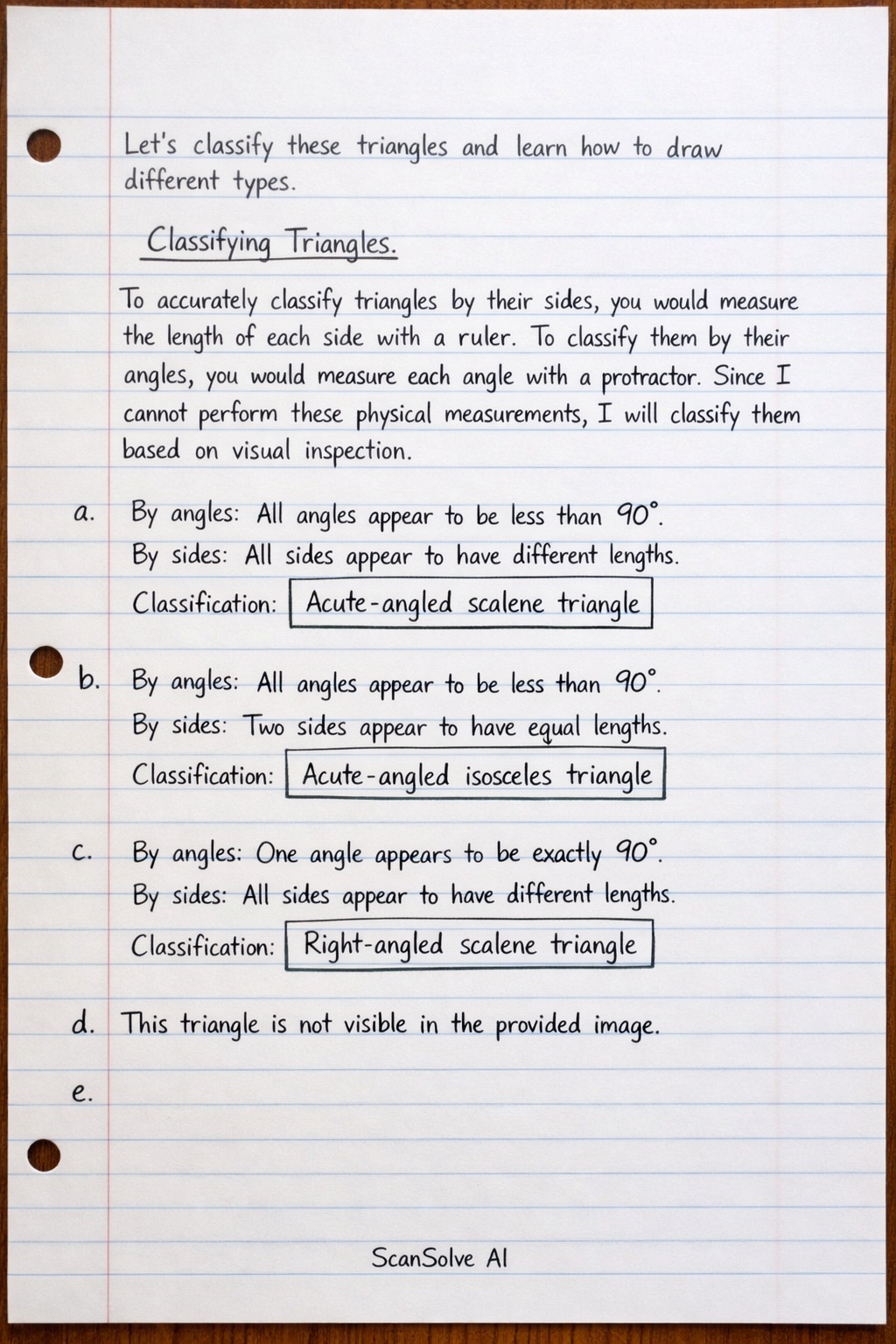
Let's classify these triangles and learn how to draw different types.
Classifying Triangles
To accurately classify triangles by their sides, you would measure the length of each side with a ruler. To classify them by their angles, you would measure each angle with a protractor. Since I cannot perform these physical measurements, I will classify them based on visual inspection.
- a.
- By angles: All angles appear to be less than .
- By sides: All sides appear to have different lengths.
- Classification:
- b.
- By angles: All angles appear to be less than .
- By sides: Two sides appear to have equal lengths.
- Classification:
- c.
- By angles: One angle appears to be exactly .
- By sides: All sides appear to have different lengths.
- Classification:
- d. This triangle is not visible in the provided image.
- e.
- By angles: One angle appears to be greater than .
- By sides: All sides appear to have different lengths.
- Classification:
- f.
- By angles: One angle appears to be greater than .
- By sides: All sides appear to have different lengths.
- Classification:
- g. This triangle is not visible in the provided image.
- h.
- By angles: One angle appears to be exactly .
- By sides: All sides appear to have different lengths.
- Classification:
- i.
- By angles: One angle appears to be exactly .
- By sides: All sides appear to have different lengths.
- Classification:
- j.
- By angles: One angle appears to be greater than .
- By sides: All sides appear to have different lengths.
- Classification:
Drawing Different Kinds of Triangles
Here are instructions on how to draw the specified types of triangles:
-
a. A right-angled triangle
- Draw a straight line segment for the base.
- At one end of the base, use a protractor to draw a line segment perpendicular to the base, forming a angle.
- Connect the end of the perpendicular line segment to the other end of the base to complete the triangle.
-
b. An acute-angled triangle
- Draw a straight line segment for the base.
- At each end of the base, draw a line segment such that both angles formed with the base are less than .
- Extend these two line segments until they intersect. The angle formed at their intersection must also be less than .
-
c. An obtuse-angled triangle (Assuming this is the missing part of the question)
- Draw a straight line segment for the base.
- At one end of the base, use a protractor to draw a line segment forming an angle greater than (e.g., ) with the base.
- Connect the end of this new line segment to the other end of the base. The other two angles must be acute.
-
d. An isosceles triangle
- Draw a straight line segment for the base.
- From the midpoint of the base, draw a perpendicular line segment upwards.
- Connect the top end of this perpendicular line segment to both ends of the base. The two non-base sides will be equal in length, and the two base angles will be equal.
Still stuck on this one?
Ask a follow-up, and the answer starts from this question.
More Mathematics Questions
Handwritten Step-by-Step Solution
Get this as a handwritten image on WhatsApp — like a tutor wrote it for you.
Try on WhatsApp