

This physics problem tests your understanding of fundamental physical laws and their applications. The step-by-step solution below breaks down the problem using relevant equations and physical reasoning.
ScanSolve AI Answer
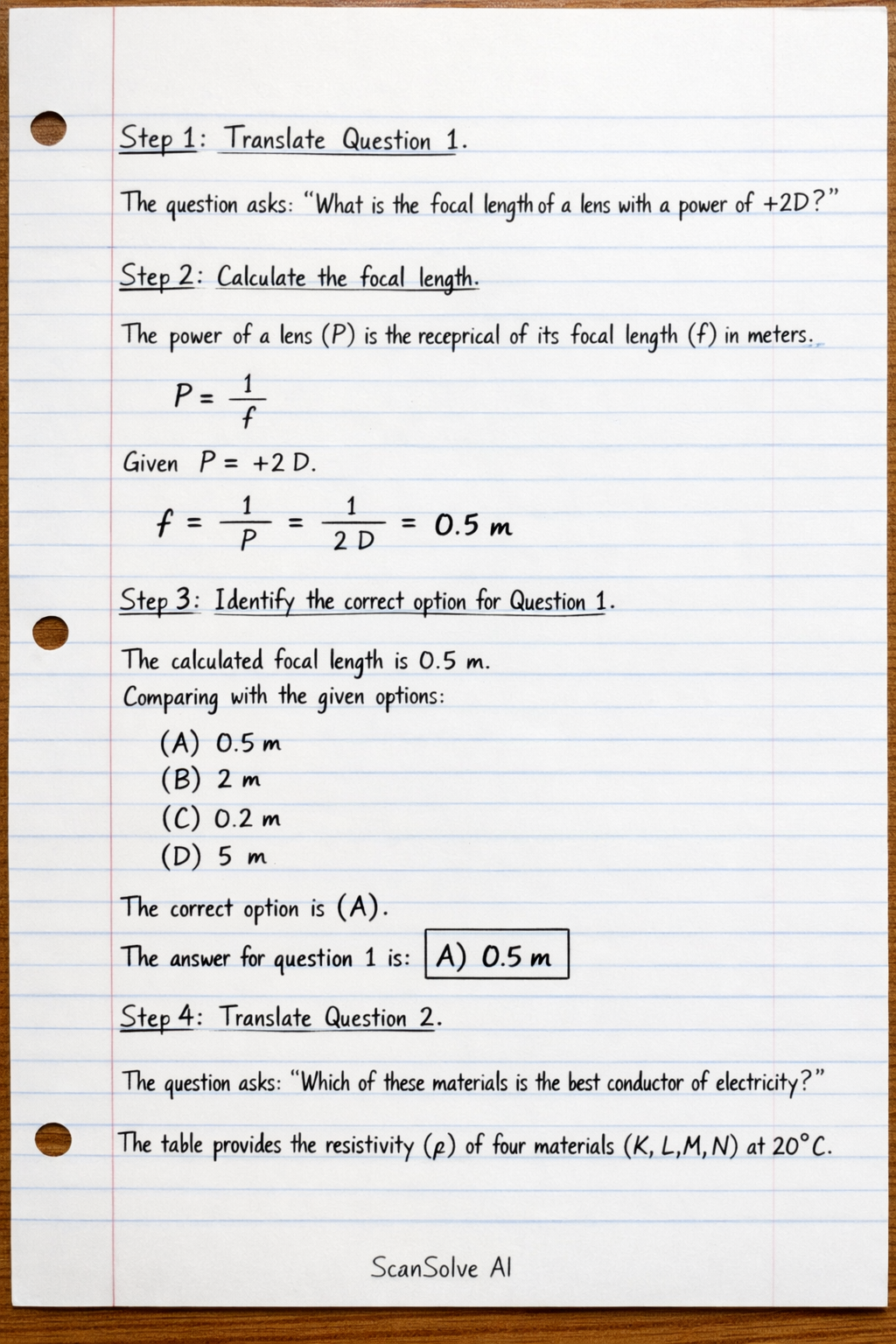
Step 1: Translate Question 1. The question asks: "What is the focal length of a lens with a power of +2D?" Step 2: Calculate the focal length. The power of a lens (P) is the reciprocal of its focal length (f) in meters. P = (1)/(f) Given P = +2 \, D. f = (1)/(P) = (1)/(2 \, D) = 0.5 \, m Step 3: Identify the correct option for Question 1. The calculated focal length is 0.5 \, m. Comparing with the given options: (A) 0.5 \, m (B) 2 \, m (C) 0.2 \, m (D) 5 \, m The correct option is (A). The answer for question 1 is A) 0.5 \, m. Step 4: Translate Question 2. The question asks: "Which of these materials is the best conductor of electricity?" The table provides the resistivity () of four materials (K, L, M, N) at 20^ C. Step 5: Analyze the resistivity values. A material with lower resistivity is a better conductor of electricity. We need to find the material with the smallest resistivity value. The given resistivity values are: • Material K: _K = 2.63 × 10^-8 \, · m • Material L: _L = 5.20 × 10^-8 \, · m • Material M: _M = 1.60 × 10^-8 \, · m • Material N: _N = 6.84 × 10^-8 \, · m Step 6: Compare the resistivity values. Comparing the numerical values (2.63, 5.20, 1.60, 6.84) while keeping the exponent 10^-8 in mind, the smallest value is 1.60. Therefore, Material M has the lowest resistivity. Step 7: Identify the correct option for Question 2. The material with the lowest resistivity is M, making it the best conductor. Comparing with the given options: (A) N (B) K (C) M (D) L The correct option is (C). The answer for question 2 is C) M.