
We read your photo as:
State whether each pair of shapes is similar or congruent:
ScanSolve AI Answer
here are the solutions to your math questions:
2.1 Use the following triangles to answer the questions that follow:
-
2.1.1 Which triangle is isosceles? A, B or C? Triangles A and B have two equal sides, making them isosceles. Answer:
-
2.1.2 What is the name of the triangle which 3 sides that are equal in length? A triangle with three equal sides is an equilateral triangle. Answer:
-
2.1.3 Which triangle has a right angle? Triangle B has a right angle, indicated by the square symbol. Answer:
-
2.1.4 Which triangle has 2 sides that are equal? Triangles A and B both have two sides of equal length. Answer:
-
2.1.5 Which triangle has 3 sides that are not equal? Triangle C has three sides of different lengths. Answer:
2.2 Complete the table below:
-
2.2.1 Four sides equal in length Answer:
-
2.2.2 Opposite sides equal in length Answer:
-
2.2.3 Only one pair of the opposite sides parallel Answer:
-
2.2.4 All four interior angles are 90 degrees Answer:
-
2.2.5 Two pairs of opposite sides parallel Answer:
2.3 State whether each pair of shapes is similar or congruent:
-
(a) Two stars The stars have the same shape but different sizes. Answer:
-
(b) Two triangles The triangles have the same shape and appear to be the same size. Answer:
-
(c) Two trapezoids The trapezoids have the same shape but different sizes. Answer:
-
(d) Two circles The circles have the same shape but different sizes. Answer:
Still stuck on this one?
Ask a follow-up, and the answer starts from this question.
More Mathematics Questions
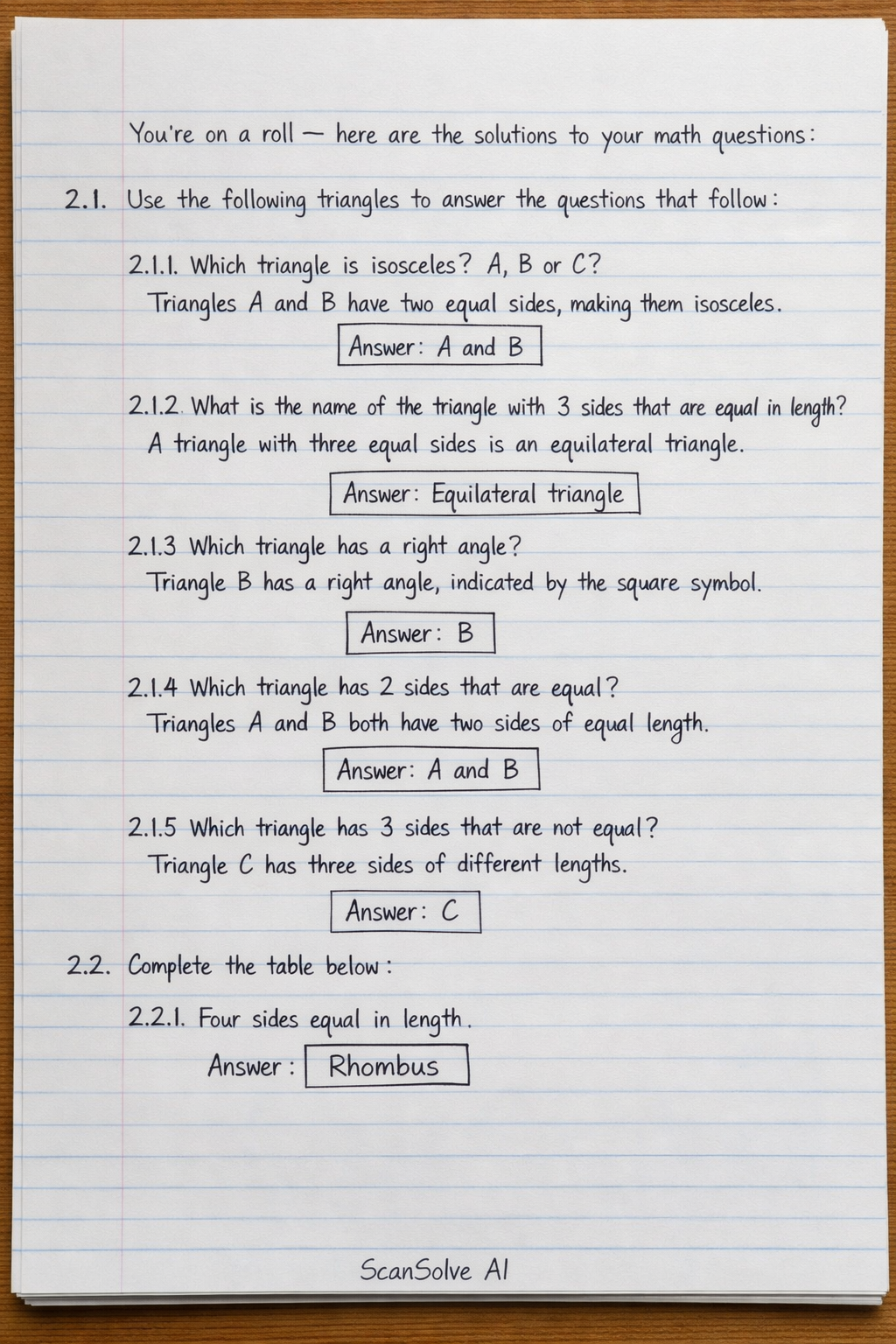
Handwritten Step-by-Step Solution
Get this as a handwritten image on WhatsApp — like a tutor wrote it for you.
Try on WhatsApp