
We read your photo as:
Determine whether (x+1) is a factor of x3+3x2+3x+1 Solve x3−6x2+11x+6=0 a Company Determine whether the profit is zero when x=4 9x+20 a Polynomial model is P(x) = x2−7x+12 determine whether x-3 is a factor
ScanSolve AI Answer
Use the left and right arrow keys to trace the curve, up and down to jump between key points, and plus and minus to zoom.
| Point | x | y |
|---|---|---|
| y-intercept | 0 | 12 |
| x-intercept | 3 | 0 |
| Minimum | 3.5 | −0.25 |
| x-intercept | 4 | 0 |
Step-by-step solution
12 stepsHere are the solutions to your assignment questions:
- Determine whether is a factor of .
Let .
According to the Factor Theorem, is a factor if .
Substitute into .
Since , by the Factor Theorem, is a factor of .
.
- Solve .
Let .
We test for rational roots using the Rational Root Theorem. Possible rational roots are divisors of the constant term 6: .
Evaluate for these possible roots
Since none of the possible rational roots result in , the polynomial has no rational roots.
Finding the exact irrational or complex roots requires methods beyond the scope of the Factor Theorem and Remainder Theorem.
- A company model the Profit by . Determine whether the Profit is zero when .
To determine if the profit is zero when , substitute into the profit function .
Calculate the value of .
Since , the profit is zero when .
.
- A polynomial model is . Determine whether is a factor.
According to the Factor Theorem, is a factor of if .
Substitute into .
Since , by the Factor Theorem, is a factor of .
.
Still stuck on this one?
Ask a follow-up, and the answer starts from this question.
More Mathematics Questions
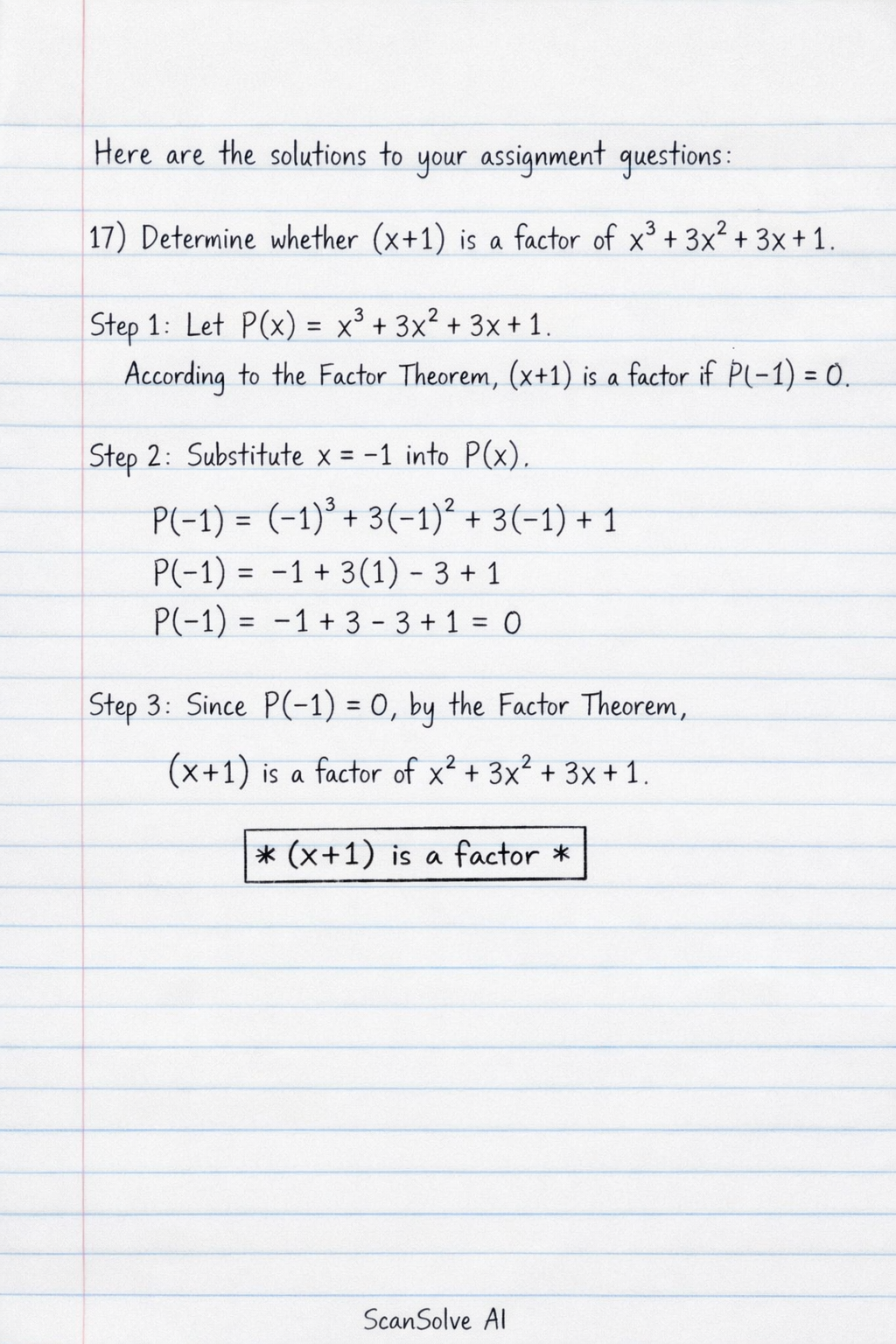
Handwritten Step-by-Step Solution
Get this as a handwritten image on WhatsApp — like a tutor wrote it for you.
Try on WhatsApp