
We read your photo as:
Given P(x) = bx3 − x2 + cx − b, if (x+1) and (x-2) are factors of P(x), find the values of b and c. Show that (x-4) is not a factor and find the remaining factor.
ScanSolve AI Answer
Answers
2 parts2x+1
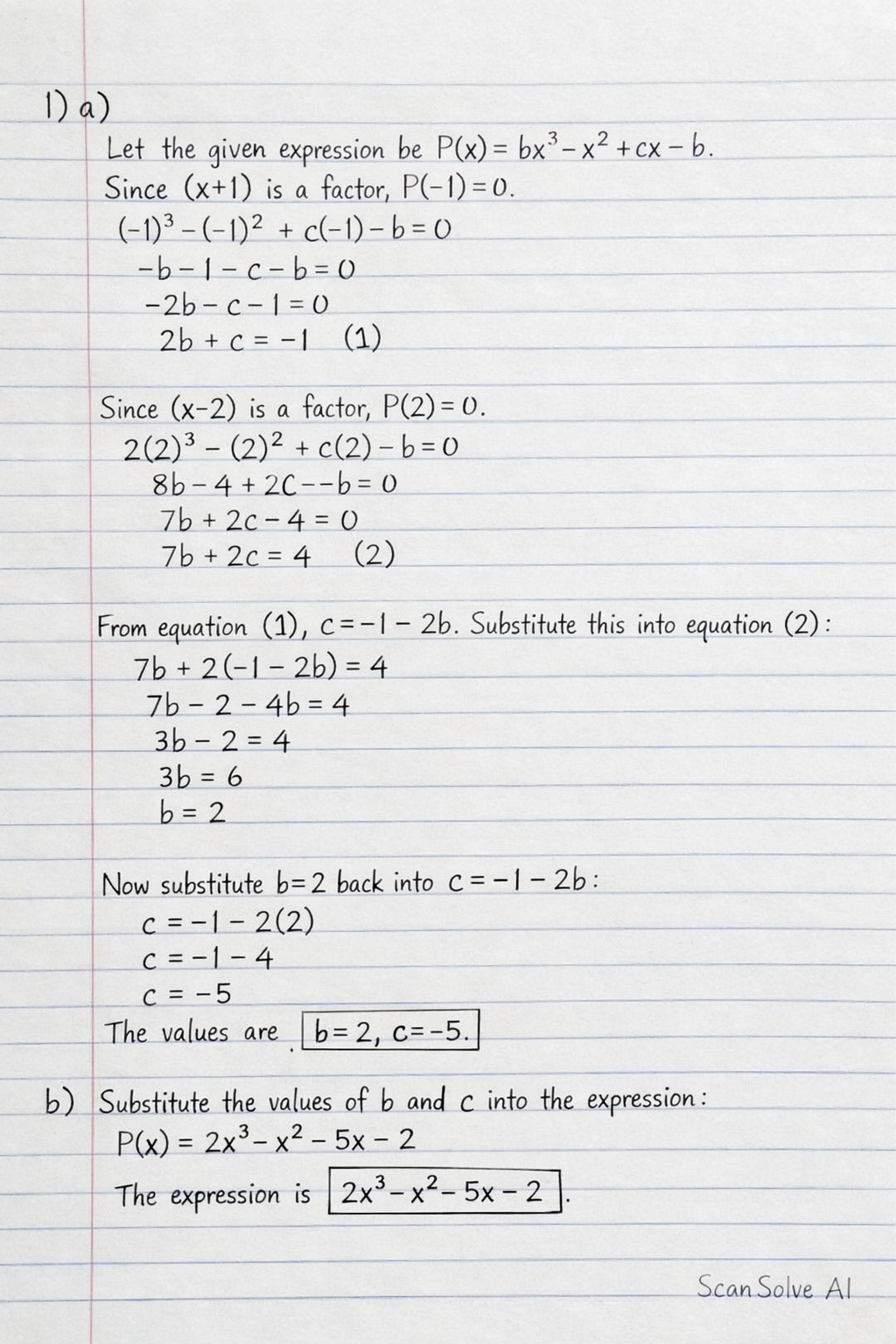
1) a)
Let the given expression be .
Since is a factor, .
Since is a factor, .
From equation (1), . Substitute this into equation (2):
Now substitute back into :
The values are .
b)
Substitute the values of and into the expression:
The expression is .
c)
To show that is not a factor, we evaluate . If , then is not a factor.
Since , is not a factor of the expression.
d)
We know that and are factors. Their product is:
Now, we divide by to find the remaining factor.
Using polynomial long division:
The remaining factor is .
To solve for when the expression is equated to zero:
Setting each factor to zero:
The remaining factor is and the values of are .
2)
Express in partial fractions.
First, factor the denominator: .
So, .
We set up the partial fraction decomposition:
Multiply both sides by :
To find , let :
To find , let :
Substitute the values of and back into the decomposition:
The partial fraction decomposition is .
Try one yourself
A new problem that tests the same skill.
Still stuck on this one?
Ask a follow-up, and the answer starts from this question.
More Mathematics Questions
Handwritten Step-by-Step Solution
Get this as a handwritten image on WhatsApp — like a tutor wrote it for you.
Try on WhatsApp