We read your photo as:

Will the manager approve the new tower location? Determine whether the communication links will be reliable? Determine whether the road lies within the secure zone? Determine whether the required signal transmission distance will be achieved?

Mathematics

ScanSolve AI Answer

Step-by-step solution

17 steps

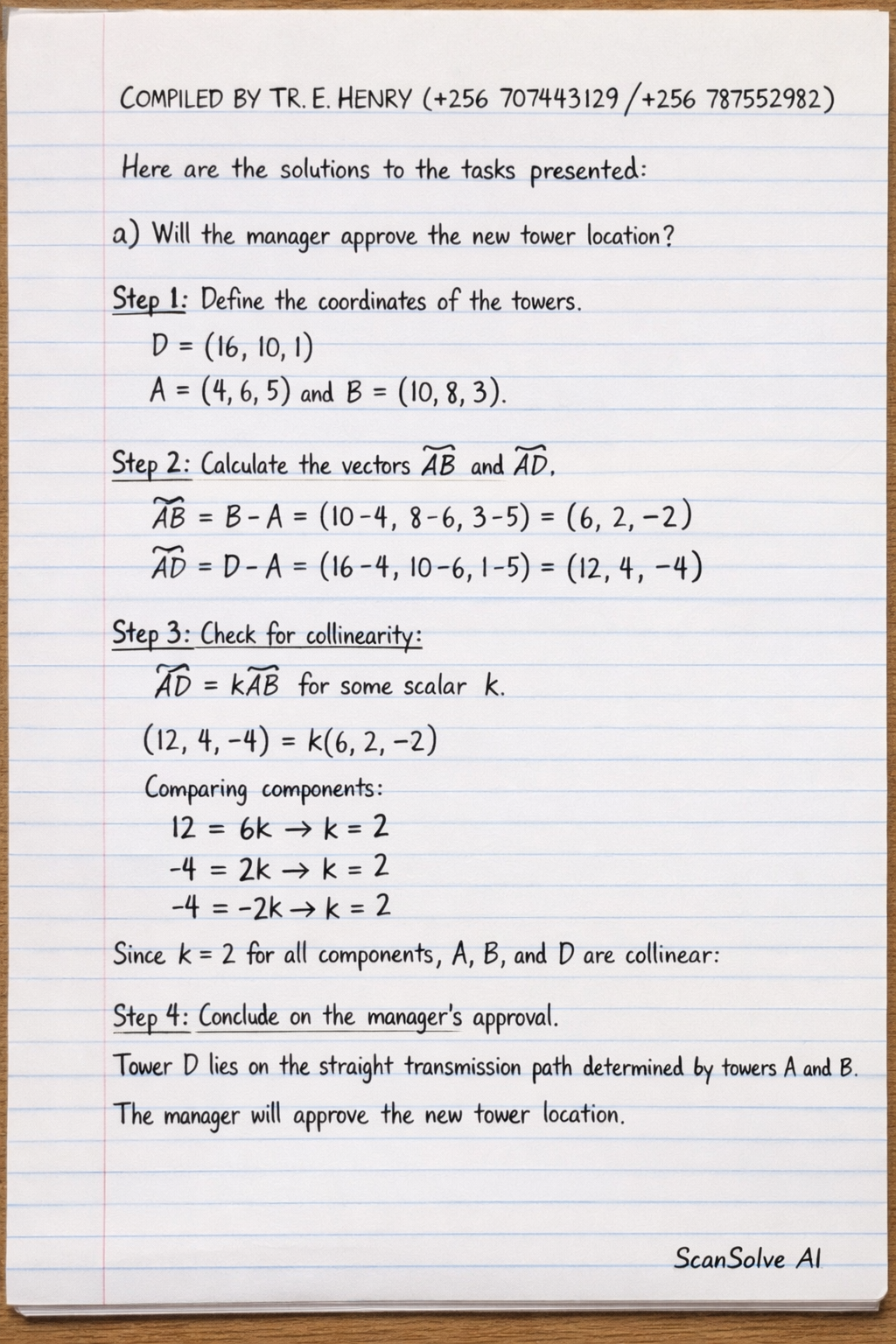
Here are the solutions to the tasks presented:

Part a· 4 steps

Will the manager approve the new tower location?

  1. Define the coordinates of the towers.

    The proposed new tower location is D=(16,10,1)D = (16, 10, 1). The existing towers are A=(4,6,5)A = (4, 6, 5) and B=(10,8,3)B = (10, 8, 3).

  2. Calculate the vectors AB⃗\vec{AB} and AD⃗\vec{AD}.

    AB⃗=B−A=(10−4,8−6,3−5)=(6,2,−2)\vec{AB} = B - A = (10-4, 8-6, 3-5) = (6, 2, -2) AD⃗=D−A=(16−4,10−6,1−5)=(12,4,−4)\vec{AD} = D - A = (16-4, 10-6, 1-5) = (12, 4, -4)
  3. Check for collinearity.

    For A, B, and D to be collinear, AD⃗\vec{AD} must be a scalar multiple of AB⃗\vec{AB}.
    We check if AD⃗=kAB⃗\vec{AD} = k \vec{AB} for some scalar kk.

    (12,4,−4)=k(6,2,−2)(12, 4, -4) = k(6, 2, -2)

    Comparing components:

    12=6k  ⟹  k=212 = 6k \implies k = 2 4=2k  ⟹  k=24 = 2k \implies k = 2 −4=−2k  ⟹  k=2-4 = -2k \implies k = 2

    Since k=2k=2 for all components, the vectors are parallel and share a common point A, meaning A, B, and D are collinear.

  4. Conclude on the manager's approval.

    Since tower D lies on the straight transmission path determined by towers A and B, the manager will approve its installation.
    The manager will approve the new tower location.

Part b· 6 steps

Determine whether the communication links will be reliable?

  1. Define the coordinates of the points.

    Control station E=(4,6,10)E = (4, 6, 10). Towers A=(4,6,5)A = (4, 6, 5), B=(10,8,3)B = (10, 8, 3), C=(6,12,1)C = (6, 12, 1).

  2. Find two vectors in the plane ABC.

    AB⃗=B−A=(10−4,8−6,3−5)=(6,2,−2)\vec{AB} = B - A = (10-4, 8-6, 3-5) = (6, 2, -2) AC⃗=C−A=(6−4,12−6,1−5)=(2,6,−4)\vec{AC} = C - A = (6-4, 12-6, 1-5) = (2, 6, -4)
  3. Find the normal vector to the plane.

    The normal vector n⃗\vec{n} is the cross product of AB⃗\vec{AB} and AC⃗\vec{AC}.

    n⃗=AB⃗×AC⃗=∣ijk62−226−4∣\vec{n} = \vec{AB} \times \vec{AC} = \begin{vmatrix} \mathbf{i} & \mathbf{j} & \mathbf{k} \\ 6 & 2 & -2 \\ 2 & 6 & -4 \end{vmatrix} n⃗=i((2)(−4)−(−2)(6))−j((6)(−4)−(−2)(2))+k((6)(6)−(2)(2))\vec{n} = \mathbf{i}((2)(-4) - (-2)(6)) - \mathbf{j}((6)(-4) - (-2)(2)) + \mathbf{k}((6)(6) - (2)(2)) n⃗=i(−8+12)−j(−24+4)+k(36−4)\vec{n} = \mathbf{i}(-8 + 12) - \mathbf{j}(-24 + 4) + \mathbf{k}(36 - 4) n⃗=4i+20j+32k\vec{n} = 4\mathbf{i} + 20\mathbf{j} + 32\mathbf{k}

    We can use a simpler normal vector by dividing by 4: n′⃗=(1,5,8)\vec{n'} = (1, 5, 8).

  4. Find the equation of the plane.

    Using point A(4,6,5)A(4, 6, 5) and the normal vector n′⃗=(1,5,8)\vec{n'} = (1, 5, 8):

    1(x−4)+5(y−6)+8(z−5)=01(x - 4) + 5(y - 6) + 8(z - 5) = 0 x−4+5y−30+8z−40=0x - 4 + 5y - 30 + 8z - 40 = 0 x+5y+8z−74=0x + 5y + 8z - 74 = 0
  5. Calculate the shortest distance from point E to the plane.

    The distance dd from point E(x0,y0,z0)=(4,6,10)E(x_0, y_0, z_0) = (4, 6, 10) to the plane Ax+By+Cz+D=0Ax + By + Cz + D = 0 is given by:

    d=∣Ax0+By0+Cz0+D∣A2+B2+C2d = \frac{|Ax_0 + By_0 + Cz_0 + D|}{\sqrt{A^2 + B^2 + C^2}}

    For the plane x+5y+8z−74=0x + 5y + 8z - 74 = 0, we have A=1,B=5,C=8,D=−74A=1, B=5, C=8, D=-74.

    d=∣1(4)+5(6)+8(10)−74∣12+52+82d = \frac{|1(4) + 5(6) + 8(10) - 74|}{\sqrt{1^2 + 5^2 + 8^2}} d=∣4+30+80−74∣1+25+64d = \frac{|4 + 30 + 80 - 74|}{\sqrt{1 + 25 + 64}} d=∣114−74∣90d = \frac{|114 - 74|}{\sqrt{90}} d=4090=40310=401030=4103 kmd = \frac{40}{\sqrt{90}} = \frac{40}{3\sqrt{10}} = \frac{40\sqrt{10}}{30} = \frac{4\sqrt{10}}{3} \text{ km}

    Numerically, d≈4.216 kmd \approx 4.216 \text{ km}.

  6. Assess the reliability of the communication links.

    The links are considered reliable if the distance is less than 8 km.
    Since 4.216 km<8 km4.216 \text{ km} < 8 \text{ km}, the communication links are reliable.
    The communication links will be reliable.

Part c· 3 steps

Determine whether the road lies within the secure zone?

  1. Define the coordinates of the points.

    The points defining the secure zone are P(18,6)P(18,6), Q(6,18)Q(6,18), and R(−6,6)R(-6,6). The road passes through point T(6,−6)T(6,-6).

  2. Find the equation of the circle passing through P, Q, and R.

    Let the equation of the circle be (x−h)2+(y−k)2=r2(x-h)^2 + (y-k)^2 = r^2.
    Substitute the coordinates of P, Q, and R into the equation:

    1. For P(18,6)P(18,6): (18−h)2+(6−k)2=r2(18-h)^2 + (6-k)^2 = r^2
    2. For Q(6,18)Q(6,18): (6−h)2+(18−k)2=r2(6-h)^2 + (18-k)^2 = r^2
    3. For R(−6,6)R(-6,6): (−6−h)2+(6−k)2=r2(-6-h)^2 + (6-k)^2 = r^2

    Equating (1) and (3):

    (18−h)2+(6−k)2=(−6−h)2+(6−k)2(18-h)^2 + (6-k)^2 = (-6-h)^2 + (6-k)^2 (18−h)2=(−6−h)2(18-h)^2 = (-6-h)^2 324−36h+h2=36+12h+h2324 - 36h + h^2 = 36 + 12h + h^2 288=48h  ⟹  h=6288 = 48h \implies h = 6

    Substitute h=6h=6 into (1) and (2):
    From (1): (18−6)2+(6−k)2=r2  ⟹  144+(6−k)2=r2(18-6)^2 + (6-k)^2 = r^2 \implies 144 + (6-k)^2 = r^2
    From (2): (6−6)2+(18−k)2=r2  ⟹  (18−k)2=r2(6-6)^2 + (18-k)^2 = r^2 \implies (18-k)^2 = r^2

    Equating these two expressions for r2r^2:

    144+(6−k)2=(18−k)2144 + (6-k)^2 = (18-k)^2 144+36−12k+k2=324−36k+k2144 + 36 - 12k + k^2 = 324 - 36k + k^2 180−12k=324−36k180 - 12k = 324 - 36k 24k=144  ⟹  k=624k = 144 \implies k = 6

    The center of the circle is (h,k)=(6,6)(h,k) = (6,6).
    Now, calculate r2r^2 using (18−k)2=r2(18-k)^2 = r^2:

    r2=(18−6)2=122=144r^2 = (18-6)^2 = 12^2 = 144

    The equation of the secure zone circle is (x−6)2+(y−6)2=144(x-6)^2 + (y-6)^2 = 144.

  3. Check if point T lies within the secure zone.

    Substitute the coordinates of T(6,−6)T(6,-6) into the circle equation:

    (6−6)2+(−6−6)2=02+(−12)2=0+144=144(6-6)^2 + (-6-6)^2 = 0^2 + (-12)^2 = 0 + 144 = 144

    Since the result 144 is equal to r2r^2, the point T lies on the boundary of the secure zone. Therefore, the road lies within the secure zone.
    The road lies within the secure zone.

Part d· 4 steps

Determine whether the required signal transmission distance will be achieved?

  1. Identify the signal transmission distance formula and requirement.

    The signal transmission distance is given by D=(30sin⁡2θ+40cos⁡2θ−2)D = (30 \sin 2\theta + 40 \cos 2\theta - 2) km.
    The engineers require a maximum transmission distance of at least 40 km.

  2. Find the maximum value of the transmission distance D.

    The expression 30sin⁡2θ+40cos⁡2θ30 \sin 2\theta + 40 \cos 2\theta can be written in the form Rsin⁡(2θ+α)R \sin(2\theta + \alpha), where R=A2+B2R = \sqrt{A^2 + B^2}.
    Here, A=30A=30 and B=40B=40.

    R=302+402=900+1600=2500=50R = \sqrt{30^2 + 40^2} = \sqrt{900 + 1600} = \sqrt{2500} = 50

    So, 30sin⁡2θ+40cos⁡2θ=50sin⁡(2θ+α)30 \sin 2\theta + 40 \cos 2\theta = 50 \sin(2\theta + \alpha).
    The maximum value of sin⁡(2θ+α)\sin(2\theta + \alpha) is 1.
    Therefore, the maximum value of 30sin⁡2θ+40cos⁡2θ30 \sin 2\theta + 40 \cos 2\theta is 50.

  3. Calculate the maximum transmission distance.

    Dmax=50−2=48 kmD_{max} = 50 - 2 = 48 \text{ km}
  4. Compare with the requirement.

    The required maximum transmission distance is at least 40 km.
    Since 48 km≥40 km48 \text{ km} \ge 40 \text{ km}, the required signal transmission distance will be achieved.
    The required signal transmission distance will be achieved.

    3 zimekamilika, zimebaki 2 leo. Unapiga hatua.

Was this helpful?

Still stuck on this one?

Ask a follow-up, and the answer starts from this question.

Got a different question?Ask your own question
Handwritten step-by-step solution preview

Handwritten Step-by-Step Solution

Get this as a handwritten image on WhatsApp — like a tutor wrote it for you.

Try on WhatsApp