
We read your photo as:
Identify the structures in Figure 25 and 26, explain the purpose of the cables in Figure 25, and compare the two structures. What is attached to them, and what shapes are formed? Why was the tower in
ScanSolve AI Answer
here are the answers to your homework questions:
Question 1
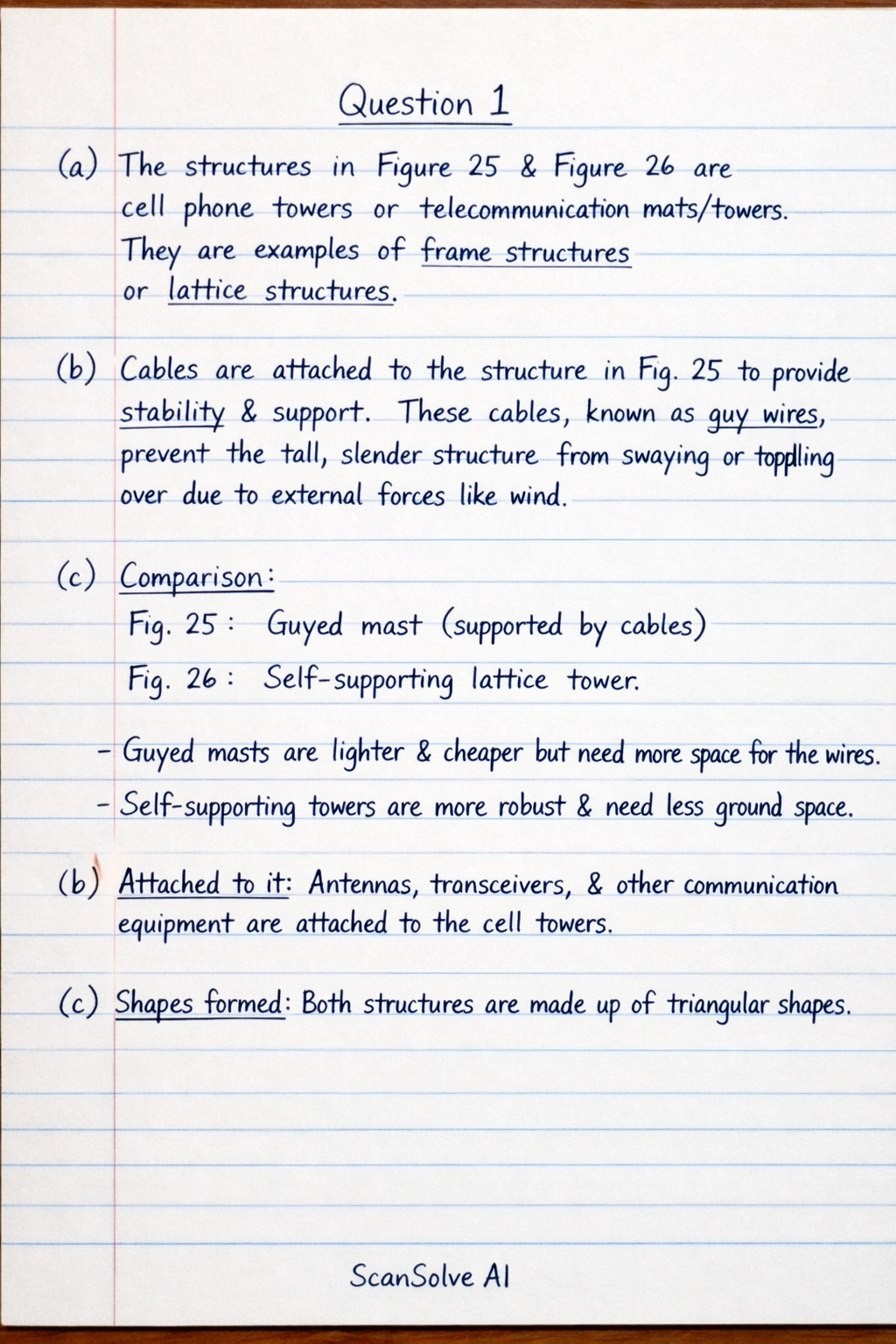
a) The structures shown in Figure 25 and Figure 26 are cell phone towers or telecommunication masts/towers. They are examples of frame structures or lattice structures.
b) Cables are attached to the structure in Figure 25 to provide stability and support. These cables, known as guy wires, prevent the tall, slender structure from swaying or toppling over due to external forces like wind.
c)
- Comparison: Figure 25 likely shows a guyed mast (supported by cables), while Figure 26 shows a self-supporting lattice tower. Guyed masts are generally lighter and cheaper for very tall structures but require a larger footprint for the guy wires. Self-supporting towers are more robust and require less ground space.
- Attached to it: Antennas, transceivers, and other electronic communication equipment are attached to the cell phone towers.
- Shapes formed: The members of both structures are joined to form triangular shapes.
Question 2
a) The cell phone tower in Figure 26 was constructed on top of a building primarily to achieve greater height for optimal signal coverage and range, especially in urban areas where ground space is limited or expensive.
b) It was painted the same colour as the building to help it blend in with its surroundings. This reduces its visual impact and makes it less conspicuous, often for aesthetic reasons or to comply with local regulations.
c) To blend the cell phone tower in Figure 25 (likely a standalone tower) with its surroundings, one could use camouflage techniques. This might involve painting it to match the sky or natural landscape (e.g., green or brown to resemble trees), or disguising it as a tree (e.g., a monopine or monopalm).
Question 3
a)
- When you push at the sides of a square shape, it will deform and change into a parallelogram.
- When you pull at the sides of a square shape, it will also deform or become slightly more rigid depending on the joints, but it is not inherently stable against shear forces.
- In contrast, when you push or pull at the sides of a triangular shape, it retains its shape and does not deform, demonstrating its rigidity.
b) When pushing at the sides, compression and shear forces are applied. When pulling, tension and shear forces are applied.
c) To modify a square shape so that it becomes more stable, you can add a diagonal brace (a member running from one corner to the opposite corner). This divides the square into two triangles, making the overall structure rigid and stable.
Still stuck on this one?
Ask a follow-up, and the answer starts from this question.
More Physics Questions
Handwritten Step-by-Step Solution
Get this as a handwritten image on WhatsApp — like a tutor wrote it for you.
Try on WhatsApp