
We read your photo as:
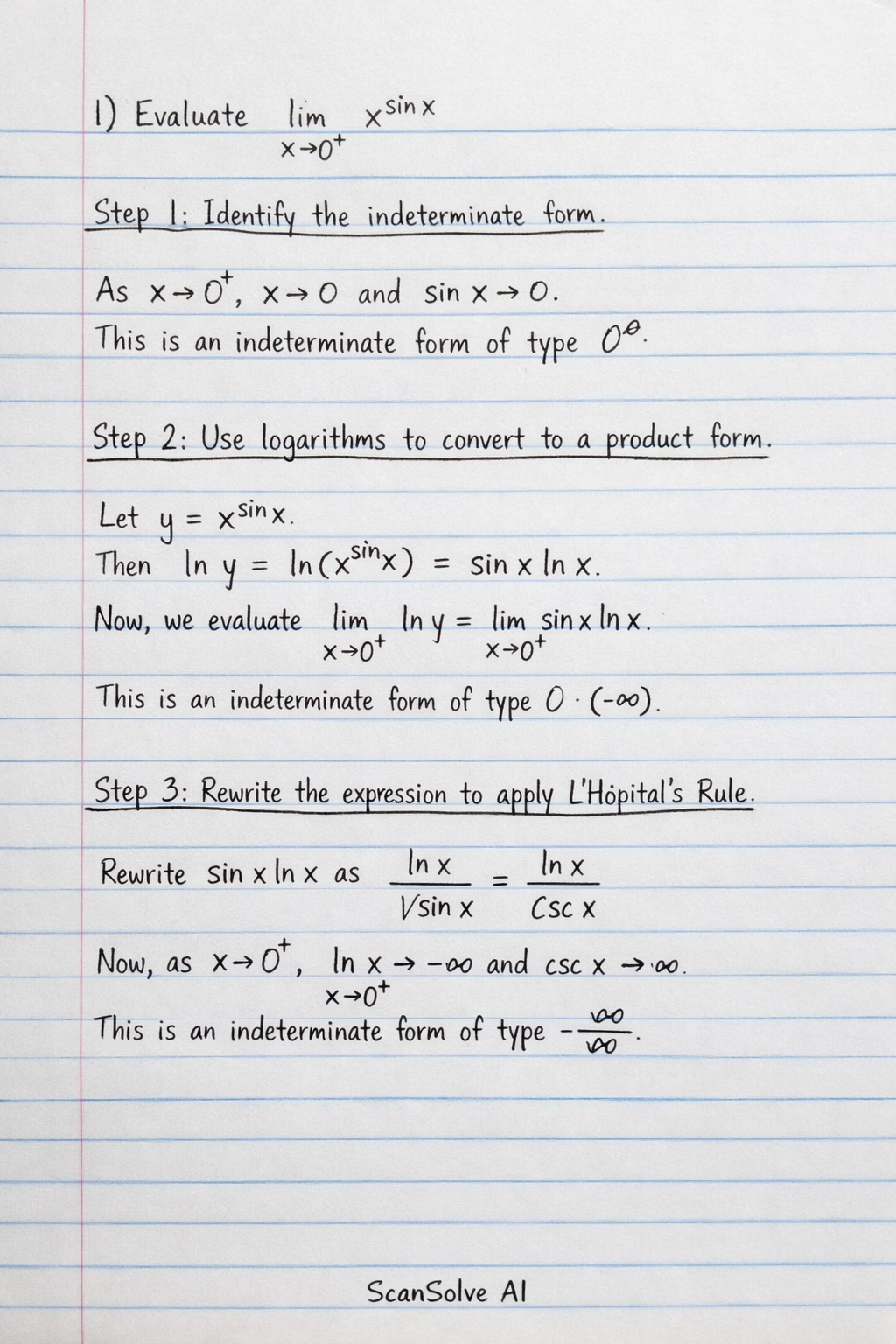
Evaluate _x 0^+ x^ x
ScanSolve AI Answer
Answer
Step-by-step solution
16 stepsHere are the evaluations for the given limits:
1) Evaluate
Identify the indeterminate form.
As , and . This is an indeterminate form of type .
Use logarithms to convert to a product form.
Let . Then .
Now, we evaluate .
This is an indeterminate form of type .Rewrite the expression to apply L'Hôpital's Rule.
Rewrite as .
Now, as , and . This is an indeterminate form of type .Apply L'Hôpital's Rule.
We can rewrite this as:
Evaluate the limit.
We know that and .
So, .Find the original limit.
Since , then .
The limit is .
2) Evaluate
Identify the indeterminate form.
As , and . This is an indeterminate form of type .
Use the standard limit definition of .
Recall the definition: .
Let . As , .
Substitute into the expression:Manipulate the exponent to match the definition of .
Evaluate the limit.
Using the property of limits for powers:
The limit is .
3) Evaluate
Identify the indeterminate form.
As , and , so . This is an indeterminate form of type .
Use logarithms to convert to a product form.
Let . Then .
Now, we evaluate .
As , and . This is an indeterminate form of type .Apply L'Hôpital's Rule.
Simplify the expression.
Evaluate the limit by dividing by the highest power of in the denominator.
Divide the numerator and denominator by :
As , .
So, .
Find the original limit.
Since , then .
The limit is .
Try one yourself
A new problem that tests the same skill.
Still stuck on this one?
Ask a follow-up, and the answer starts from this question.
More Mathematics Questions
Handwritten Step-by-Step Solution
Get this as a handwritten image on WhatsApp — like a tutor wrote it for you.
Try on WhatsApp