X follows geo 2/3 Find p x greater than 3 Find p x greater than 6/ p x greater 2

Mathematics

ScanSolve AI Answer

Answers

2 parts
a

127\frac{1}{27}

b

181\frac{1}{81}

Step-by-step solution

5 steps

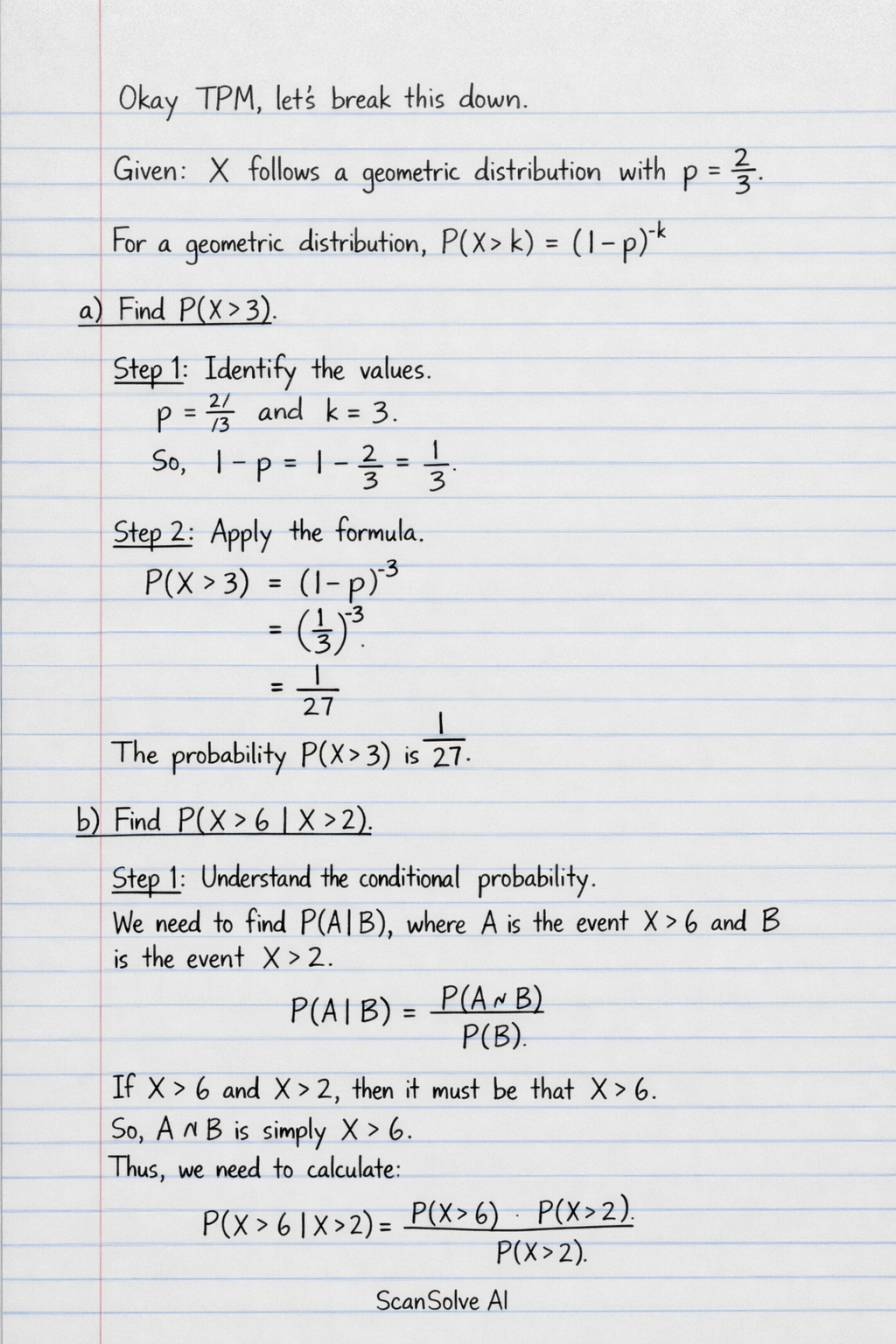
Okay ####PM, let's break this down.

Given that XX follows a geometric distribution with parameter p=23p = \frac{2}{3}.
For a geometric distribution (number of trials until the first success), the probability P(X>k)P(X > k) is given by:

P(X>k)=(1−p)kP(X > k) = (1-p)^k

Part a· 2 steps

Find P(X>3)P(X > 3)

  1. Identify the values.

    Here, p=23p = \frac{2}{3} and k=3k = 3.
    So, 1−p=1−23=131-p = 1 - \frac{2}{3} = \frac{1}{3}.

  2. Apply the formula.

    P(X>3)=(1−p)3=(13)3P(X > 3) = (1-p)^3 = \left(\frac{1}{3}\right)^3 P(X>3)=1333=127P(X > 3) = \frac{1^3}{3^3} = \frac{1}{27}

    The probability P(X>3)P(X > 3) is 127\boxed{\frac{1}{27}}.

Part b

181\frac{1}{81}

Find P(X>6∣X>2)P(X > 6 \mid X > 2)

  1. Understand the conditional probability.

    We need to find P(A∣B)P(A \mid B), where AA is the event X>6X > 6 and BB is the event X>2X > 2.
    The formula for conditional probability is P(A∣B)=P(A∩B)P(B)P(A \mid B) = \frac{P(A \cap B)}{P(B)}.
    If X>6X > 6 and X>2X > 2, then it must be that X>6X > 6. So, A∩BA \cap B is simply X>6X > 6.
    Thus, we need to calculate:

    P(X>6∣X>2)=P(X>6)P(X>2)P(X > 6 \mid X > 2) = \frac{P(X > 6)}{P(X > 2)}
  2. Calculate P(X>6)P(X > 6) and P(X>2)P(X > 2).

    Using the formula P(X>k)=(1−p)kP(X > k) = (1-p)^k with 1−p=131-p = \frac{1}{3}:

    P(X>6)=(13)6P(X > 6) = \left(\frac{1}{3}\right)^6 P(X>2)=(13)2P(X > 2) = \left(\frac{1}{3}\right)^2
  3. Substitute and simplify.

    P(X>6∣X>2)=(13)6(13)2P(X > 6 \mid X > 2) = \frac{\left(\frac{1}{3}\right)^6}{\left(\frac{1}{3}\right)^2}

    Using exponent rules (am/an=am−na^m / a^n = a^{m-n}):

    P(X>6∣X>2)=(13)6−2=(13)4P(X > 6 \mid X > 2) = \left(\frac{1}{3}\right)^{6-2} = \left(\frac{1}{3}\right)^4 P(X>6∣X>2)=1434=181P(X > 6 \mid X > 2) = \frac{1^4}{3^4} = \frac{1}{81}

    Alternatively, using the memoryless property of the geometric distribution, P(X>a+b∣X>a)=P(X>b)P(X > a+b \mid X > a) = P(X > b).
    Here, a=2a=2 and a+b=6a+b=6, so b=4b=4.

    P(X>6∣X>2)=P(X>4)=(13)4=181P(X > 6 \mid X > 2) = P(X > 4) = \left(\frac{1}{3}\right)^4 = \frac{1}{81}

    The probability P(X>6∣X>2)P(X > 6 \mid X > 2) is 181\boxed{\frac{1}{81}}.

Was this helpful?

Try one yourself

A new problem that tests the same skill.

Still stuck on this one?

Ask a follow-up, and the answer starts from this question.

Got a different question?Ask your own question
Handwritten step-by-step solution preview

Handwritten Step-by-Step Solution

Get this as a handwritten image on WhatsApp — like a tutor wrote it for you.

Try on WhatsApp