We read your photo as:

y = (t2 sin t) / (cos t). 2) If y = (t2 sin t) / (cos t) show that t2(d2y/dt2) + 4t(dy/dt) − (t2+6)y = 0. 3) If y = tⁿ show that dy/dt = nt^(n-1).

Mathematics

ScanSolve AI Answer

Step-by-step solution

8 steps

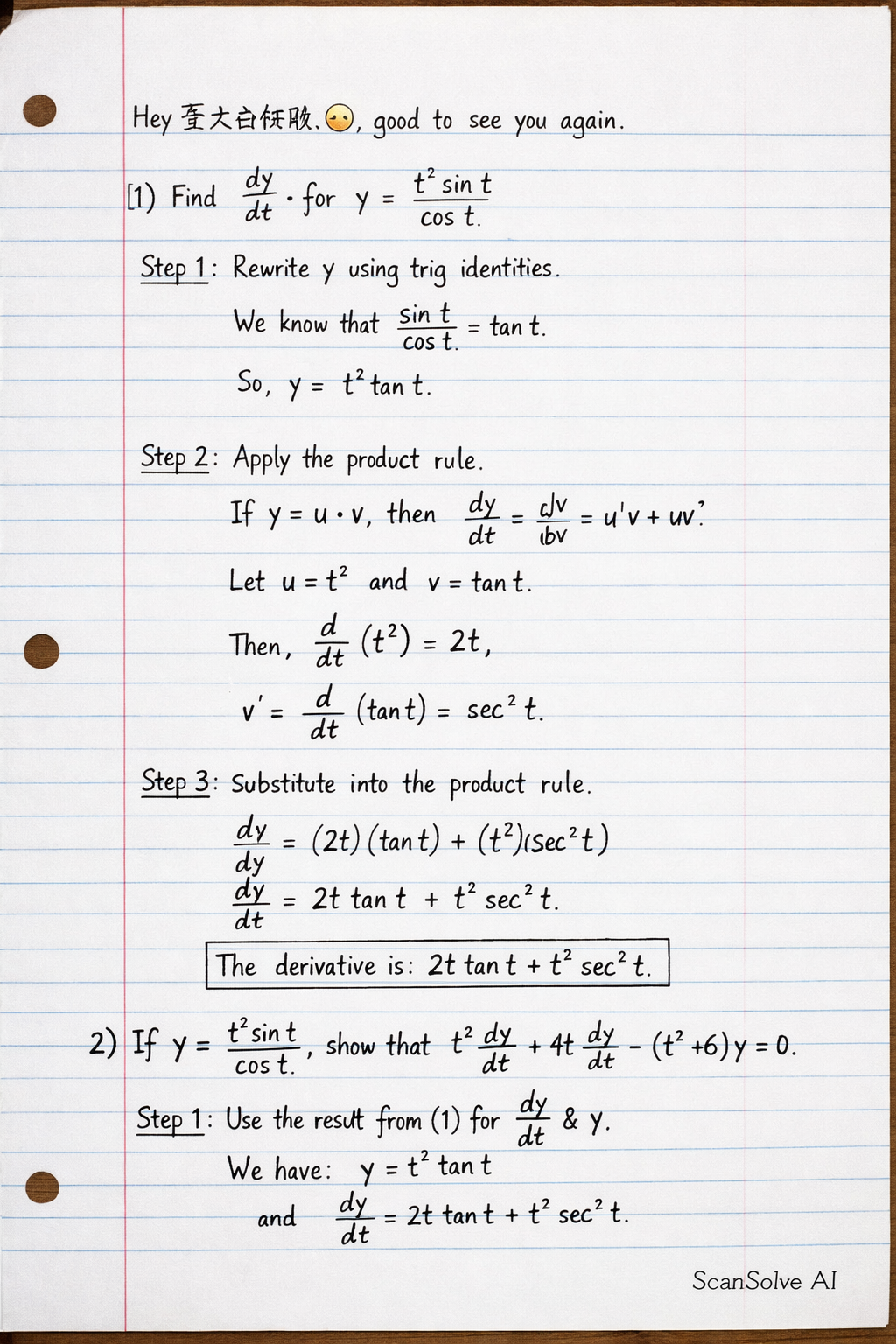
1) Find dydt\frac{dy}{dt} for y=t2sin⁡tcos⁡ty = \frac{t^2 \sin t}{\cos t}

  1. Rewrite the expression for yy using trigonometric identities.

    We know that sin⁡tcos⁡t=tan⁡t\frac{\sin t}{\cos t} = \tan t.
    So, we can write yy as:

    y=t2tan⁡ty = t^2 \tan t
  2. Apply the product rule for differentiation.

    The product rule states that if y=u⋅vy = u \cdot v, then dydt=u′v+uv′\frac{dy}{dt} = u'v + uv'.
    Let u=t2u = t^2 and v=tan⁡tv = \tan t.
    Then, u′=ddt(t2)=2tu' = \frac{d}{dt}(t^2) = 2t.
    And v′=ddt(tan⁡t)=sec⁡2tv' = \frac{d}{dt}(\tan t) = \sec^2 t.

  3. Substitute $u, v, u', v'$ into the product rule formula.

    dydt=(2t)(tan⁡t)+(t2)(sec⁡2t)\frac{dy}{dt} = (2t)(\tan t) + (t^2)(\sec^2 t) dydt=2ttan⁡t+t2sec⁡2t\frac{dy}{dt} = 2t \tan t + t^2 \sec^2 t

    The derivative is 2ttan⁡t+t2sec⁡2t\boxed{2t \tan t + t^2 \sec^2 t}.

    2) If y=t2sin⁡tcos⁡ty = \frac{t^2 \sin t}{\cos t}, show that t2d2ydt2+4tdydt−(t2+6)y=0t^2 \frac{d^2y}{dt^2} + 4t \frac{dy}{dt} - (t^2+6)y = 0.

  4. Use the result from for dydt\frac{dy}{dt} and the expression for yy.

    We have y=t2tan⁡ty = t^2 \tan t and dydt=2ttan⁡t+t2sec⁡2t\frac{dy}{dt} = 2t \tan t + t^2 \sec^2 t.

  5. Find the second derivative, d2ydt2\frac{d^2y}{dt^2}.

    We need to differentiate dydt\frac{dy}{dt} with respect to tt:

    d2ydt2=ddt(2ttan⁡t+t2sec⁡2t)\frac{d^2y}{dt^2} = \frac{d}{dt}(2t \tan t + t^2 \sec^2 t)

    Differentiate 2ttan⁡t2t \tan t using the product rule:
    ddt(2ttan⁡t)=(2)(tan⁡t)+(2t)(sec⁡2t)=2tan⁡t+2tsec⁡2t\frac{d}{dt}(2t \tan t) = (2)(\tan t) + (2t)(\sec^2 t) = 2 \tan t + 2t \sec^2 t.
    Differentiate t2sec⁡2tt^2 \sec^2 t using the product rule and chain rule:
    ddt(t2sec⁡2t)=(2t)(sec⁡2t)+(t2)(2sec⁡t⋅sec⁡ttan⁡t)=2tsec⁡2t+2t2sec⁡2ttan⁡t\frac{d}{dt}(t^2 \sec^2 t) = (2t)(\sec^2 t) + (t^2)(2 \sec t \cdot \sec t \tan t) = 2t \sec^2 t + 2t^2 \sec^2 t \tan t.
    Combine these two results for d2ydt2\frac{d^2y}{dt^2}:

    d2ydt2=(2tan⁡t+2tsec⁡2t)+(2tsec⁡2t+2t2sec⁡2ttan⁡t)\frac{d^2y}{dt^2} = (2 \tan t + 2t \sec^2 t) + (2t \sec^2 t + 2t^2 \sec^2 t \tan t) d2ydt2=2tan⁡t+4tsec⁡2t+2t2sec⁡2ttan⁡t\frac{d^2y}{dt^2} = 2 \tan t + 4t \sec^2 t + 2t^2 \sec^2 t \tan t
  6. Substitute yy, dydt\frac{dy}{dt}, and d2ydt2\frac{d^2y}{dt^2} into the left-hand side of the given equation.

    The left-hand side (LHS) is t2d2ydt2+4tdydt−(t2+6)yt^2 \frac{d^2y}{dt^2} + 4t \frac{dy}{dt} - (t^2+6)y.
    Substitute the expressions:

    LHS=t2(2tan⁡t+4tsec⁡2t+2t2sec⁡2ttan⁡t)\text{LHS} = t^2 (2 \tan t + 4t \sec^2 t + 2t^2 \sec^2 t \tan t) +4t(2ttan⁡t+t2sec⁡2t)+ 4t (2t \tan t + t^2 \sec^2 t) −(t2+6)(t2tan⁡t)- (t^2+6)(t^2 \tan t)
  7. Expand and simplify the expression.

    Expand each term:
    t2d2ydt2=2t2tan⁡t+4t3sec⁡2t+2t4sec⁡2ttan⁡tt^2 \frac{d^2y}{dt^2} = 2t^2 \tan t + 4t^3 \sec^2 t + 2t^4 \sec^2 t \tan t
    4tdydt=8t2tan⁡t+4t3sec⁡2t4t \frac{dy}{dt} = 8t^2 \tan t + 4t^3 \sec^2 t
    −(t2+6)y=−t4tan⁡t−6t2tan⁡t-(t^2+6)y = -t^4 \tan t - 6t^2 \tan t

    Now, sum these expanded terms:

    LHS=(2t2tan⁡t+4t3sec⁡2t+2t4sec⁡2ttan⁡t)\text{LHS} = (2t^2 \tan t + 4t^3 \sec^2 t + 2t^4 \sec^2 t \tan t) +(8t2tan⁡t+4t3sec⁡2t)+ (8t^2 \tan t + 4t^3 \sec^2 t) +(−t4tan⁡t−6t2tan⁡t)+ (-t^4 \tan t - 6t^2 \tan t)

    Group terms by tan⁡t\tan t:
    (2t2+8t2−6t2−t4)tan⁡t=(4t2−t4)tan⁡t(2t^2 + 8t^2 - 6t^2 - t^4) \tan t = (4t^2 - t^4) \tan t
    Group terms by sec⁡2t\sec^2 t:
    (4t3+4t3)sec⁡2t=8t3sec⁡2t(4t^3 + 4t^3) \sec^2 t = 8t^3 \sec^2 t
    Group terms by sec⁡2ttan⁡t\sec^2 t \tan t:
    2t4sec⁡2ttan⁡t2t^4 \sec^2 t \tan t

    Combining these, the LHS simplifies to:

    LHS=(4t2−t4)tan⁡t+8t3sec⁡2t+2t4sec⁡2ttan⁡t\text{LHS} = (4t^2 - t^4) \tan t + 8t^3 \sec^2 t + 2t^4 \sec^2 t \tan t

    This expression does not simplify to 0. It is possible there is a typo in the question.

    3) If y=tny = t^n show that dydt=ntn−1\frac{dy}{dt} = nt^{n-1}.

  8. Apply the power rule for differentiation.

    The power rule states that if y=tny = t^n, then dydt=ntn−1\frac{dy}{dt} = n t^{n-1}.
    Given y=tny = t^n.

    dydt=ntn−1\frac{dy}{dt} = n t^{n-1}

    This is a direct application of the power rule.
    The derivative is ntn−1\boxed{nt^{n-1}}.

Was this helpful?

Still stuck on this one?

Ask a follow-up, and the answer starts from this question.

Got a different question?Ask your own question
Handwritten step-by-step solution preview

Handwritten Step-by-Step Solution

Get this as a handwritten image on WhatsApp — like a tutor wrote it for you.

Try on WhatsApp