How do you divide a triangle into ⅙

Mathematics

ScanSolve AI Answer

Answer

they will all have equal areas

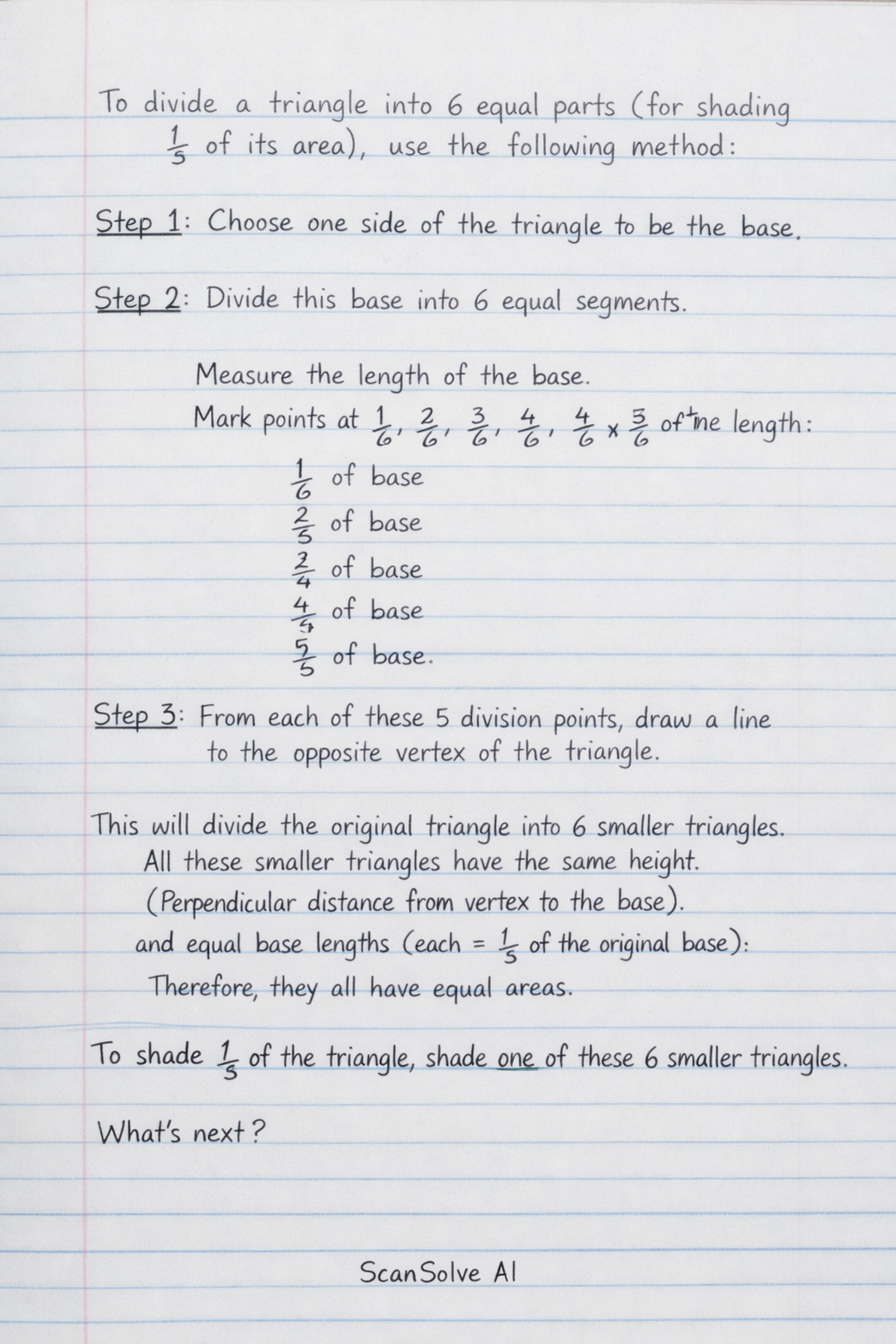
To divide a triangle into 6 equal parts (specifically for shading 16\frac{1}{6} of its area), you can use the following method:

Step 1: Choose one side of the triangle to be the base. Step 2: Divide this base into 6 equal segments. You can do this by measuring the length of the base and marking points at 16\frac{1}{6}, 26\frac{2}{6}, 36\frac{3}{6}, 46\frac{4}{6}, and 56\frac{5}{6} of its length from one end. Step 3: From each of these 5 division points on the base, draw a straight line to the opposite vertex of the triangle.

This will divide the original triangle into 6 smaller triangles. All these smaller triangles will have the same height (the perpendicular distance from the opposite vertex to the chosen base) and equal base lengths (each being 16\frac{1}{6} of the original base). Therefore, they will all have equal areas.

To shade 16\frac{1}{6} of the triangle, you would then shade one of these 6 smaller triangles.

What's next?

Was this helpful?

Need help with your own homework?

Get instant step-by-step solutions to any question. Free to start.

Ask Your Question
Handwritten step-by-step solution preview

Handwritten Step-by-Step Solution

Get this as a handwritten image on WhatsApp — like a tutor wrote it for you.

Try on WhatsApp

Still have questions?

Quick Answer

To divide a triangle into 6 equal parts (specifically for shading (1)/(6) of its area), you can use the following method: Step 1: Choose one side of the triangle to be the base.

How do you divide a triangle into ⅙
Mathematics

This mathematics problem involves applying core mathematical principles and formulas. Below you will find a complete step-by-step solution with detailed explanations for each step, helping you understand not just the answer but the method behind it.

ScanSolve AI Answer
To divide a triangle into 6 equal parts (specifically for shading (1)/(6) of its area), you can use the following method: Step 1: Choose one side of the triangle to be the base. Step 2: Divide this base into 6 equal segments. You can do this by measuring the length of the base and marking points at (1)/(6), (2)/(6), (3)/(6), (4)/(6), and (5)/(6) of its length from one end. Step 3: From each of these 5 division points on the base, draw a straight line to the opposite vertex of the triangle. This will divide the original triangle into 6 smaller triangles. All these smaller triangles will have the same height (the perpendicular distance from the opposite vertex to the chosen base) and equal base lengths (each being (1)/(6) of the original base). Therefore, they will all have equal areas. To shade (1)/(6) of the triangle, you would then shade one of these 6 smaller triangles. What's next?