
We read your photo as:
How do you find the value of n, given the equation ^ (n+1)C(n−1) = rac16 [^(n+1)P(n-1)]?
Mathematics
ScanSolve AI Answer
Answer
4
Step-by-step solution
4 stepshere's how to find the value of .
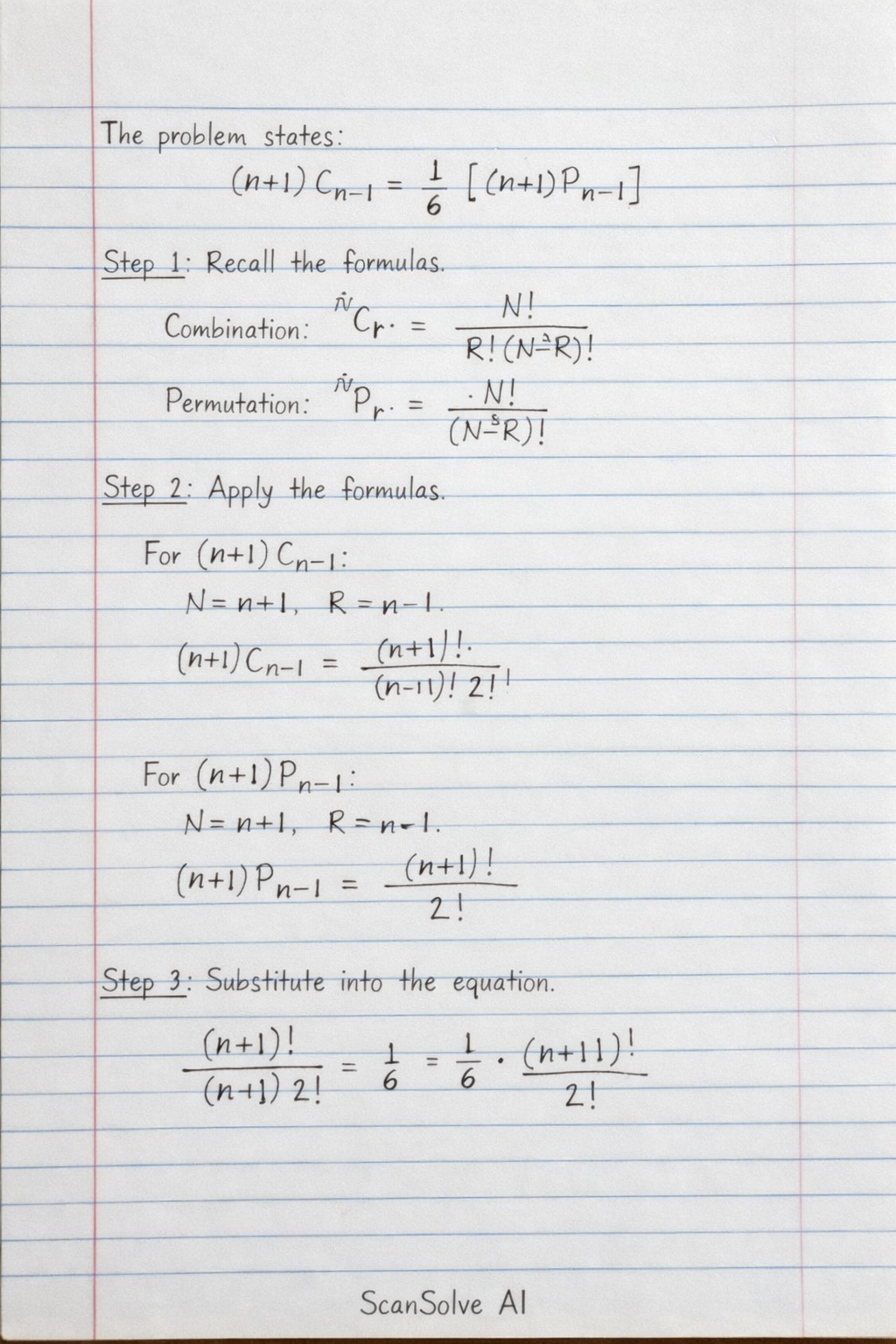
The problem states:
Recall the formulas for combinations and permutations.
The formula for combinations is .
The formula for permutations is .Apply the formulas to the given terms.
For :
Here, and .For :
Here, and .Substitute these expressions back into the original equation.
Simplify the equation to solve for .
We can cancel out the common term from both sides of the equation, assuming and .
This implies:
We know that .
So, we can write:Equating the arguments of the factorial:
The value of is .
Was this helpful?
Try one yourself
A new problem that tests the same skill.
Still stuck on this one?
Ask a follow-up, and the answer starts from this question.
Got a different question?Ask your own question
More Mathematics Questions
Handwritten Step-by-Step Solution
Get this as a handwritten image on WhatsApp — like a tutor wrote it for you.
Try on WhatsApp