
We read your photo as:
When 1,2 kg of this gas is heated from 15°C to 210°C at constant pressure, the heat required is 160 kJ. If the characteristic gas constant is R = 0,242 kJ/kg.K, determine the:
ScanSolve AI Answer
Answers
2 partsStep-by-step solution
5 stepsHere are the solutions to the problems:
10. Determine the value of the index of expansion .
Step 1: Write down the given values and the polytropic process equation.
The process follows the law .
Given:
Step 2: Rearrange the equation to solve for .
Taking the natural logarithm of both sides:
Step 3: Substitute the given values and calculate .
The value of the index of expansion is .
11. Calculate the value of the characteristic gas constant .
Step 1: Convert temperature to Kelvin and pressure to Pascals.
Given:
Step 2: Use the ideal gas law in terms of density to find .
The ideal gas law is .
Rearrange to solve for :
Step 3: Substitute the values and calculate .
Converting to :
The characteristic gas constant is .
12. Determine the specific heat capacities.
Given:
(at constant pressure)
Part 12.1· 3 steps
Specific heat capacity of the gas at constant pressure ().
Calculate the change in temperature ().
Use the formula for heat transfer at constant pressure to find .
Rearrange to solve for :
Substitute the values and calculate .
The specific heat capacity at constant pressure is .
Part 12.2
Specific heat capacity of the gas at constant volume ().
Use Mayer's relation, which connects , , and .
Rearrange to solve for :
Substitute the calculated from 12.1 and the given .
The specific heat capacity at constant volume is .
Try one yourself
A new problem that tests the same skill.
Still stuck on this one?
Ask a follow-up, and the answer starts from this question.
More Physics Questions
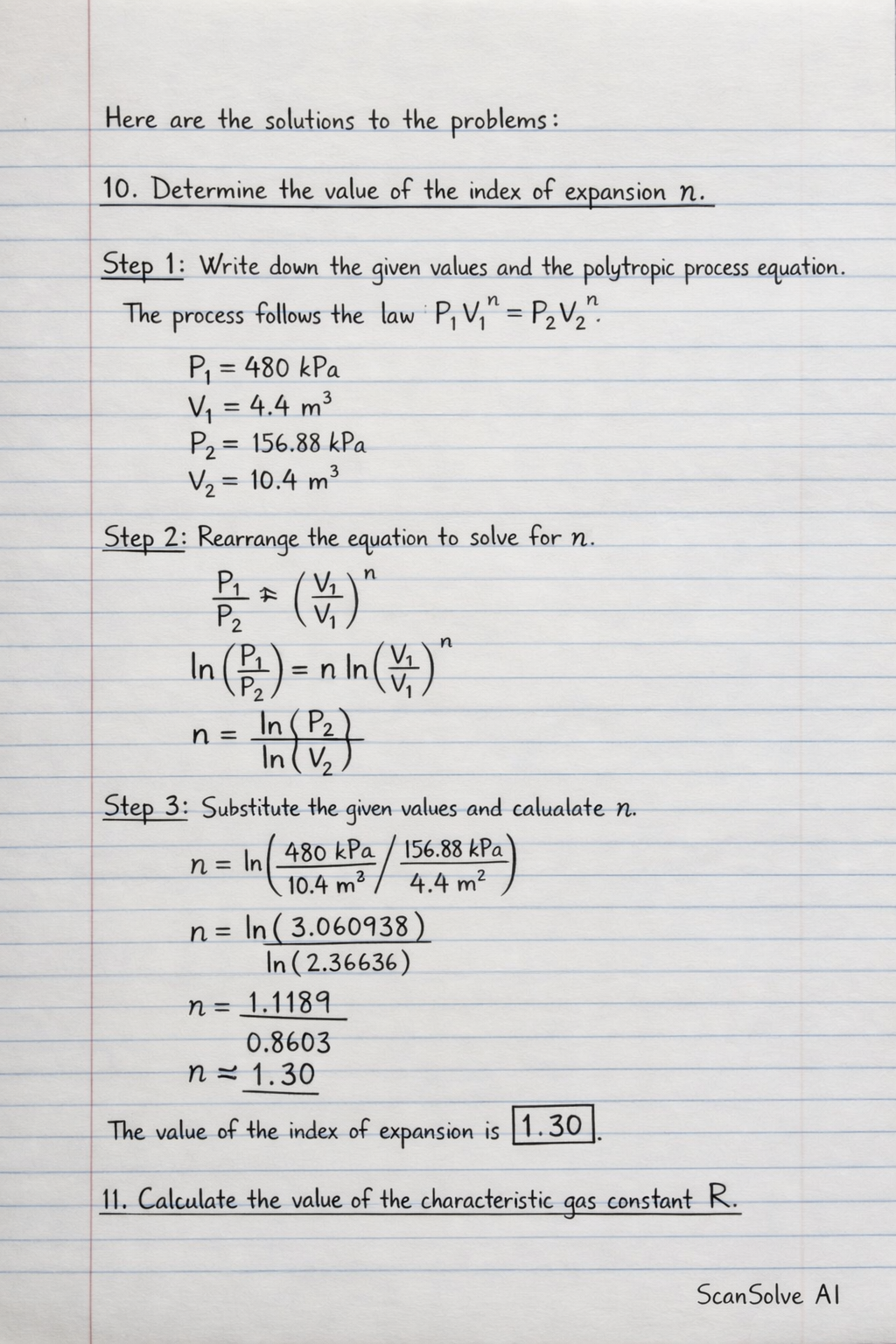
Handwritten Step-by-Step Solution
Get this as a handwritten image on WhatsApp — like a tutor wrote it for you.
Try on WhatsApp