
We read your photo as:
1 A certain mass is attached to a mass of 0.500kg. If it has a spring constant of 25.0 N/m and oscillation has an amplitude 0.15m. Calculate (a) Total energy (b)Find the potential and kinetic energy equations with respect to time
ScanSolve AI Answer
Answers
2 partsStep-by-step solution
5 stepsHere's how to solve the problem:
Part a· 2 steps
Total energy
The total energy in a simple harmonic oscillator is given by the formula , where is the spring constant and is the amplitude.
Given and .
Substitute the values into the formula and calculate the total energy.
The total energy is .
Part b
Potential and kinetic energy equations with respect to time
First, calculate the angular frequency using the formula .
Given and .
The potential energy of a simple harmonic oscillator is given by .
Assuming the oscillation starts at maximum displacement (), the potential energy equation is:
Substitute the values for , , and :
The kinetic energy of a simple harmonic oscillator is given by .
Using , this simplifies to:
Substitute the values for , , and :
Still stuck on this one?
Ask a follow-up, and the answer starts from this question.
More Physics Questions
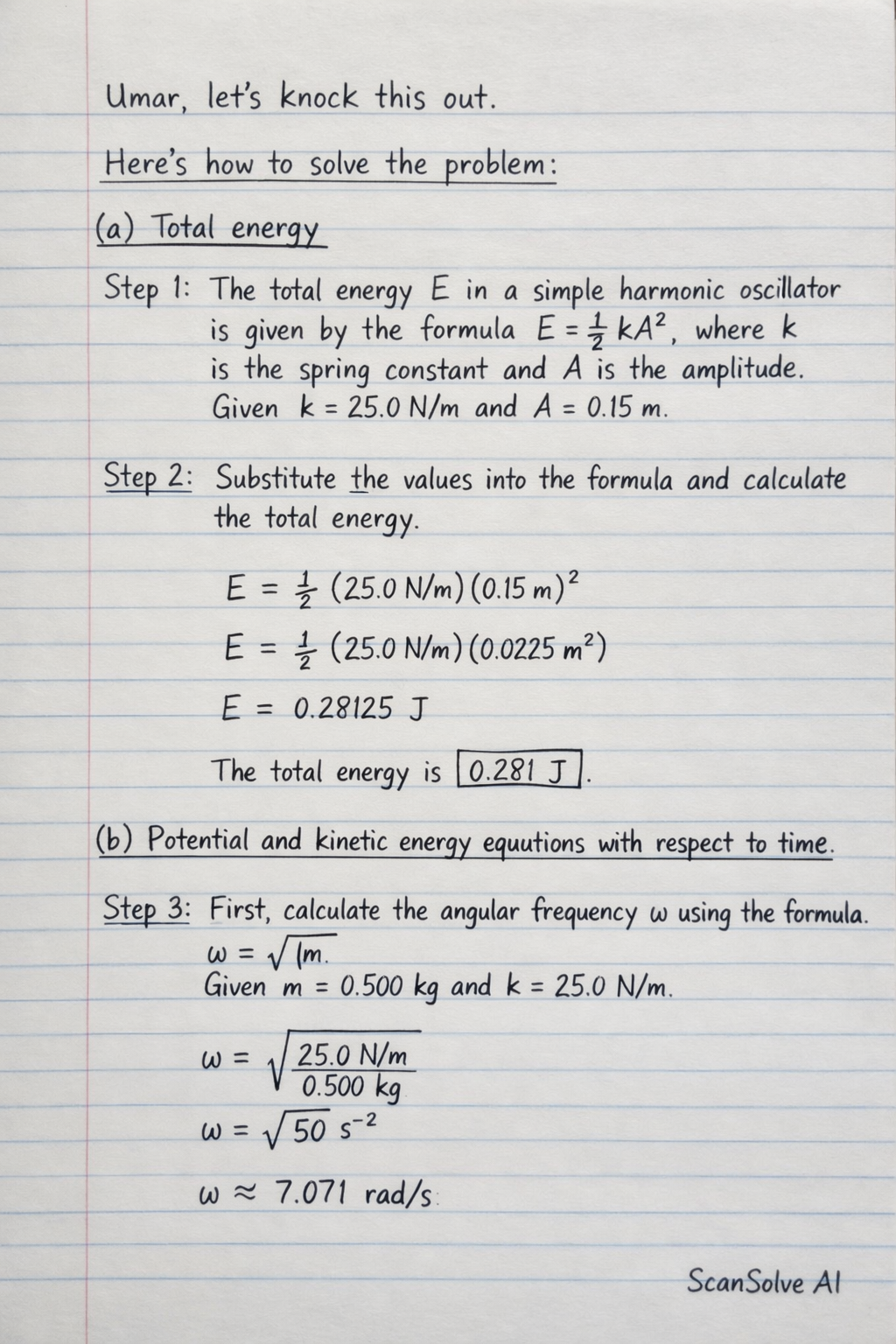
Handwritten Step-by-Step Solution
Get this as a handwritten image on WhatsApp — like a tutor wrote it for you.
Try on WhatsApp