

This physics problem tests your understanding of fundamental physical laws and their applications. The step-by-step solution below breaks down the problem using relevant equations and physical reasoning.
ScanSolve AI Answer
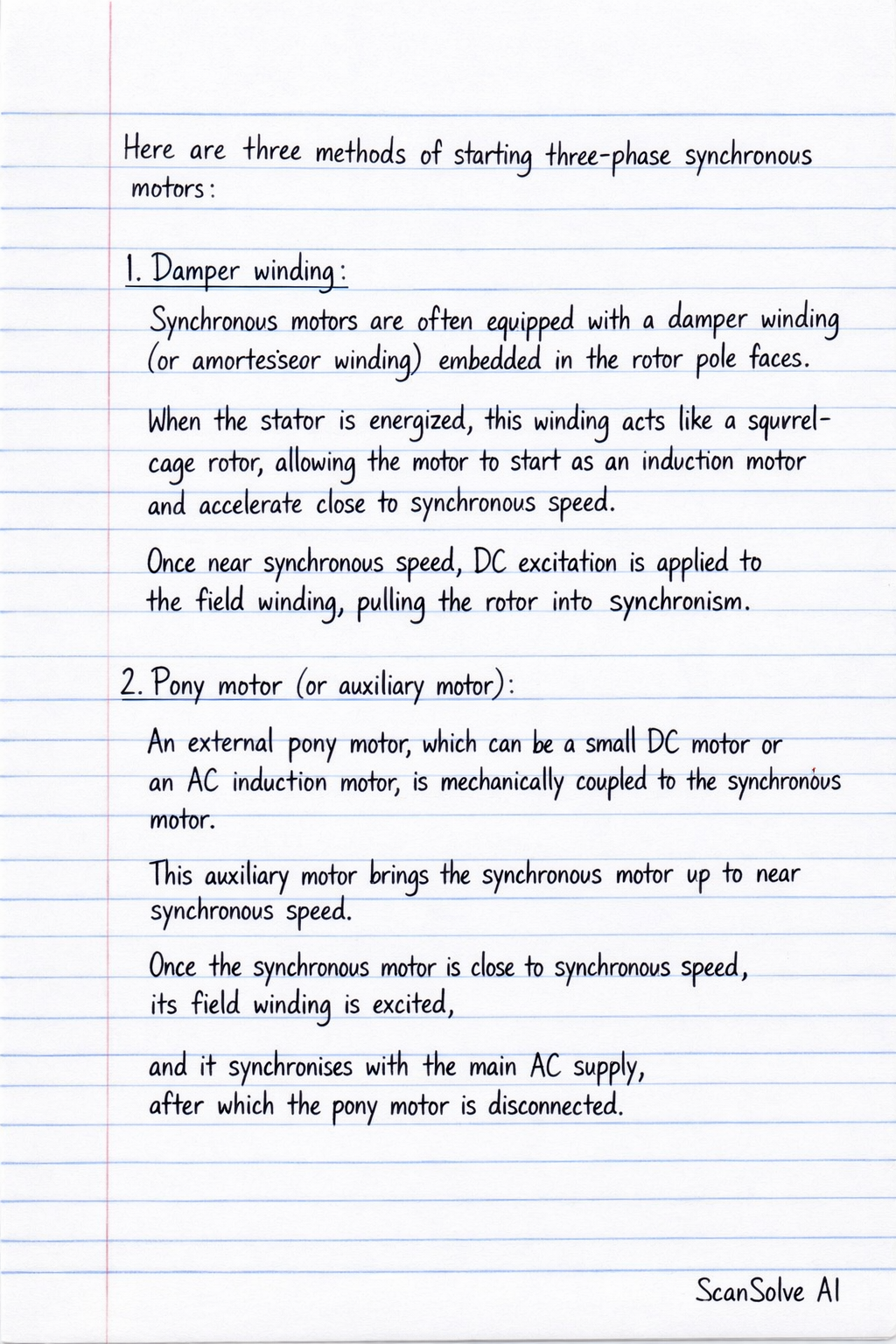
Here are three methods of starting three-phase synchronous motors: 1. Damper winding: Synchronous motors are often equipped with a damper winding (or amortisseur winding) embedded in the rotor pole faces. When the stator is energized, this winding acts like a squirrel-cage rotor, allowing the motor to start as an induction motor and accelerate close to synchronous speed. Once near synchronous speed, DC excitation is applied to the field winding, pulling the rotor into synchronism. 2. Pony motor (or auxiliary motor): An external pony motor, which can be a small DC motor or an AC induction motor, is mechanically coupled to the synchronous motor. This auxiliary motor brings the synchronous motor up to near synchronous speed. Once the synchronous motor is close to synchronous speed, its field winding is excited, and it synchronizes with the main AC supply, after which the pony motor is disconnected. 3. Variable frequency supply: Modern synchronous motors can be started using a variable frequency drive (VFD). The VFD applies a low-frequency, low-voltage AC supply to the stator and gradually increases both the frequency and voltage. This allows the synchronous motor to accelerate smoothly from standstill to synchronous speed while maintaining synchronism throughout the starting process.