
We read your photo as:
Newton's second Law of motion. Coefficient of friction. Newton's first Law of motion. In Figure Q4 (b) the coefficient of static friction between the 3.00 kg crate and the 35.0° incline is 0.30.
ScanSolve AI Answer
Answers
2 partsStep-by-step solution
5 stepsPart a(i)
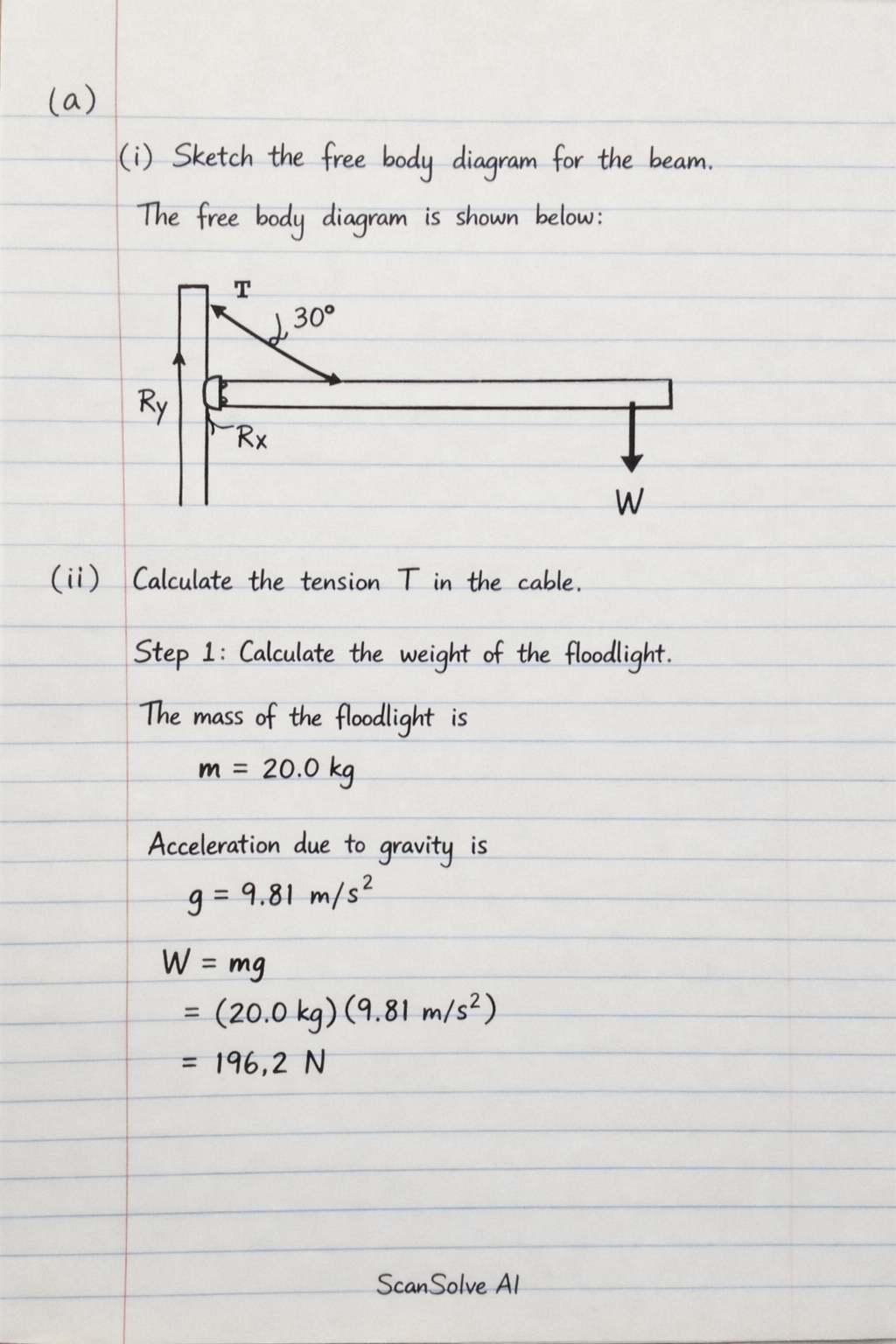
Sketch the free body diagram for the beam.
The free body diagram for the horizontal beam includes the following forces:
- Weight of the floodlight (): Acts vertically downwards at the far end of the beam.
- Tension in the cable (): Acts upwards and towards the pole, at an angle of above the horizontal beam, applied at the far end of the beam.
- Horizontal reaction force from the pole (): Acts horizontally to the right at the hinge point (where the beam is attached to the pole).
- Vertical reaction force from the pole (): Acts vertically at the hinge point (where the beam is attached to the pole).
Part a(ii)
Calculate the tension T in the cable.
Calculate the weight of the floodlight.
The mass of the floodlight is . The acceleration due to gravity is .
Apply the condition for rotational equilibrium.
Taking torques about the hinge point (where the beam meets the pole), the sum of torques must be zero. Let be the length of the beam. The weight creates a clockwise torque, and the vertical component of the tension creates a counter-clockwise torque.
Solve for the tension .
Rounding to three significant figures:
Part a(iii)
Calculate the components of forces exerted on the beam by the pole.
Apply the condition for translational equilibrium in the horizontal (x) direction.
The sum of horizontal forces must be zero. The horizontal component of tension acts to the left. The horizontal reaction force from the pole acts to the right.
Rounding to three significant figures:
Apply the condition for translational equilibrium in the vertical (y) direction.
The sum of vertical forces must be zero. The vertical component of tension acts upwards. The weight acts downwards. The vertical reaction force from the pole acts upwards.
From Step 2, we know .
The vertical component of the force exerted by the pole on the beam is zero.
Try one yourself
A new problem that tests the same skill.
Still stuck on this one?
Ask a follow-up, and the answer starts from this question.
More Physics Questions
Handwritten Step-by-Step Solution
Get this as a handwritten image on WhatsApp — like a tutor wrote it for you.
Try on WhatsApp