
Assuming they give us coefficient of friction, what formula do we use?
ScanSolve AI Answer
Answer
If the coefficient of kinetic friction () is given, we would follow these steps to calculate the work done against friction and then the total work done.
Step-by-step solution
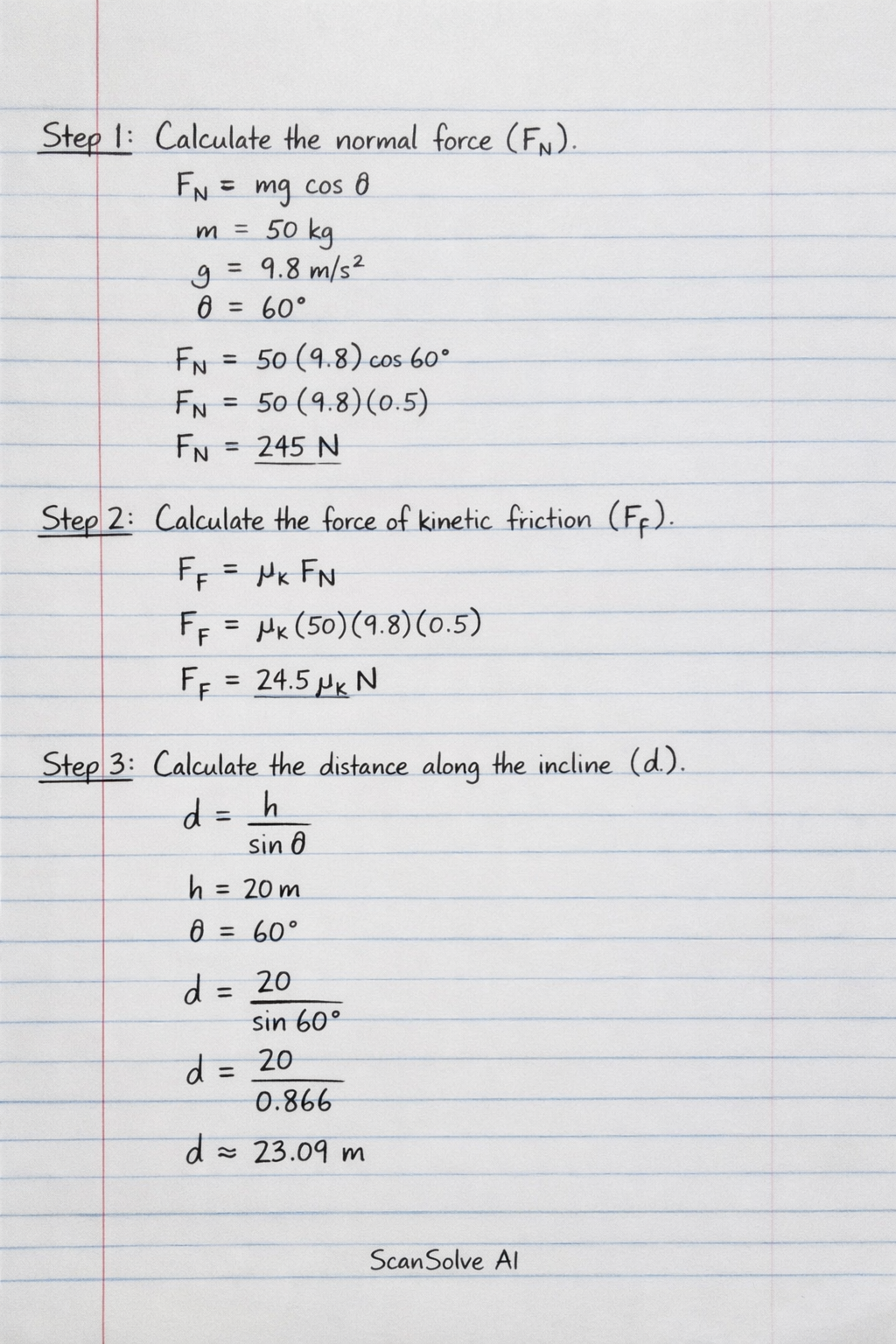
5 stepsCalculate the normal force ().
On an incline, the normal force is the component of the gravitational force perpendicular to the incline.
Where:
- is the mass of the crate (50 kg)
- is the acceleration due to gravity (9.8 m/s²)
- is the angle of incline (60°)
Calculate the force of kinetic friction ().
The force of kinetic friction is given by the product of the coefficient of kinetic friction and the normal force.
Calculate the distance along the incline ().
As calculated previously:
Where:
- is the height of the incline (20 m)
- is the angle of incline (60°)
Calculate the work done against friction ().
The work done against friction is the force of friction multiplied by the distance along the incline.
This can also be written as:
Calculate the total work done ().
The total work done by the applied force to move the crate up the incline is the sum of the work done against gravity and the work done against friction.
We know .
So, the formula for total work done would be:This formula would allow you to calculate the total work done if the coefficient of kinetic friction () were provided.
Still stuck on this one?
Ask a follow-up, and the answer starts from this question.
More Physics Questions
Handwritten Step-by-Step Solution
Get this as a handwritten image on WhatsApp — like a tutor wrote it for you.
Try on WhatsApp