
We read your photo as:
Given: mass m = 12 kg, angle of inclination theta = 30^, coefficient of friction mu = (2)/(3), and g = 10 ms⁻².
ScanSolve AI Answer
Answers
2 partsStep-by-step solution
2 stepsStep 1: Calculate the weight of the body and its components parallel and perpendicular to the inclined plane.
Given: mass , angle of inclination , coefficient of friction , and .
The weight of the body is .
The component of weight parallel to the plane (acting down the plane) is .
The component of weight perpendicular to the plane is .
The normal reaction force is equal to .
The maximum static frictional force is .
Note that and . Since , the body will not slide down the plane on its own.
Part a· 1 step
Find the value of if the body is at the point of moving down the plane.
Determine the direction of and set up the force balance equation for impending downward motion.
Since the body would not slide down on its own (), the external force must be acting down the plane to initiate motion.
At the point of impending motion down the plane, the forces acting down the plane are balanced by the forces acting up the plane. Friction acts up the plane, opposing the downward motion.Substitute the calculated values:
Solve for :
The value of is .
Part b
Find the value of if the body is at the point of moving up the plane.
Determine the direction of and set up the force balance equation for impending upward motion.
For the body to move up the plane, the external force must be acting up the plane.
At the point of impending motion up the plane, the forces acting up the plane are balanced by the forces acting down the plane. Friction acts down the plane, opposing the upward motion.Substitute the calculated values:
The value of is .
Try one yourself
A new problem that tests the same skill.
Still stuck on this one?
Ask a follow-up, and the answer starts from this question.
More Physics Questions
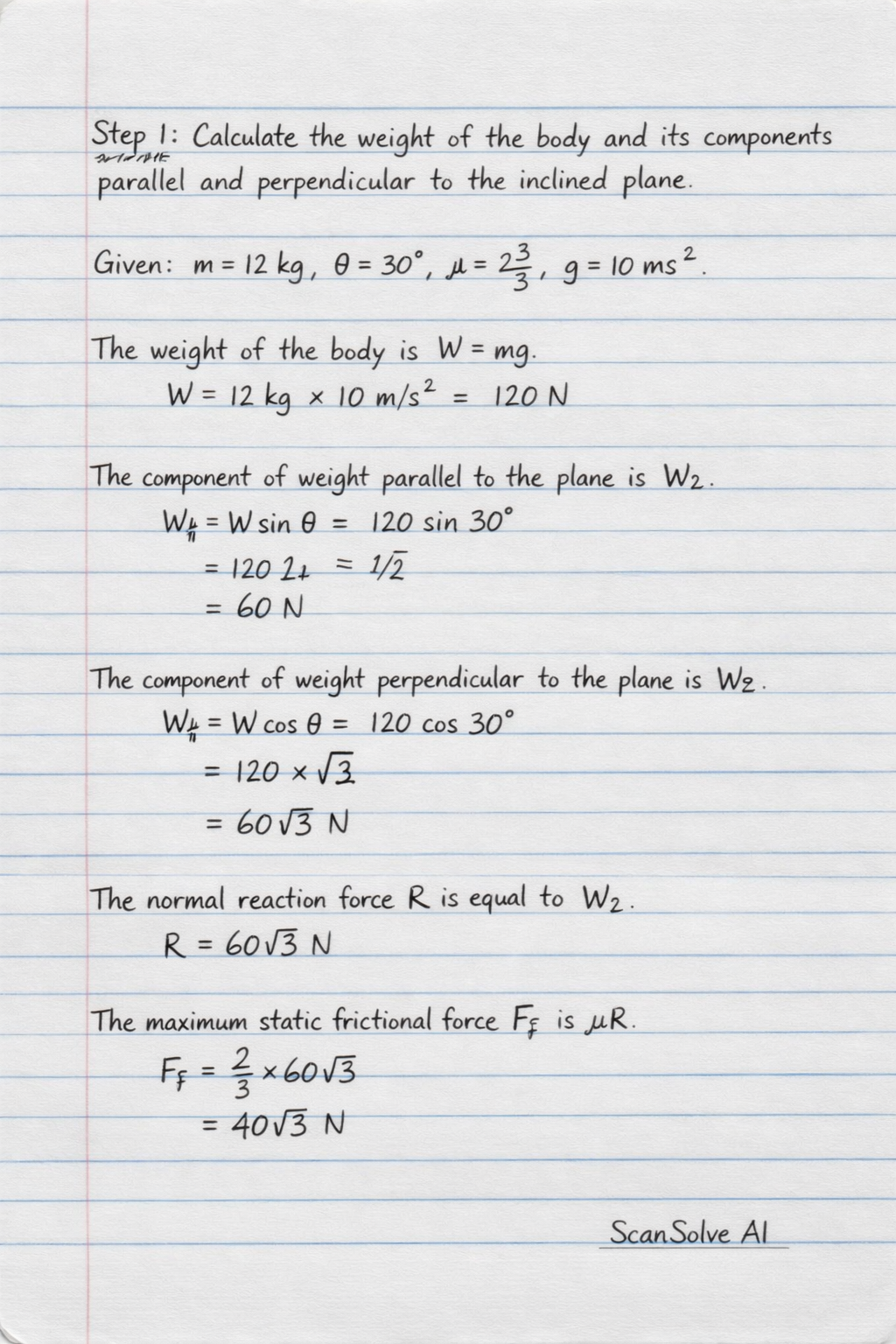
Handwritten Step-by-Step Solution
Get this as a handwritten image on WhatsApp — like a tutor wrote it for you.
Try on WhatsApp