
We read your photo as:
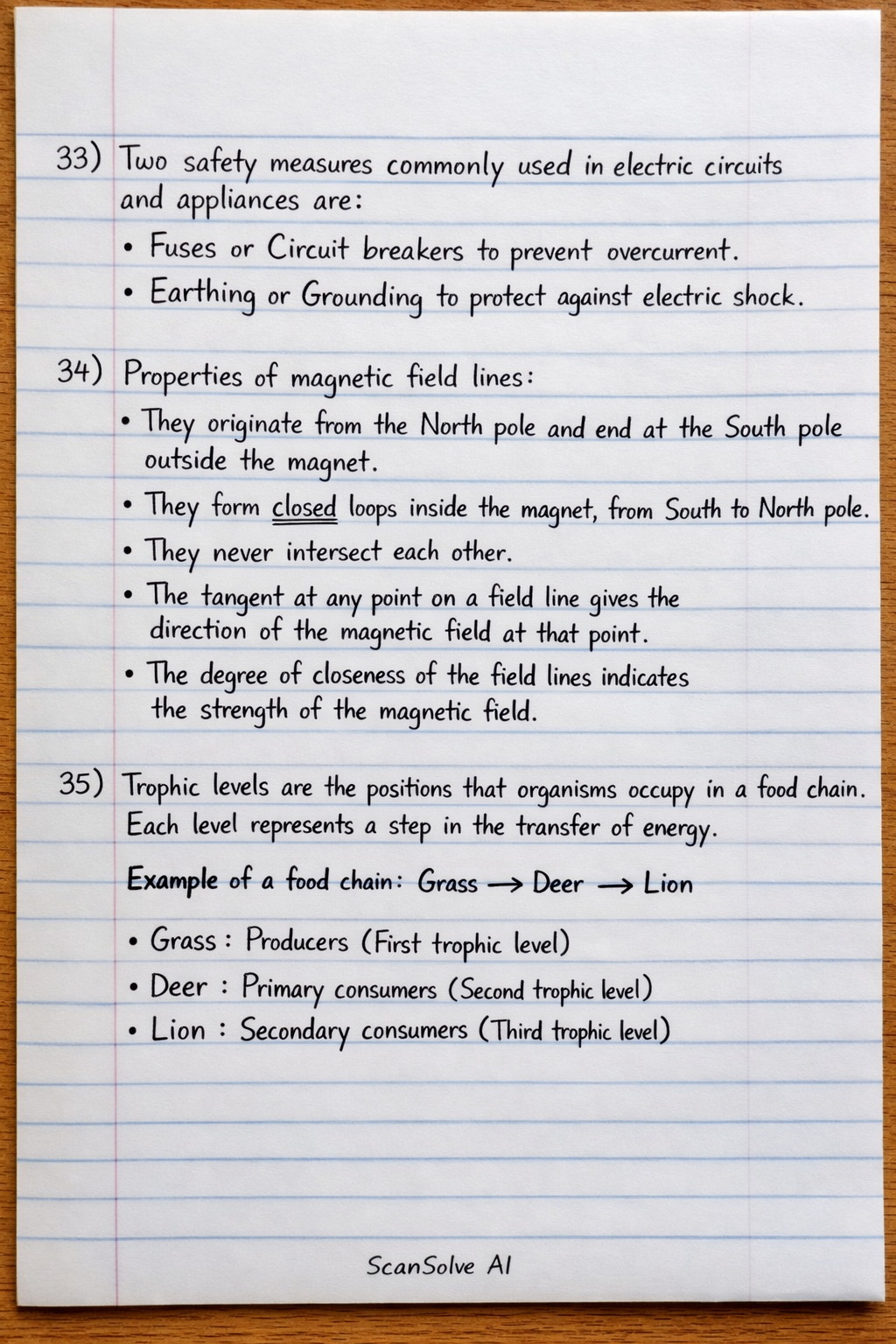
Two safety measures commonly used in electric circuits and appliances are:
ScanSolve AI Answer
Here are the answers to your questions:
- Two safety measures commonly used in electric circuits and appliances are:
- Fuses or Circuit breakers to prevent overcurrent.
- Earthing or Grounding to protect against electric shock.
- Properties of magnetic field lines:
- They originate from the North pole and end at the South pole outside the magnet.
- They form closed loops inside the magnet, from South to North pole.
- They never intersect each other.
- The tangent at any point on a field line gives the direction of the magnetic field at that point.
- The degree of closeness of the field lines indicates the strength of the magnetic field.
- Trophic levels are the positions that organisms occupy in a food chain. Each level represents a step in the transfer of energy.
Example of a food chain: Grass Deer Lion
- Grass: Producers (First trophic level)
- Deer: Primary consumers (Second trophic level)
- Lion: Secondary consumers (Third trophic level)
-
Ozone () is a molecule composed of three oxygen atoms. In the stratosphere, it forms the ozone layer, which absorbs harmful ultraviolet (UV) radiation from the sun. Its effect on the ecosystem is crucial: by absorbing UV radiation, it protects living organisms from skin cancer, cataracts, and damage to DNA, thus maintaining the balance of ecosystems.
-
Changes seen in boys at the time of puberty include:
- Increase in height and weight.
- Growth of facial hair (beard and mustache) and body hair.
- Deepening of the voice due to the growth of the larynx (Adam's apple).
- Enlargement of the testes and penis.
- Increased muscle development.
- The balanced equations for the following chemical reactions are:
i) Hydrogen + Chlorine Hydrogen Chloride
ii) Calcium hydroxide + Carbon dioxide Calcium carbonate + Water
iii) Sodium + Water Sodium hydroxide + Hydrogen
- Physical properties of metals:
- They are generally lustrous (shiny).
- They are malleable (can be hammered into thin sheets).
- They are ductile (can be drawn into thin wires).
- They are good conductors of heat and electricity.
- They are typically solids at room temperature (except mercury).
- They have high melting and boiling points.
- Corrosion is the process by which metals are gradually eaten away by the action of air, moisture, or a chemical (like an acid) on their surface. A common example is the rusting of iron. Some remedies to prevent corrosion include:
- Painting the metal surface.
- Oiling or greasing the metal surface.
- Galvanizing (coating with a layer of zinc).
- Electroplating (coating with a layer of another metal like chromium or nickel).
- Alloying (mixing metals to create a more resistant material, e.g., stainless steel).
- The hormones and their functions secreted by the given endocrine glands are:
i) Pancreas:
- Hormones: Insulin and Glucagon.
- Functions: Insulin lowers blood glucose levels by promoting glucose uptake by cells. Glucagon raises blood glucose levels by stimulating the liver to release stored glucose.
ii) Thyroid gland:
- Hormone: Thyroxine.
- Functions: Regulates the body's metabolism, growth, and development.
iii) Ovaries:
- Hormones: Estrogen and Progesterone.
- Functions: Estrogen is responsible for the development of female secondary sexual characteristics and regulates the menstrual cycle. Progesterone helps in maintaining pregnancy.
Still stuck on this one?
Ask a follow-up, and the answer starts from this question.
More Physics Questions
Handwritten Step-by-Step Solution
Get this as a handwritten image on WhatsApp — like a tutor wrote it for you.
Try on WhatsApp