
We read your photo as:
A 90 N block rests on a horizontal surface. It takes 40 N to get it moving and 25 N to keep it moving. Calculate the coefficients of static and kinetic friction.
ScanSolve AI Answer
Answer
Step-by-step solution
4 stepsHere's the solution to question 2:
Identify the given values.
The weight of the block is .
The force required to get the block moving (static friction) is .
The force required to keep the block moving at a constant velocity (kinetic friction) is .Calculate the normal force.
For a block on a horizontal surface, the normal force is equal to its weight .
Calculate the coefficient of static friction ().
The formula for static friction is .
Rearrange to solve for :Substitute the values:
Calculate the coefficient of kinetic friction ().
The formula for kinetic friction is .
Rearrange to solve for :Substitute the values:
The coefficients of friction are:
Static friction coefficient:
Kinetic friction coefficient:
Try one yourself
A new problem that tests the same skill.
Still stuck on this one?
Ask a follow-up, and the answer starts from this question.
More Physics Questions
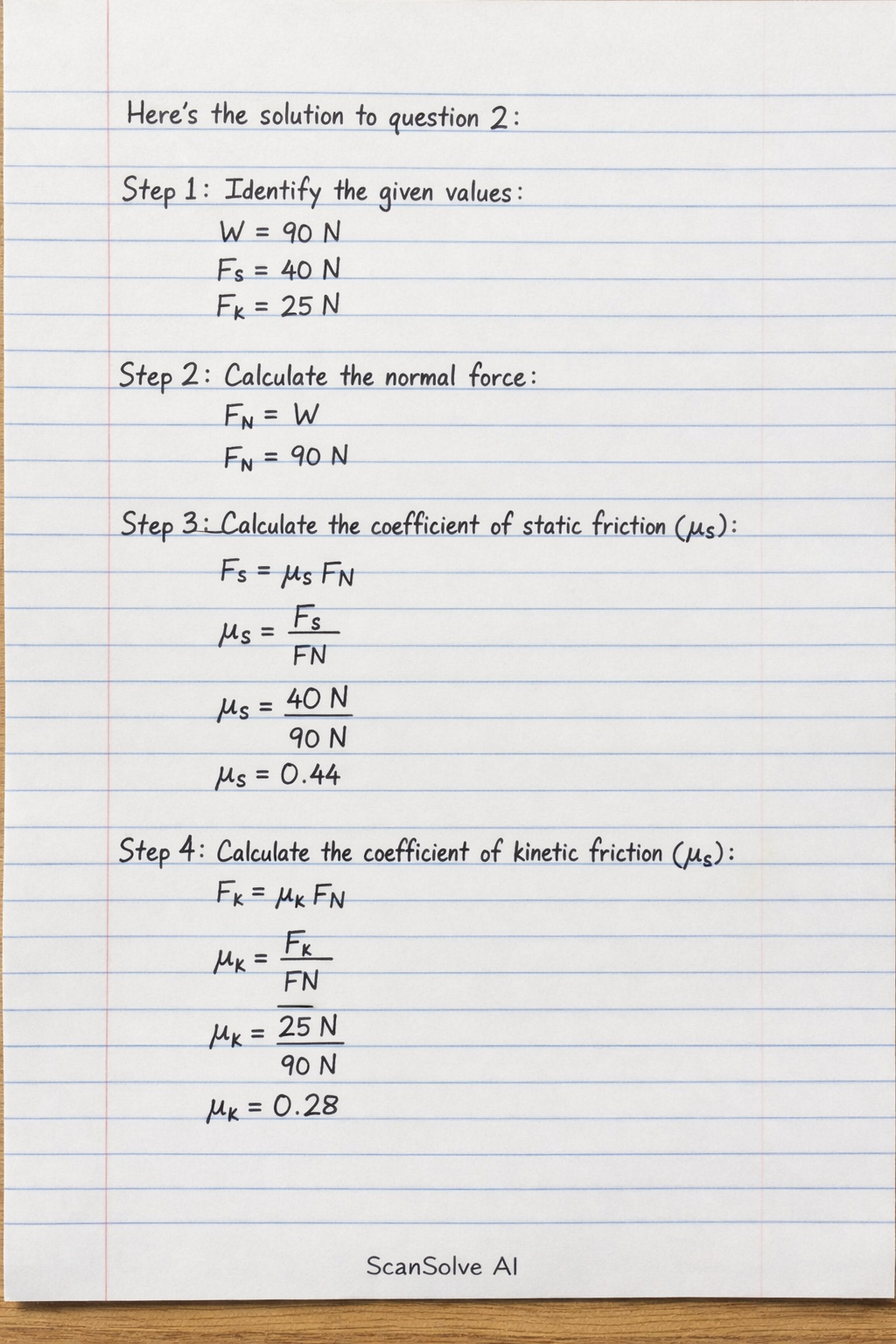
Handwritten Step-by-Step Solution
Get this as a handwritten image on WhatsApp — like a tutor wrote it for you.
Try on WhatsApp