
We read your photo as:
1 State Coulomb's Law. 7.2 Draw a labelled free-body diagram for sphere P. 7.3.1 Calculate the magnitude of the electrostatic force between sphere P and sphere Q.
ScanSolve AI Answer
Step-by-step solution
11 stepsQuestion 7
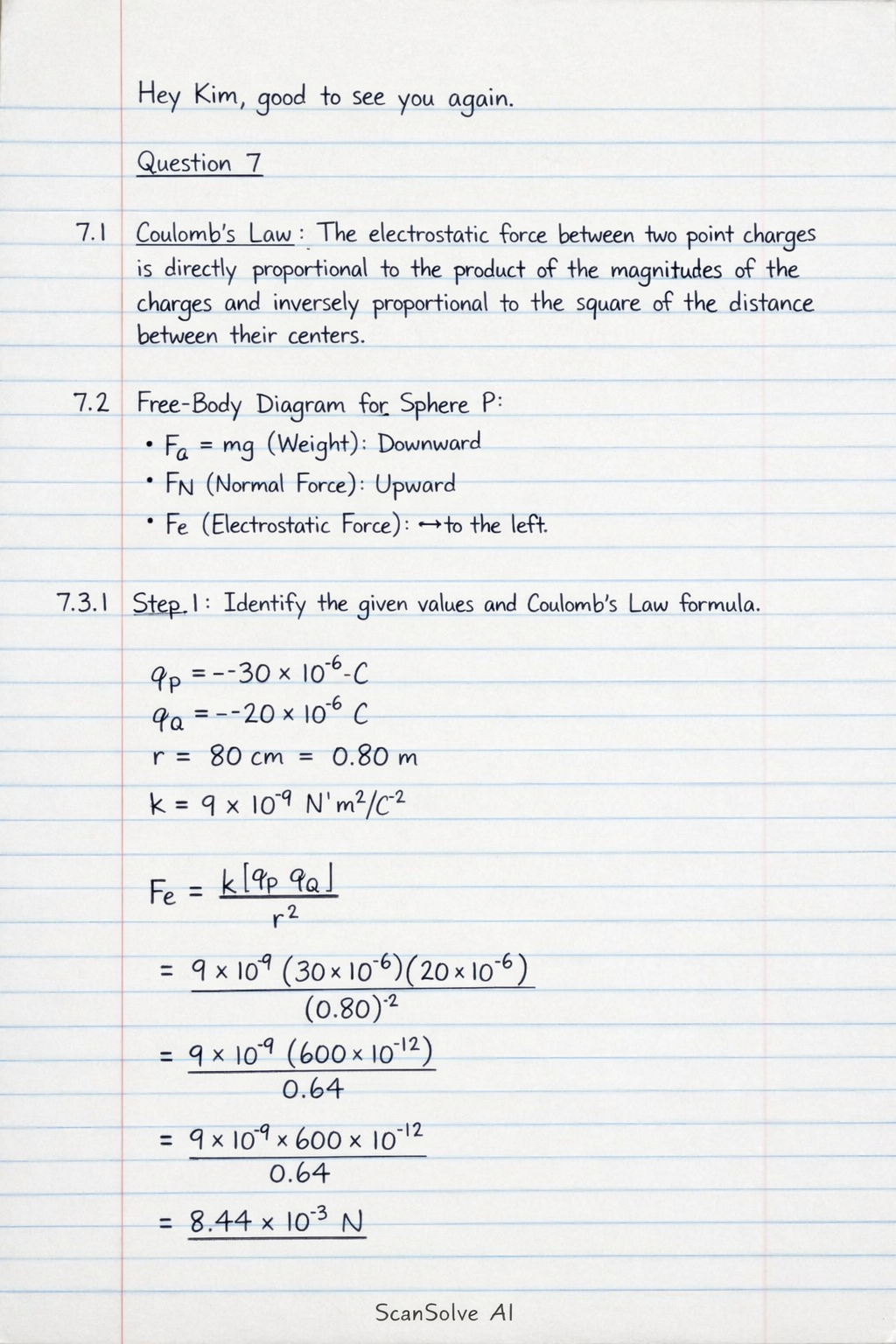
7.1 Coulomb's Law states that the electrostatic force between two point charges is directly proportional to the product of the magnitudes of the charges and inversely proportional to the square of the distance between their centers.
7.2
A labelled free-body diagram for sphere P:
- Weight ( or ): Acting vertically downwards.
- Normal force (): Acting vertically upwards from the stand.
- Electrostatic force (): Acting horizontally to the left, due to repulsion from sphere Q.
7.3.1
Identify the given values and Coulomb's Law formula.
The charges are and .
The distance between them is .
Coulomb's constant is .
The formula for electrostatic force is .Substitute the values into the formula and calculate the force.
The magnitude of the electrostatic force is .
7.3.2
Calculate the weight of sphere Q.
The mass of sphere Q is .
The acceleration due to gravity is .Use the equilibrium conditions for sphere Q.
Sphere Q is in equilibrium, so the net force in both horizontal and vertical directions is zero.
From the free-body diagram for Q (not P, as asked in 7.2, but implied for 7.3.2/7.3.3):- Horizontal forces:
- Vertical forces: We have and .
Calculate the angle .
Divide the horizontal equilibrium equation by the vertical equilibrium equation:
Calculate the tension T.
Using the vertical equilibrium equation:
The tension T in the string is .
7.3.3
The angle was calculated in Step 3 of 7.3.2.The angle is .
Question 8
8.1 The electric field at a point is defined as the electrostatic force experienced per unit positive test charge placed at that point.
8.2
The electric field pattern between spheres A (+5 nC) and B (-4 nC) would show:- Field lines originating from sphere A (positive charge).
- Field lines terminating on sphere B (negative charge).
- Arrows on the field lines pointing away from A and towards B.
- The lines would be denser closer to the charges, especially near A due to its larger magnitude of charge compared to B.
- The lines would not cross each other.
8.3
Identify the given values and distances.
Distance from X to A is .
Distance from X to B is .
Net electric field at X is West.Determine the direction of electric fields due to A and B at point X.
- For (positive), the electric field at X points away from A. Since X is to the left of A, points to the left (West).
- For (negative), the electric field at X points towards B. Since X is to the left of B, points to the right (East).
Write the expressions for and .
Calculate the net electric field at X.
Since is West, (West) must be greater than (East).
Solve for .
The value of r is .
Still stuck on this one?
Ask a follow-up, and the answer starts from this question.
More Physics Questions
Handwritten Step-by-Step Solution
Get this as a handwritten image on WhatsApp — like a tutor wrote it for you.
Try on WhatsApp