
1 to 8 solved physics questions
ScanSolve AI Answer
Answers
3 partsStep-by-step solution
8 stepsPart 6· 3 steps
The question asks what can cause a change in a vector.
Consider the effect of "Rotation of frame of reference".
If the coordinate system (frame of reference) rotates, the components of a vector, when expressed in that frame, will change. For example, a vector pointing along the -axis in one frame will have both and components in a frame rotated by . Although the vector itself (its magnitude and direction in absolute space) remains unchanged, its representation (components) in the rotated frame changes. In physics, a change in components is considered a "change in a vector" in the context of its representation.
Consider the effect of "Rotation of vector".
If the vector itself rotates, its direction changes. A vector is defined by both its magnitude and direction. If either of these changes, the vector itself changes. For example, if a vector pointing east rotates to point north, it is a different vector.
Conclude based on both effects.
Both the rotation of the frame of reference (leading to a change in components) and the rotation of the vector itself (leading to a change in direction) result in a change in the vector.
The final answer is .
Part 7
Given that the resultant of two vectors and is perpendicular to and its magnitude is half of . We need to find the angle between and .
Define the resultant vector and use the given conditions.
Let be the resultant vector.
Given that is perpendicular to , their dot product is zero:Let and . Let be the angle between and .
Since (otherwise would be and not perpendicular to unless is also zero), we can divide by :
Since is a magnitude, . This implies that must be negative, so is an obtuse angle.
Use the given magnitude of the resultant.
Given that the magnitude of the resultant is half of :
The magnitude of the resultant of two vectors is given by:
Substitute :
Substitute equation (1) into equation (2) to solve for .
From (1), . Substitute this into (2):
Assuming , divide the entire equation by :
Rearrange to solve for :
Take the square root:
From Step 1, we determined that must be negative.
The angle in the range for which is:
The final answer is .
Part 8
Given and the magnitudes . We need to find the angle between and .
Determine the relationship between and .
We are given the magnitudes .
Notice that . This means .
For vector addition , the magnitude is given by , where is the angle between and .
Substituting the magnitudes:This implies or radians. Therefore, vector is perpendicular to vector .
Find the angle between and .
Let be the angle between and . We can use the dot product definition:
Substitute :
Since is perpendicular to , .
Also, .Since , we can divide by :
Substitute the given magnitudes and :
The final answer is .
Try one yourself
A new problem that tests the same skill.
Still stuck on this one?
Ask a follow-up, and the answer starts from this question.
More Physics Questions
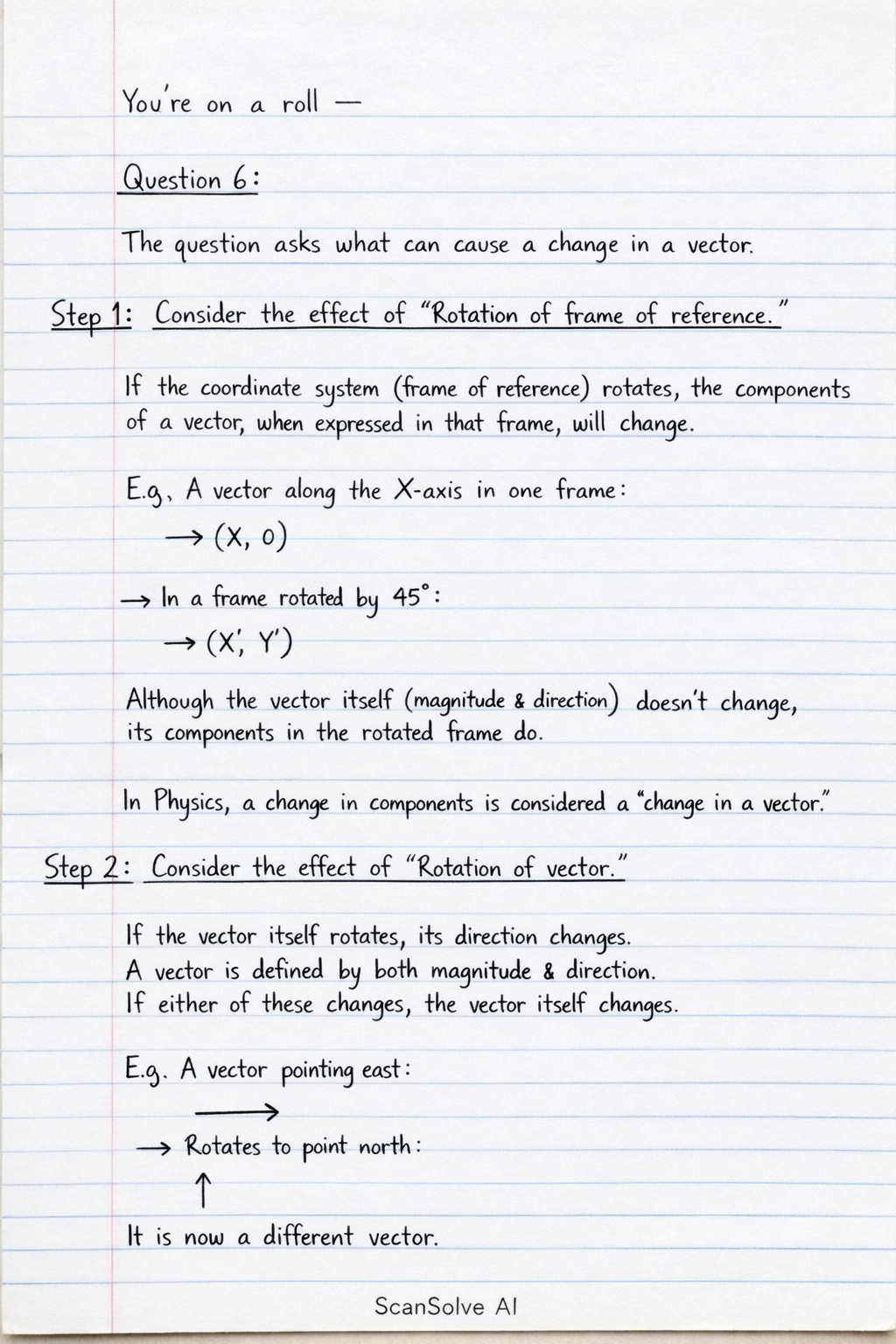
Handwritten Step-by-Step Solution
Get this as a handwritten image on WhatsApp — like a tutor wrote it for you.
Try on WhatsApp