

This physics problem tests your understanding of fundamental physical laws and their applications. The step-by-step solution below breaks down the problem using relevant equations and physical reasoning.
ScanSolve AI Answer
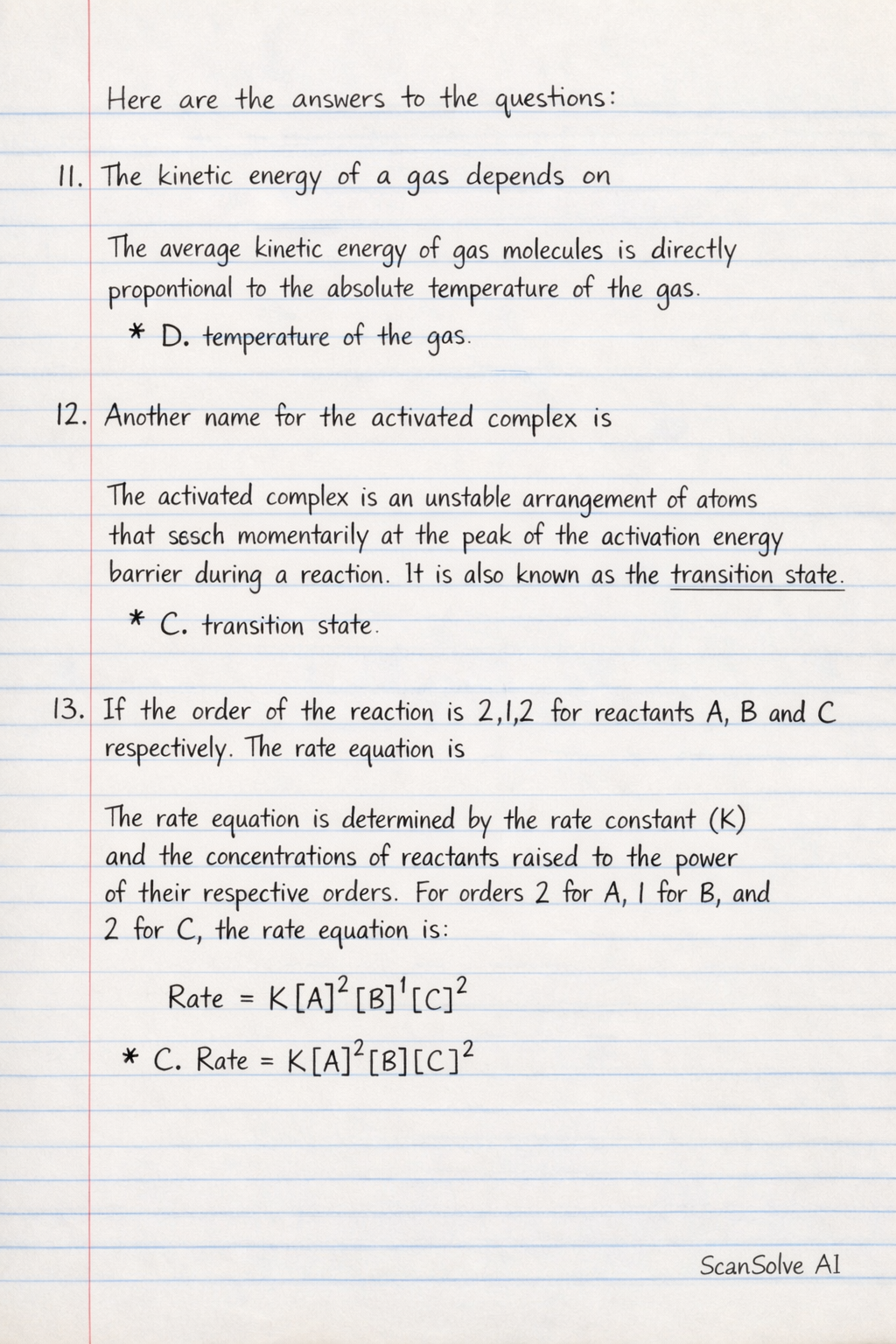
Here are the answers to the questions: 11. The kinetic energy of a gas depends on The average kinetic energy of gas molecules is directly proportional to the absolute temperature of the gas. D. temperature of the gas 12. Another name for the activated complex is The activated complex is an unstable arrangement of atoms that exists momentarily at the peak of the activation energy barrier during a reaction. It is also known as the transition state. C. transition state 13. If the order of the reaction is 2,1,2 for reactants A, B and C respectively. The rate equation is The rate equation is determined by the rate constant (K) and the concentrations of reactants raised to the power of their respective orders. For orders 2 for A, 1 for B, and 2 for C, the rate equation is: Rate = K[A]^2[B]^1[C]^2 C. Rate = K[A]^2[B][C]^2 14. The sum of the powers of concentration in the rate law is The sum of the exponents of the concentration terms in the rate law is defined as the overall order of the reaction. B. overall order of reaction 15. The unit of rate is? The rate of a chemical reaction is typically expressed as the change in concentration per unit time. Concentration is commonly measured in moles per liter (M or mol/dm^3), and time in seconds (s). Therefore, the unit of rate is M/s or M s^-1. A. Msec^-1 16. The value for H of a reaction is negative. This means that the reaction is A negative value for the change in enthalpy ( H) indicates that the reaction releases heat to its surroundings. This type of reaction is called exothermic. B. exothermic 17. Which of the following is a condition for spontaneous reaction? A reaction is spontaneous if the change in Gibbs free energy ( G) is negative. The relationship between Gibbs free energy, enthalpy, and entropy is given by G = H - T S. Therefore, for a spontaneous reaction, H - T S < 0, or H - T S = -ve. D. H - T S = -ve 18. A chemical reaction is in equilibrium when At equilibrium, the net change in Gibbs free energy ( G) is zero. Since G = H - T S, at equilibrium, we have 0 = H - T S, which implies H = T S. A. H = T S 19. The enthalpy of combustion of a substance can be determined in a/an A bomb calorimeter is a specialized device used to measure the heat released during combustion reactions at constant volume. B. bomb calorimeter 20. Enthalpy of a substance is the same as its Enthalpy (H) is a thermodynamic property often referred to as the "heat content" of a system at constant pressure. While "heat constant" is not a standard thermodynamic term, among the given options, it is the only one that attempts to relate enthalpy directly to "heat". The other options (free energy, activation energy, entropy) are distinct thermodynamic or kinetic properties. Assuming "heat constant" is a poorly phrased term for "heat content", this would be the intended answer. A. heat constant