
We read your photo as:
Use the information below to plot a graph of extension (cm) against load (N).
Physics
ScanSolve AI Answer
Step-by-step solution
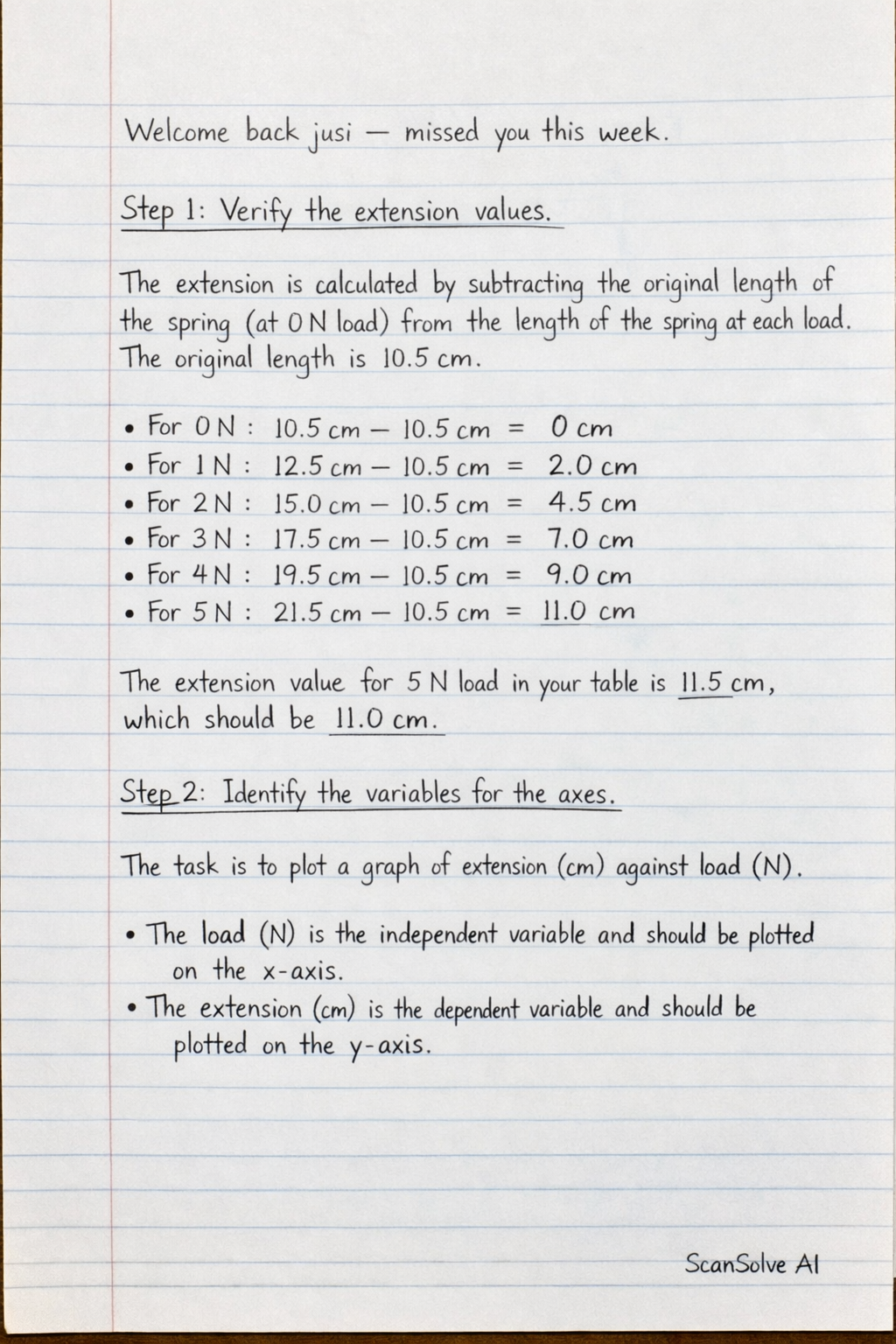
4 stepsVerify the extension values.
The extension is calculated by subtracting the original length of the spring (at 0 N load) from the length of the spring at each load. The original length is .
- For :
- For :
- For :
- For :
- For :
- For :
The extension value for load in your table is , which should be .
Identify the variables for the axes.
The task is to plot a graph of extension (cm) against load (N).
- The load (N) is the independent variable and should be plotted on the x-axis.
- The extension (cm) is the dependent variable and should be plotted on the y-axis.
List the data points to be plotted.
Using the corrected extension value for , the points to plot are (Load, Extension):
Plot the graph.
- Draw two perpendicular axes. Label the horizontal axis "Load (N)" and the vertical axis "Extension (cm)".
- Choose appropriate scales for both axes. The x-axis should go from 0 N to at least 5 N, and the y-axis should go from 0 cm to at least 11.0 cm.
- Plot each data point from Step 3 on the graph.
- Draw a line of best fit through the plotted points. This line should be a straight line passing through the origin, as expected for a spring obeying Hooke's Law within its elastic limit.
The corrected data for plotting is:
Was this helpful?
Still stuck on this one?
Ask a follow-up, and the answer starts from this question.
Got a different question?Ask your own question
More Physics Questions
QUsing the data in Table 1, calculate the extension e of the spring when L = 5.00 N. Plot a graph of…Q(ii) Plot a graph of effort distance, (y-axis) against load distance, (x-axis).QA student investigates the stretching of a spring. Calculate the extension e of the spring using the…QCalculate the strain on a wire given its original length is 100 cm and its extension is 0.008 cm.QDetermine the slope of the graph of Force against Extension using the provided data points.
Handwritten Step-by-Step Solution
Get this as a handwritten image on WhatsApp — like a tutor wrote it for you.
Try on WhatsApp