
Explain why anti-static grounding during the high-velocity discharge of non-conductive solvents through a pipe/ tank or manifold is important
ScanSolve AI Answer
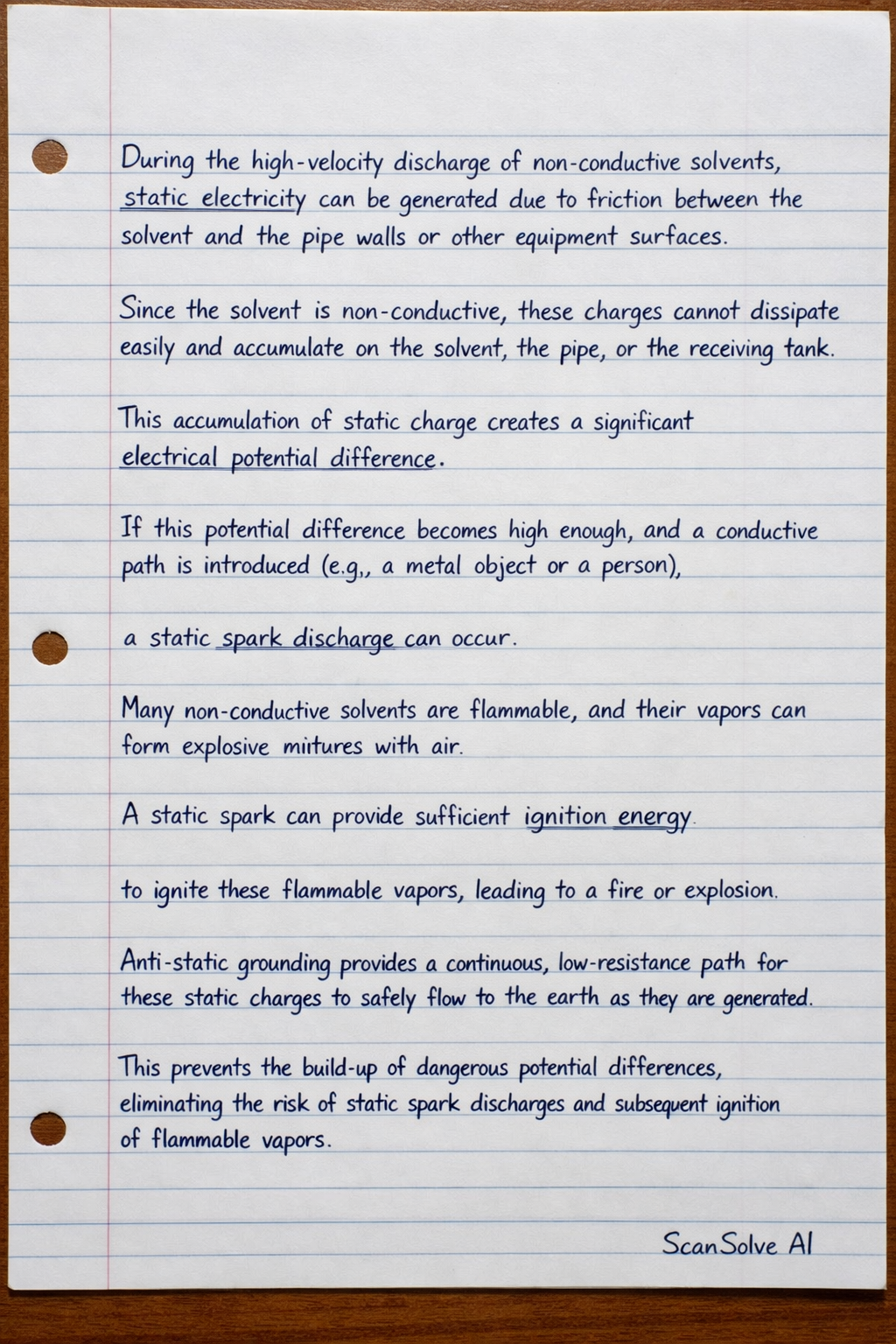
During the high-velocity discharge of non-conductive solvents, static electricity can be generated due to friction between the solvent and the pipe walls or other equipment surfaces. Since the solvent is non-conductive, these charges cannot dissipate easily and accumulate on the solvent, the pipe, or the receiving tank.
This accumulation of static charge creates a significant electrical potential difference. If this potential difference becomes high enough, and a conductive path is introduced (e.g., a metal object or a person), a static spark discharge can occur. Many non-conductive solvents are flammable, and their vapors can form explosive mixtures with air. A static spark can provide sufficient ignition energy to ignite these flammable vapors, leading to a fire or explosion.
Anti-static grounding provides a continuous, low-resistance path for these static charges to safely flow to the earth as they are generated. This prevents the build-up of dangerous potential differences, eliminating the risk of static spark discharges and subsequent ignition of flammable vapors.
Still stuck on this one?
Ask a follow-up, and the answer starts from this question.
More Physics Questions
Handwritten Step-by-Step Solution
Get this as a handwritten image on WhatsApp — like a tutor wrote it for you.
Try on WhatsApp