
We read your photo as:
What causes static electricity and the interaction between charged materials?
Physics
ScanSolve AI Answer
Here is the completed concept map for static electricity:
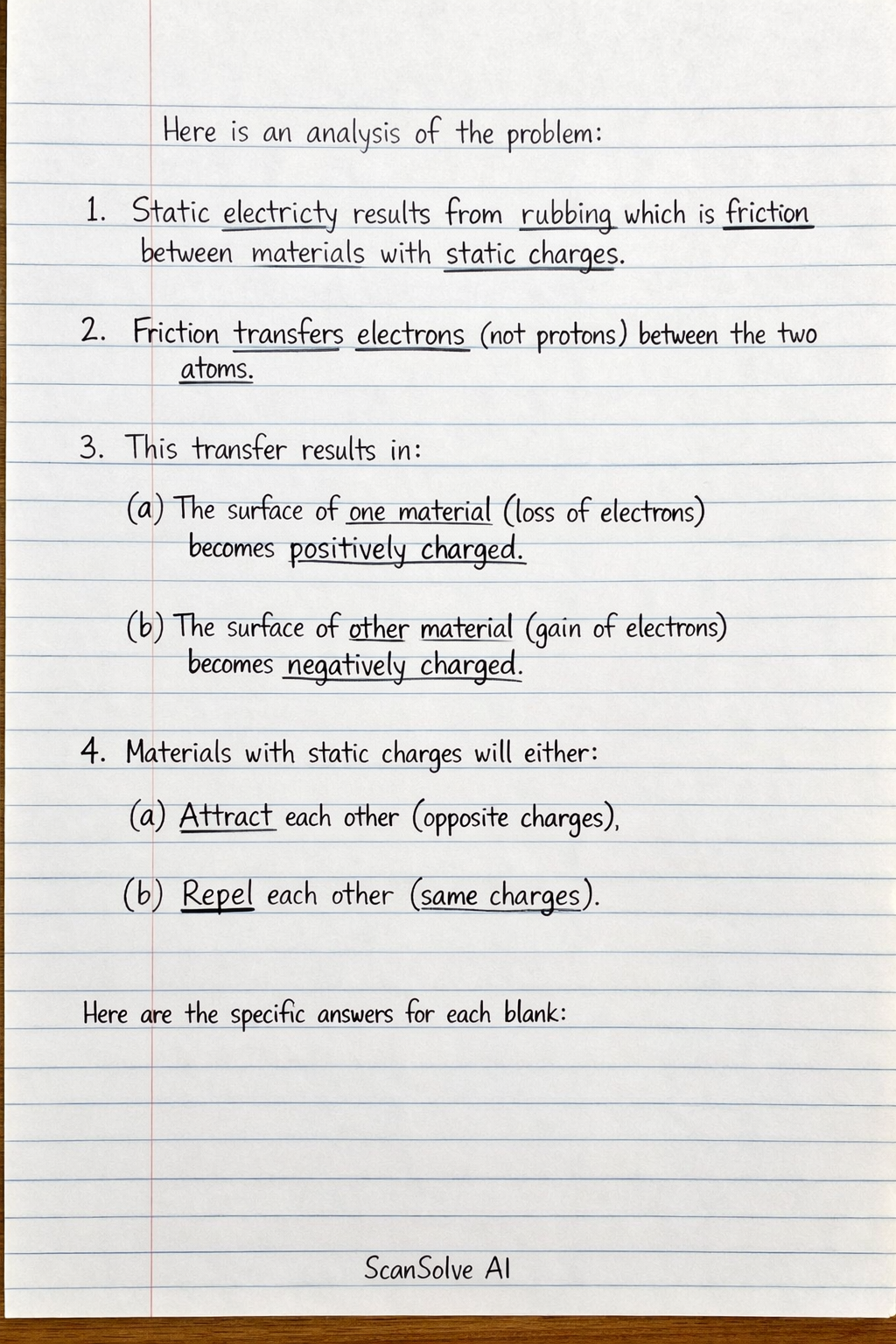
- Static electricity results from rubbing which is friction between materials with static charges.
- Friction transfers electrons (and NOT protons) between the two atoms.
- This transfer results in:
- The surface of one material (due to loss of electrons) becoming positively charged.
- The surface of other material (due to gain in electrons) becoming negatively charged.
- Materials with static charges will either:
- attract each other (if they have opposite charges, as shown by the two different charged surfaces).
- repel each other (if they have same charges).
Here are the specific answers for each blank:
- The blank after "materials with" (top right, leading to attract/repel): static charges
- The blank after "and NOT" (middle, parallel to electrons): protons
- The blank after "surface of one material becoming" (left, due to loss of electrons): positively charged
- The blank after "surface of other material becoming" (bottom left, due to gain in electrons): negatively charged
- The blank after "materials with" (bottom right, leading to repel): same charges
Was this helpful?
Still stuck on this one?
Ask a follow-up, and the answer starts from this question.
Got a different question?Ask your own question
More Physics Questions
QElectric fields and charged objectsQState the laws of electrostatics. Two electric charges of +15µC and +1µC are spaced 50 cm apart in…QComplete the mind map about static electricity.QExplain the purpose of wooden stands in electrostatics experiments and calculate charge distribution…QTwo rods, A (glass) and B (plastic), are rubbed with different materials (wool for A, cat's fur for…
Handwritten Step-by-Step Solution
Get this as a handwritten image on WhatsApp — like a tutor wrote it for you.
Try on WhatsApp