
We read your photo as:
Explain the purpose of wooden stands in electrostatics experiments and calculate charge distribution after conducting spheres touch.
ScanSolve AI Answer
Step-by-step solution
13 stepsHere are the solutions to your electrostatics questions:
Part 1
Part 1.1· 1 step
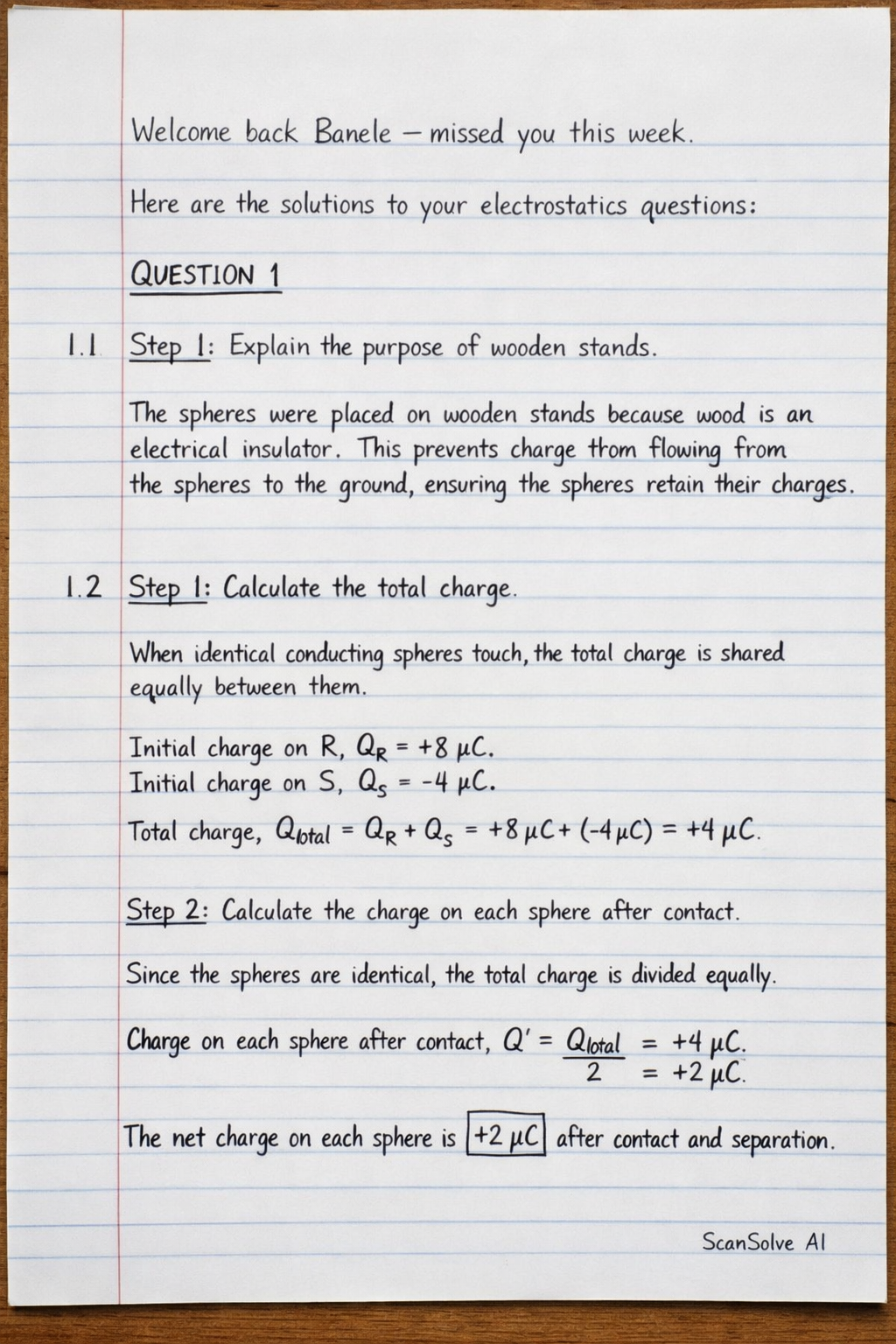
Explain the purpose of wooden stands.
The spheres were placed on wooden stands because wood is an electrical insulator. This prevents charge from flowing from the spheres to the ground, ensuring the spheres retain their charges.
Part 1.2· 2 steps
Calculate the total charge.
When identical conducting spheres touch, the total charge is shared equally between them.
Initial charge on R, .
Initial charge on S, .
Total charge .Calculate the charge on each sphere after contact.
Since the spheres are identical, the total charge is divided equally.
Charge on each sphere after contact, .
The net charge on each sphere is after contact and separation.
Part 1.3· 1 step
Describe the electric field pattern.
After contact, both spheres R and S have a positive charge of . Electric field lines originate from positive charges and point outwards. Since both spheres are positively charged, the field lines will repel each other in the region between the spheres, creating a region of weaker field or a neutral point directly between them. The field lines will curve away from each other.
Part 1.4· 1 step
Describe the forces on sphere T.
Sphere T has a charge of . Sphere R has a charge of . Sphere S has a charge of .
- Force on T due to R (): Since both R and T are positive, the force is repulsive. acts on T, pushing it away from R (to the right).
- Force on T due to S (): Since both S and T are positive, the force is repulsive. acts on T, pushing it away from S (to the left).
Part 1.5· 4 steps
Convert charges and distances to SI units.
Coulomb's constant .Calculate the electrostatic force exerted by R on T ().
Using Coulomb's Law, :
Calculate the electrostatic force exerted by S on T ().
Calculate the net electrostatic force on T.
Let's take the direction to the right as positive.
The net electrostatic force experienced by T is .
Part 1.6· 1 step
Define electric field.
The electric field at a point is defined as the electrostatic force experienced per unit positive test charge placed at that point. It is a vector quantity.
Mathematically, .
Part 1.7· 3 steps
Calculate the electric field due to R at the location of T ().
Using the formula :
Calculate the electric field due to S at the location of T ().
Calculate the magnitude of the net electric field at T.
Let's take the direction to the right as positive.
The magnitude of the net electric field at the location of T is
\boxed{\text{1.35 \times 10^6 N/C}}.
Still stuck on this one?
Ask a follow-up, and the answer starts from this question.
More Physics Questions
Handwritten Step-by-Step Solution
Get this as a handwritten image on WhatsApp — like a tutor wrote it for you.
Try on WhatsApp