
We read your photo as:
A 20 ohm resistor with temperature coefficient 0.004/°C is connected to a 24 V supply. The temperature rises from 1.5°C to 10°C, determine: I) New resistance II) Circuit current before and after heating III) explain your answers. [9 marks]
ScanSolve AI Answer
Step-by-step solution
5 stepsHere's the solution for Q5.b:
Given:
Resistors , , connected in series.
Supply voltage .
Resistance of each resistor increases by 2.5% due to heating.
I) Initial current
Calculate the total initial resistance.
For resistors in series, the total resistance is the sum of individual resistances.
Calculate the initial current.
Using Ohm's Law, .
The initial current is .
II) Final current
Calculate the total final resistance.
Each resistor's resistance increases by 2.5%, so the total resistance also increases by 2.5%.
Calculate the final current.
Using Ohm's Law, .
The final current is .
III) Percentage change in current
Calculate the percentage change in current.
The percentage change is given by .
The negative sign indicates a decrease in current.
The percentage change in current is .
Still stuck on this one?
Ask a follow-up, and the answer starts from this question.
More Physics Questions
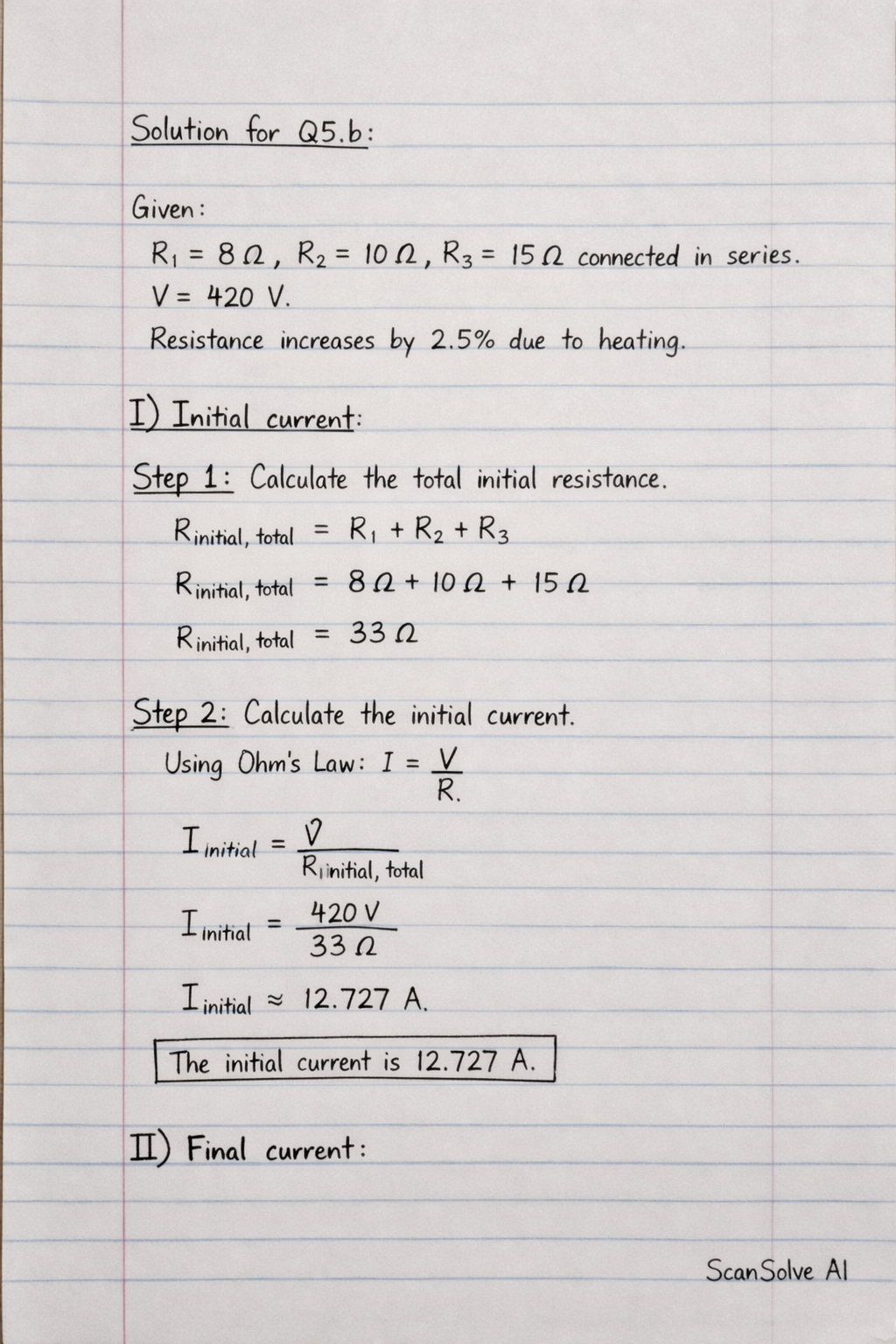
Handwritten Step-by-Step Solution
Get this as a handwritten image on WhatsApp — like a tutor wrote it for you.
Try on WhatsApp