
We read your photo as:
A 20 Ω resistor with temperature coefficient 0.04/°C is connected to a 24 V supply. If its temperature rises from 1.5°C to 10°C, determine: I) New resistance II) Circuit current before and after heating III) explain your answers.
ScanSolve AI Answer
Step-by-step solution
5 stepshere's the solution for Q4.a:
Given:
Initial resistance
Temperature coefficient
Initial temperature
Final temperature
Supply voltage
I) New resistance
Calculate the change in temperature.
Calculate the new resistance.
The formula for resistance change with temperature is .
The new resistance is .
II) Circuit current before and after heating
Calculate the circuit current before heating.
Using Ohm's Law, .
The current before heating is .
Calculate the circuit current after heating.
Using Ohm's Law, .
The current after heating is .
III) Explain your answers
Explain the change in current.
As the temperature of the resistor increases from to , its resistance increases from to . According to Ohm's Law (), for a constant voltage, an increase in resistance leads to a decrease in current. Therefore, the current in the circuit decreases from to approximately .
Still stuck on this one?
Ask a follow-up, and the answer starts from this question.
More Physics Questions
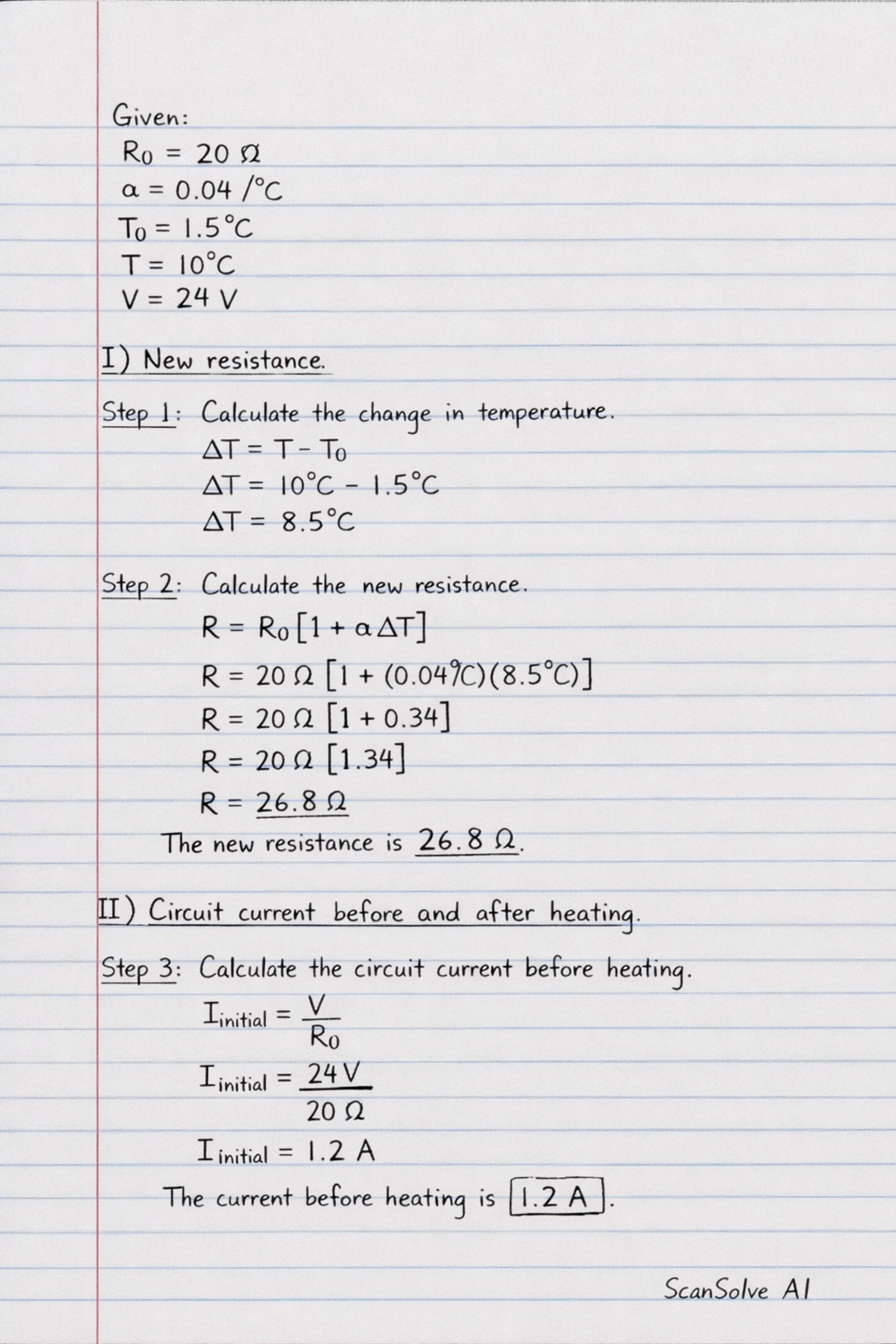
Handwritten Step-by-Step Solution
Get this as a handwritten image on WhatsApp — like a tutor wrote it for you.
Try on WhatsApp