
We read your photo as:
Calculate the: i. Current supplied by the battery. ii. Power dissipated in the 5 resistor. c) Explain why a wire heats up when current is passed through it.
ScanSolve AI Answer
Step-by-step solution
3 stepsHere are the solutions to the remaining questions:
4.c) A bare copper wire AB lie horizontally over fixed rails X and Y connected...
The diagram shows a bare copper wire AB placed between the poles of a U-shaped magnet, connected to rails X and Y, a switch K, and a cell.
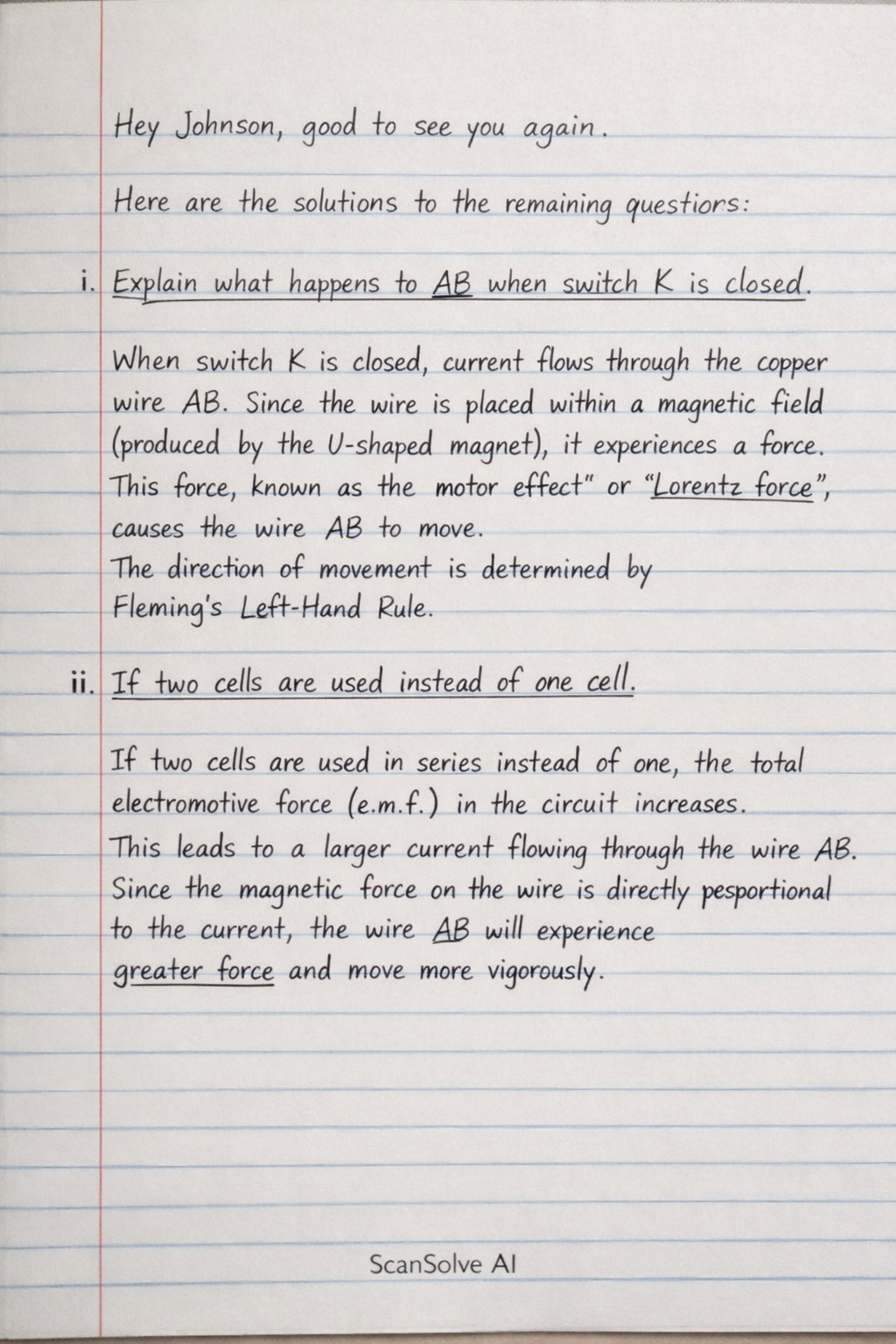
i. Explain what happens to AB when switch K is closed.
When switch K is closed, current flows through the copper wire AB. Since the wire is placed within a magnetic field (produced by the U-shaped magnet), it experiences a force. This force, known as the motor effect or Lorentz force, causes the wire AB to move. The direction of movement is determined by Fleming's Left-Hand Rule.
ii. If two cells are used instead of one cell.
If two cells are used in series instead of one, the total electromotive force (e.m.f.) in the circuit increases. This leads to a larger current flowing through the wire AB. Since the magnetic force on the wire is directly proportional to the current, the wire AB will experience a greater force and move more vigorously.
4.d) Name two instruments which use the effect in (c).
Two instruments that use the motor effect (force on a current-carrying conductor in a magnetic field) are:
- Electric motors
- Loudspeakers
4.e) State two ways of demagnetizing a magnet.
Two ways to demagnetize a magnet are:
- Heating the magnet above its Curie temperature.
- Hammering or subjecting the magnet to repeated mechanical shocks.
5.a) i. Define electrical resistance.
Electrical resistance is the opposition to the flow of electric current in a circuit. It is defined as the ratio of the potential difference across a conductor to the current flowing through it.
ii. State three physical properties that affect resistance of a metal wire.
Three physical properties that affect the resistance of a metal wire are:
- Length of the wire (resistance is directly proportional to length).
- Cross-sectional area of the wire (resistance is inversely proportional to area).
- Type of material (resistivity of the material).
5.b) Draw a sketch graph of current against p.d for the following;
i. A metal wire.
For a metal wire at a constant temperature (an ohmic conductor), current is directly proportional to the potential difference.
ii. A semi-conductor diode.
A semiconductor diode exhibits a non-linear relationship between current and potential difference. It conducts very little current in reverse bias and only conducts significantly in forward bias after a certain threshold voltage.
5.c) A battery of e.m.f 3.0 V and negligible internal resistance is connected to resistors of 5 , 2 and 2 as shown in figure.
i. Calculate the Current supplied by the battery.
Calculate the equivalent resistance of the parallel combination of two 2 resistors.
Calculate the total equivalent resistance of the circuit.
The parallel combination is in series with the 5 resistor.
Calculate the current supplied by the battery using Ohm's Law.
The current supplied by the battery is .
ii. Power dissipated in the 5 resistor.
The current flowing through the 5 resistor is the total current supplied by the battery, which is 0.5 A.
The power dissipated in the 5 resistor is .
iii. Explain why a wire heats up when current is passed through it.
When electric current flows through a wire, the moving electrons collide with the atoms or ions in the wire's lattice structure. These collisions transfer kinetic energy from the electrons to the lattice atoms, causing them to vibrate more vigorously. This increased vibrational energy of the atoms is manifested as heat, leading to a rise in the wire's temperature. This phenomenon is known as the Joule heating effect.
Still stuck on this one?
Ask a follow-up, and the answer starts from this question.
More Physics Questions
Handwritten Step-by-Step Solution
Get this as a handwritten image on WhatsApp — like a tutor wrote it for you.
Try on WhatsApp