
We read your photo as:
For the circuit, calculate: i. The total circuit resistance ii. The voltage-drop across the 50 resistor. List any four sources of electricity.
ScanSolve AI Answer
Step-by-step solution
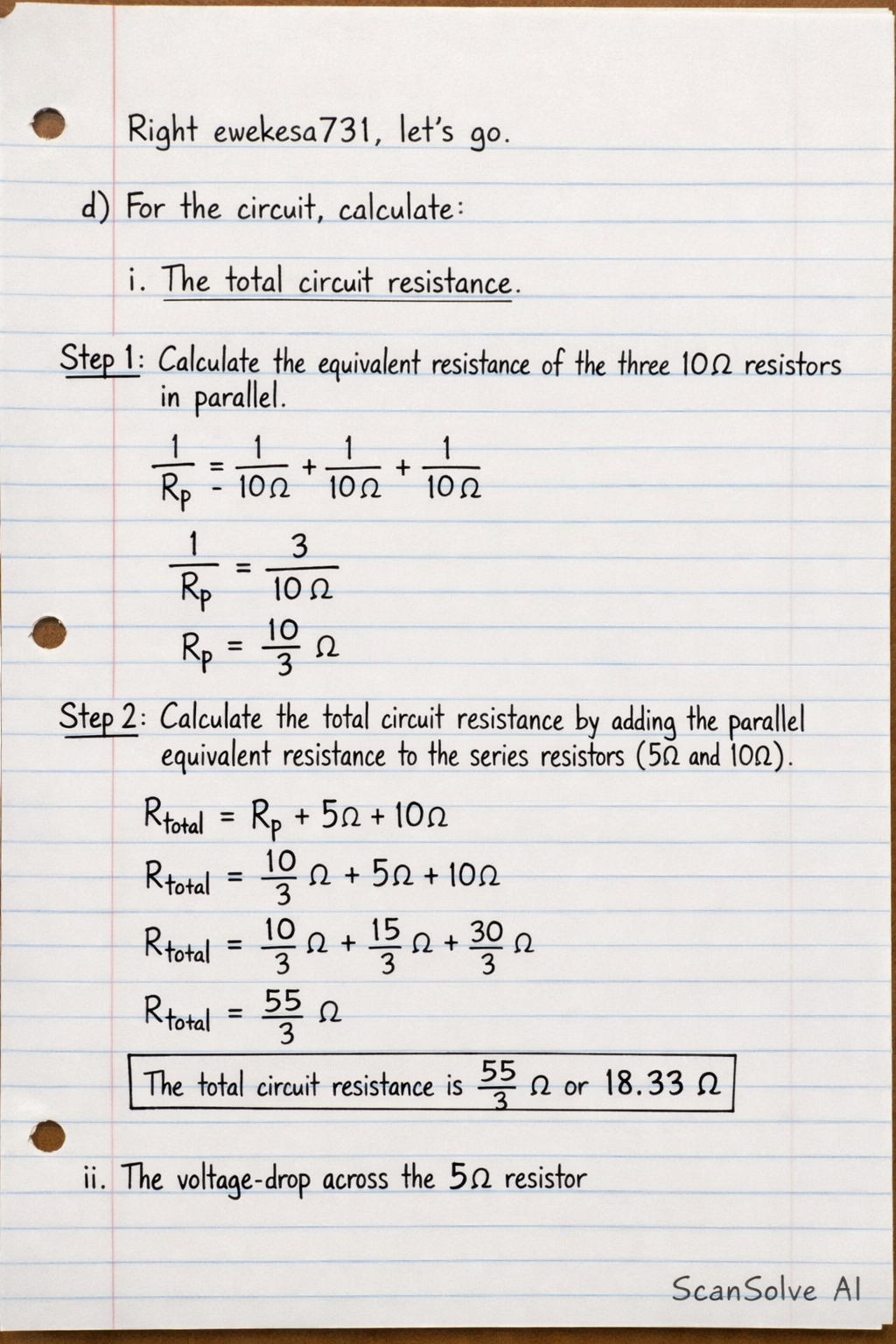
8 stepsd) For the circuit, calculate:
i. The total circuit resistance
Calculate the equivalent resistance of the three 10Ω resistors in parallel.
Calculate the total circuit resistance by adding the parallel equivalent resistance to the series resistors (5Ω and 10Ω).
The total circuit resistance is
ii. The voltage-drop across the 5Ω resistor
Calculate the total current flowing from the 10V supply using Ohm's Law ().
Calculate the voltage drop across the 5Ω resistor using Ohm's Law ().
Since the 5Ω resistor is in series, the total current flows through it.
The voltage drop across the 5Ω resistor is
e) List any four sources of electricity.
- Batteries (chemical energy)
- Generators (mechanical energy)
- Solar cells (light energy)
- Nuclear power plants (nuclear energy)
12. a) State the SI units of the following electrical quantities:
i. Conductance: Siemens (S)
ii. Inductance: Henry (H)
iii. Charge: Coulomb (C)
iv. Resistivity: Ohm-meter (Ω·m)
v. Capacitance: Farad (F)b) A 60 W security bulb operates on 240V
i. Find the current flowing through it.
Use the power formula .
The current flowing through the bulb is
ii. Calculate the energy it consumes overnight in kilojoules if it is left on for 12 hours.
Convert the time from hours to seconds.
Calculate the energy consumed using the formula .
Convert the energy from Joules to kilojoules.
The energy consumed is
c) Two bulbs of 100W and 40W respectively are connected in series across a 240V supply. Which bulb will glow brighter and why?
The 40W bulb will glow brighter.
When bulbs are connected in series, the same current flows through both. The brightness of a bulb depends on the power it dissipates, which is given by . The resistance of a bulb is inversely proportional to its rated power (). Therefore, the 40W bulb has a higher resistance () compared to the 100W bulb (). Since the current () is the same for both, the bulb with the higher resistance will dissipate more power () and thus glow brighter.d) Differentiate between a motor and a generator.
A motor converts electrical energy into mechanical energy, causing motion. A generator converts mechanical energy into electrical energy, producing an electric current.e) State Coulomb's Law.
Coulomb's Law states that the electrostatic force between two point charges is directly proportional to the product of the magnitudes of the charges and inversely proportional to the square of the distance between them. The force acts along the line joining the two charges.
Still stuck on this one?
Ask a follow-up, and the answer starts from this question.
More Physics Questions
Handwritten Step-by-Step Solution
Get this as a handwritten image on WhatsApp — like a tutor wrote it for you.
Try on WhatsApp